A faint background hum of extremely low frequency gravitational waves, subtly detected through an expansive network of cosmic lighthouses known as pulsars, may harbor profound clues to events that unfolded more than 13 billion years ago, including the mysterious genesis of some of the Universe’s earliest supermassive black holes. This groundbreaking research, published as a Letter in Physical Review D by Colgate University scientists Sohan Ghodla and Cosmin Ilie, explores the audacious possibility that supermassive black holes born in the nascent Universe could be the primary architects of the gravitational wave background currently being meticulously measured by Pulsar Timing Arrays (PTAs).
The study forges an unexpected link between two seemingly disparate frontiers of astronomical inquiry: the perplexing observation of colossal black holes already existing when the Universe was barely a toddler, and the gravitational waves produced eons later by the cataclysmic mergers of their colossal descendants. It posits that a specific class of primordial black hole seeds, theorized remnants from the collapse of colossal "Dark Stars," could provide a dominant contribution to the elusive nanohertz gravitational wave signal detected by PTAs.
"Pulsar timing arrays are usually thought of as probes of supermassive black-hole binaries in the relatively recent Universe," stated Dr. Ilie, co-author of the study. "What our work shows is that the signal may also contain information about how the ancestors of those black holes formed at cosmic dawn. In that sense, gravitational waves observed today could provide a new window onto the birth of the first supermassive black holes." This revelation opens an entirely new avenue for understanding the very origins of cosmic structures, potentially allowing scientists to peer back in time using gravitational ripples rather than electromagnetic light.
The Cosmic Symphony: Gravitational Waves and Pulsar Timing Arrays
To fully appreciate the significance of this research, it is crucial to understand the intricate mechanisms involved in detecting these gravitational waves. Gravitational waves, first predicted by Albert Einstein’s theory of general relativity over a century ago, are ripples in the fabric of spacetime itself, propagating at the speed of light. While high-frequency gravitational waves, originating from the violent mergers of stellar-mass black holes and neutron stars, have been directly detected by ground-based observatories like LIGO, Virgo, and Kagra, the waves explored in this study operate on an entirely different scale – extremely low frequencies, in the nanohertz range. These immense wavelengths mean that detecting them requires a detector of truly astronomical proportions, one that spans the galaxy.
This is where Pulsar Timing Arrays (PTAs) come into play. PTAs harness the incredible precision of pulsars, rapidly spinning neutron stars that emit beams of radio waves like cosmic lighthouses. As these beams sweep across Earth, they create incredibly regular "ticks" that serve as exceptionally precise celestial clocks. By meticulously monitoring dozens of these pulsars scattered across the Milky Way over many years, astronomers can detect minuscule deviations in the arrival times of their pulses. These tiny timing shifts, often on the order of tens to hundreds of nanoseconds over decades, are precisely what a passing gravitational wave would induce.
Imagine the Earth, our solar system, and the pulsars themselves as points on a vast cosmic drumhead. A passing gravitational wave stretches and compresses this drumhead, subtly altering the distances between us and the pulsars, thereby slightly delaying or accelerating the arrival of their radio pulses. By correlating these timing deviations across a large array of pulsars, international collaborations such as the North American Nanohertz Observatory for Gravitational Waves (NANOGrav), the European Pulsar Timing Array (EPTA), the Parkes Pulsar Timing Array (PPTA) in Australia, and the Indian Pulsar Timing Array (InPTA) have pooled their data to form the International Pulsar Timing Array (IPTA). In June 2023, these collaborations independently announced compelling evidence for a stochastic (random, background) gravitational wave background at nanohertz frequencies, a long-sought goal in astrophysics.
The most widely accepted astrophysical explanation for this observed background is a cosmic population of supermassive black hole binaries, pairs of gargantuan black holes gradually spiraling inward towards an inevitable, cataclysmic merger. These binaries are typically found at the centers of merging galaxies, and as they draw closer, they emit gravitational waves. Systems whose black holes boast a combined mass greater than approximately a billion times that of our Sun are particularly significant contributors at the nanohertz frequencies detectable by PTAs.
Unraveling the Mystery of Cosmic Dawn
While the existence of supermassive black hole binaries provides a compelling explanation for the observed gravitational wave background, it simultaneously raises a more fundamental and perplexing question: how did these behemoths come to be? Astronomers still grapple with the mystery of their original "seeds." The "cosmic dawn" refers to the epoch roughly 100 million to 1 billion years after the Big Bang, when the first stars and galaxies ignited, ending the Universe’s long "dark ages." It is during this period that the seeds of today’s supermassive black holes must have formed.
Observations from cutting-edge facilities like the James Webb Space Telescope (JWST) and the Chandra X-ray Observatory have repeatedly uncovered surprisingly massive black holes at unexpectedly early stages of cosmic history. These discoveries, revealing black holes with masses already in the millions or even billions of solar masses just a few hundred million years after the Big Bang (at redshifts greater than 6, and even beyond redshift 10 in some cases), have intensified the scientific community’s interest in formation mechanisms capable of producing such large black hole seeds very rapidly. Traditional models, which suggest black holes grow slowly from the remnants of the first massive stars, struggle to account for their sheer size and prevalence so early on.
This is precisely the cosmic enigma that Ghodla and Ilie sought to address. They investigated whether the descendants of such ancient, massive black hole seeds, once formed, could persist through cosmic time, growing in tandem with their host galaxies, eventually pairing up during galactic mergers, and ultimately generating the gravitational wave background detected billions of years later by PTAs. Their research connects the observable present with the unobservable past, using gravitational waves as a unique chronological probe.
Hypothetical Origins: Dark Stars and Direct Collapse Black Holes
The Colgate University team explored two prominent theoretical pathways for producing massive black hole seeds in the early Universe, mechanisms that could bypass the slower growth rates of conventional models:
-
Direct Collapse Black Holes (DCBHs): This scenario proposes that under very specific conditions in the early Universe – namely, the rapid accretion of vast amounts of pristine, metal-free gas in a dense region, prevented from cooling and fragmenting into stars – a colossal gas cloud could collapse directly into a black hole without first forming a star. Such an event could theoretically produce a black hole of tens of thousands to hundreds of thousands of solar masses in a relatively short period. These DCBHs are considered a prime candidate for the seeds of early supermassive black holes.
-
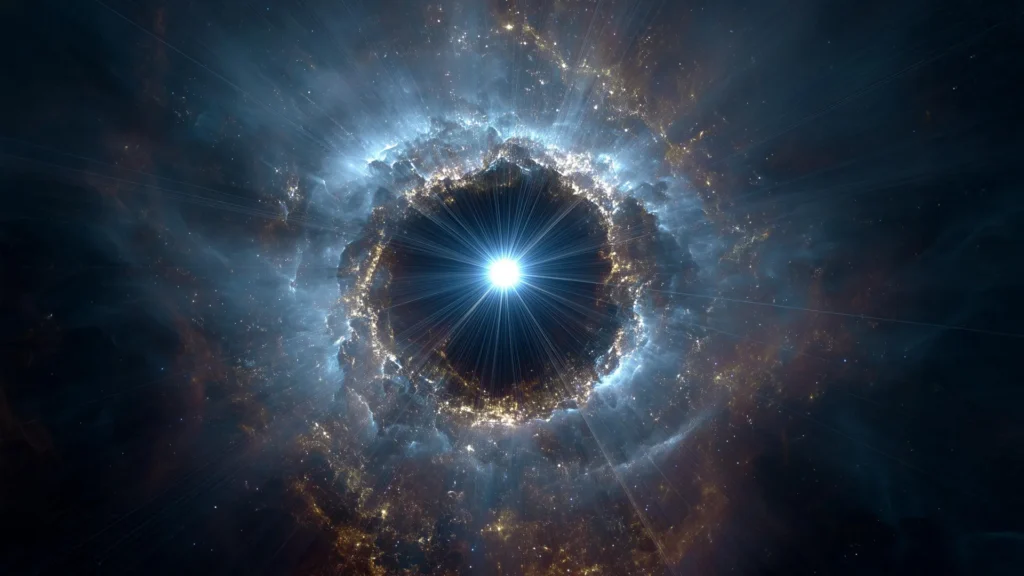
Black Holes formed through the collapse of Supermassive Dark Stars: This is a more exotic, yet compelling, hypothesis. Dark Stars are hypothetical primordial stars that would have been powered not by conventional nuclear fusion, but primarily by the annihilation of dark matter particles within their cores. In the widely discussed Weakly Interacting Massive Particle (WIMP) dark matter scenario, these stars would continuously accrete more ordinary matter, remaining relatively cool and extended due to the dark matter heating. Under the right conditions, they could grow to truly enormous sizes – potentially a million times the mass of the Sun or even more – before eventually exhausting their dark matter fuel or becoming unstable and collapsing directly into equally massive black holes. These "Dark Star seeds" would be significantly more massive than the seeds formed from the collapse of ordinary first stars.
Ghodla and Ilie meticulously modeled how black holes produced through these two distinct pathways would evolve over the vast expanse of cosmic history. Their simulations tracked the dark matter halos hosting these nascent black holes, estimated the frequency with which these objects would merge as their host galaxies collided, and then calculated the cumulative gravitational wave background that these mergers would produce across billions of years, right up to the present day.
Modeling the Cosmic Evolution and Key Findings
The researchers’ detailed calculations yielded a striking result: if remnants of supermassive Dark Stars existed at a number density of approximately 10^-3 per cubic megaparsec (Mpc^-3), their colossal descendants could potentially provide a large, and possibly even dominant, share of the gravitational wave signal currently being measured by PTAs. A cubic megaparsec is an immense volume of space, roughly 3.26 million light-years on each side, meaning that even a relatively sparse distribution of these Dark Star remnants could leave a significant cosmic imprint.
In stark contrast, the direct collapse black hole (DCBH) population considered in their study appeared to have been much less common. With characteristic densities closer to 10^-6 Mpc^-3 – a thousand times less frequent than the Dark Star remnants – these objects would contribute substantially less to the overall observed gravitational wave background. This finding suggests that if Dark Stars indeed played a role in seeding early supermassive black holes, their contribution to the modern gravitational wave sky might be far more significant than previously imagined.
A New Window to the Early Universe
One of the study’s most profound conclusions is that current PTA measurements possess an unprecedented ability to place critical limits on how common the earliest seeds of supermassive black holes could have been. The gravitational wave background acts as a cosmic thermometer, indicating the overall "heat" generated by merging black holes over cosmic history.
"Produce too many of these massive seeds and you end up over-producing the PTA-detected signal. Produce too few, and you need other sources to efficiently assemble these supermassive black holes later in the life of the universe to match PTA observations," explained Sohan Ghodla, the lead author of the study. This delicate balance means that the observed gravitational wave background provides a powerful constraint.
Within the models examined by Ghodla and Ilie, if the seed densities were to reach the range of 10^-2 to 10^-1 Mpc^-3, they would begin generating more gravitational wave background than current PTA observations allow. This effectively sets an upper limit on the abundance of these early, massive black hole seeds. The precise nature of this limit, the researchers note, depends strongly on the masses of the dark matter halos where those seeds originally formed, highlighting the intricate interplay between dark matter and black hole evolution.
This gives PTA observations an unexpected and potent capability: the power to probe extremely ancient populations of objects. Even though the mergers of their colossal descendants that create the detectable gravitational waves happen much later in cosmic history, sometimes billions of years after their formation, the cumulative signal provides a direct window into the conditions and processes at redshifts greater than 10 – an era when the Universe was less than 500 million years old. This represents a paradigm shift, as traditionally, our understanding of such distant epochs relies almost exclusively on electromagnetic observations, which are often obscured by the early Universe’s opaque conditions.
The calculations also lend strong support to earlier findings in gravitational wave astrophysics, confirming that binary systems with total black hole masses roughly above 10^9 solar masses overwhelmingly dominate the predicted PTA signal. Binary systems containing less massive black holes, while numerous, contribute far less to the nanohertz background, underscoring the importance of these cosmic titans.
Connecting the Cosmic Tapestry: Dark Matter, Dark Stars, and Black Holes
The findings from Ghodla and Ilie’s research weave together several of the most fundamental and enduring mysteries in modern cosmology, creating new observational links between them. These include the enigmatic nature of dark matter, the formation of the Universe’s very first luminous objects, the origins and rapid growth of supermassive black holes, and the gravitational waves that continuously ripple through the cosmos.
"Dark Stars were originally proposed as objects that might be seen directly at cosmic dawn," Dr. Ilie remarked, referencing previous theoretical work suggesting JWST might directly observe these hypothetical objects. "This work points to a completely different way of testing their possible role in cosmic history. Their descendants could leave a gravitational-wave imprint that persists all the way to the present-day Universe." This suggests that even if Dark Stars are too faint or short-lived to be directly observed, their legacy could be etched into the very fabric of spacetime, detectable by future generations of gravitational wave observatories.
The implications for dark matter research are particularly profound. If Dark Stars prove to be significant contributors to the gravitational wave background, it would provide compelling, albeit indirect, evidence for the existence and specific properties of certain dark matter candidates, such as WIMPs, which are central to the Dark Star hypothesis. This transforms PTAs from mere detectors of black hole mergers into potential probes of fundamental particle physics.
The Future of Gravitational Wave Astronomy
As Pulsar Timing Array measurements become increasingly precise with longer observation times and more sensitive radio telescopes, and as astronomers continue to improve their understanding of distant black holes and the galaxies that hosted them, researchers anticipate being able to distinguish more clearly among competing explanations for how the Universe’s first supermassive black holes formed. The next decade promises a significant boost in PTA sensitivity, with ongoing data collection by the IPTA and the potential for new, more powerful radio telescopes to join the global effort.
Moreover, the upcoming launch of the European Space Agency’s Laser Interferometer Space Antenna (LISA) mission, a dedicated space-based gravitational wave observatory designed to detect much higher (but still low) frequency gravitational waves than PTAs, will offer a complementary view of the supermassive black hole population. While LISA will primarily target merging black holes in the millions to hundreds of millions of solar masses range, its observations will provide crucial context and constraints for the models used to interpret PTA data. The synergy between ground-based electromagnetic telescopes, space-based gravitational wave observatories, and galaxy-spanning PTAs will create an unprecedented multi-messenger view of the Universe’s most enigmatic objects and events.
The ability to use gravitational waves as a new form of cosmic archaeology offers an exciting frontier. It allows scientists to not only map the distribution and evolution of supermassive black holes throughout cosmic time but also to potentially uncover the exotic physics that governed the very first moments of the Universe, bridging the gap between theoretical cosmology and observational astronomy in ways previously unimaginable. The subtle hum detected today may be the clearest echo yet of the Universe’s ancient, violent birth.