A groundbreaking new study published by a team of researchers, including the authors of the original findings, suggests that the universe may not be uniformly symmetric in every direction, posing a fundamental challenge to the prevailing "standard cosmological model." While the shape of the cosmos is not a subject frequently contemplated by the general public, this research indicates that the universe could be asymmetric or lopsided, diverging from the long-held assumption of isotropy – the principle that it appears the same in all directions when averaged on large scales. This revelation stems from a rigorous examination of what is known as the cosmic dipole anomaly, a significant discrepancy that could necessitate a radical re-evaluation of our most accepted descriptions of the universe, including the widely used Lambda-CDM model.
Foundations of the Standard Cosmological Model
To understand the profound implications of this new research, it is crucial to first grasp the bedrock upon which modern cosmology is built. The "standard cosmological model," often referred to as the Lambda-CDM model (Lambda for dark energy and Cold Dark Matter), provides the most comprehensive framework for describing the dynamics, structure, and evolution of the entire cosmos. Its success lies in its ability to explain a vast array of observational phenomena, from the expansion of the universe to the formation of large-scale structures like galaxies and galaxy clusters, and the precise measurements of the cosmic microwave background radiation.
Central to the Lambda-CDM model are two fundamental assumptions about the universe’s large-scale properties: homogeneity and isotropy. Homogeneity implies that the universe is roughly the same everywhere, meaning matter and energy are distributed uniformly on cosmic scales. Isotropy, on the other hand, suggests that the universe looks the same in all directions from any given point. These two principles, collectively known as the "cosmological principle," vastly simplify Einstein’s complex equations of general relativity, allowing cosmologists to model the universe using the Friedmann–Lemaître–Robertson–Walker (FLRW) metric. Developed independently by Alexander Friedmann, Georges Lemaître, Howard P. Robertson, and Arthur G. Walker in the 1920s and 1930s, the FLRW metric provides a maximally symmetric description of spacetime, which has been the cornerstone of cosmological theory for decades.
The historical timeline of cosmological understanding underscores the significance of these assumptions. Following Albert Einstein’s formulation of general relativity in 1915, which revolutionized our understanding of gravity and spacetime, observations began to reshape our cosmic view. In 1929, Edwin Hubble’s seminal discovery of the expanding universe provided the first strong evidence that the cosmos was not static, leading to the development of the Big Bang theory. The subsequent detection of the cosmic microwave background (CMB) radiation in 1964 by Arno Penzias and Robert Wilson provided overwhelming evidence for the Big Bang. The CMB, a faint glow of electromagnetic radiation filling the universe, is the relic heat leftover from the universe’s infancy, approximately 380,000 years after the Big Bang. Its remarkable uniformity across the sky, to within one part in a hundred thousand, strongly supported the isotropic and homogeneous assumptions, cementing the FLRW description and the Lambda-CDM model as the accepted paradigm.
Cracks in the Cosmic Fabric: Emerging Tensions
Despite its successes, the standard cosmological model has faced increasing scrutiny in recent years due to several persistent "tensions" or disagreements in cosmological data. These tensions represent inconsistencies between measurements derived from different cosmic probes or at different epochs of the universe’s evolution. They suggest that either our understanding of the universe is incomplete, or there might be fundamental flaws in the Lambda-CDM model itself.
One of the most widely debated of these issues is the "Hubble tension." Named after Edwin Hubble, who first quantified the expansion of the universe, this tension refers to a significant disagreement in the measured value of the Hubble Constant (H₀), which describes the universe’s current expansion rate. Measurements of H₀ derived from observations of the early universe, primarily from the cosmic microwave background by missions like Planck, yield a value around 67-68 kilometers per second per megaparsec (km/s/Mpc). In contrast, measurements from the nearby, more recent universe, using "cosmic distance ladders" based on supernovae and Cepheid variables observed by instruments like the Hubble Space Telescope and more recently, data from the Gaia satellite, consistently produce a higher value, around 73-74 km/s/Mpc. This approximately 9% difference, well beyond statistical uncertainties, has become a major puzzle, indicating either new physics beyond the standard model or systematic errors in our measurements.
While the Hubble tension has garnered significant attention, the new study highlights another, potentially even more fundamental, challenge: the cosmic dipole anomaly. This anomaly delves into the very assumption of cosmic isotropy, directly questioning whether the universe looks the same in all directions.
Unpacking the Cosmic Dipole Anomaly
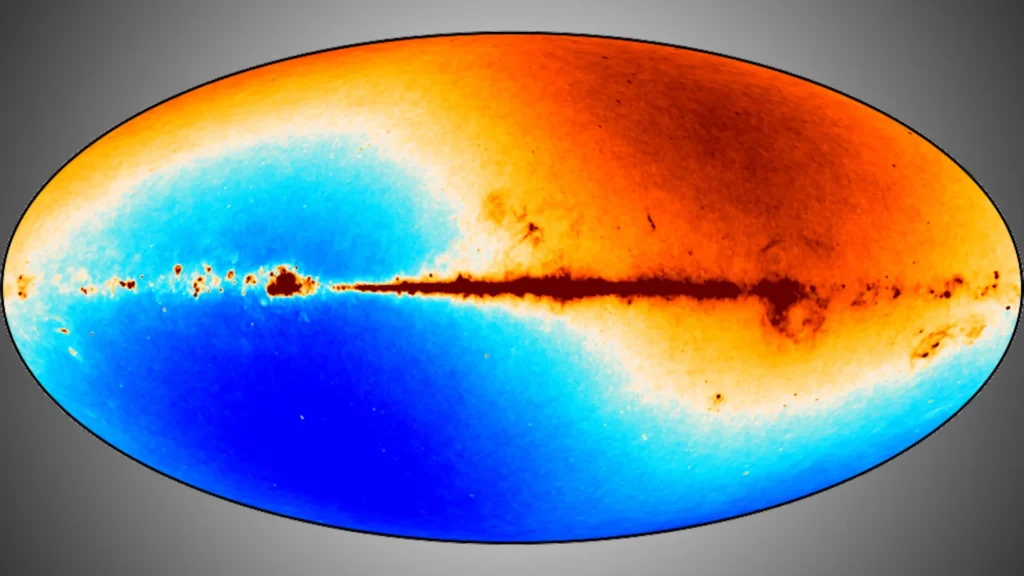
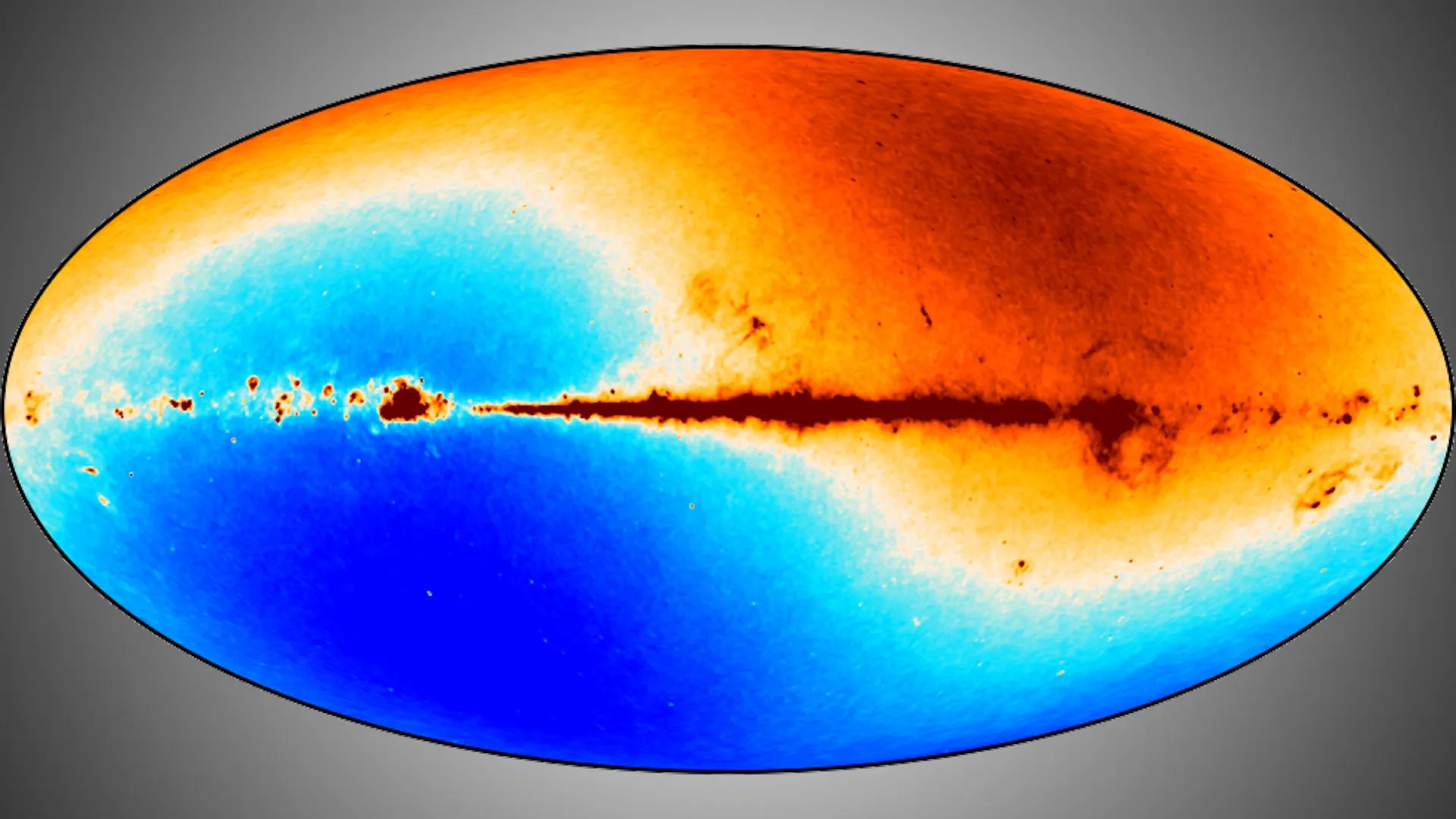
The story of the cosmic dipole anomaly begins with the cosmic microwave background. While the CMB is exceptionally uniform, precise measurements by satellites like COBE (Cosmic Background Explorer), WMAP (Wilkinson Microwave Anisotropy Probe), and Planck have revealed subtle variations. One of the most prominent of these variations is the CMB dipole anisotropy. This is the largest temperature difference observed in the CMB across the sky, where one hemisphere appears slightly hotter and the opposite hemisphere slightly cooler – by about one part in a thousand.
Cosmologists have a well-established explanation for this CMB dipole: it is attributed to our own "peculiar velocity" or local motion relative to the CMB rest frame. As our solar system, along with the Milky Way galaxy, moves through space, we observe the CMB radiation blue-shifted in the direction of our motion (making it appear hotter) and red-shifted in the opposite direction (making it appear cooler). This phenomenon is analogous to the Doppler effect for sound waves. Because this dipole is understood as a local kinematic effect, it does not, in itself, challenge the fundamental assumptions of the Lambda-CDM model or the FLRW description of a globally isotropic universe.
However, the crucial question then arises: if our local motion causes a dipole in the CMB, should we not observe a corresponding dipole in the distribution of distant matter sources across the sky? This is precisely what the "Ellis-Baldwin test" seeks to investigate. In 1984, astrophysicists George Ellis and John Baldwin posed this critical question, asking whether a similar "dipole anisotropy" exists in the sky distribution of distant astronomical sources, such as radio galaxies and quasars. The stipulation that these sources must be very distant is vital, as nearby sources could introduce a spurious "clustering dipole" that merely reflects local variations in matter density, rather than a fundamental cosmic anisotropy.
According to the symmetrical FLRW assumption underpinning the standard model, the observed variation in distant astronomical sources should be directly determined and consistent with the observed variation in the CMB dipole caused by our motion. In essence, if we are moving through an otherwise isotropic universe, then all distant phenomena should appear to have the same dipole signature reflecting that motion.
The Study’s Findings: The Universe Fails the Ellis-Baldwin Test
For decades, performing the Ellis-Baldwin test with sufficient precision was technologically challenging, requiring extensive and deep sky surveys of distant objects. However, with the advent of modern telescopes and advanced data processing capabilities, the necessary data catalogues have recently become available, allowing researchers to finally execute this critical test.
The new study, a culmination of these efforts, has delivered a startling result: the universe, as observed through the distribution of distant matter, fails the Ellis-Baldwin test. The variation in matter distribution across the sky does not match that observed in the cosmic microwave background. This discord is a direct and robust challenge to the standard Lambda-CDM model and, more fundamentally, to the FLRW description itself.
The researchers emphasize the strength of their findings by noting that the outcome remains consistent across different observational methods and wavelengths. Whether using terrestrial radio telescopes observing at radio frequencies or satellites observing at mid-infrared wavelengths, the same significant discrepancy emerges. This cross-validation is crucial, as it mitigates concerns about potential systematic errors unique to specific instruments or observational techniques. The consistency across diverse datasets lends substantial credibility to the conclusion that the cosmic dipole anomaly is a genuine feature of our universe, not merely an observational artifact.
Profound Implications for Fundamental Physics
The establishment of the cosmic dipole anomaly as a robust observational fact carries truly profound implications for fundamental physics. Unlike the Hubble tension, which might potentially be resolved by new physics within an otherwise isotropic and homogeneous universe (such as modified dark energy models or new particle physics), the cosmic dipole anomaly directly assails the very foundation of the cosmological principle. If the universe is indeed asymmetric or lopsided on large scales, then the FLRW metric, which assumes maximal symmetry, would no longer be an accurate description of the cosmos.
This situation demands more than just a minor adjustment to the Lambda-CDM model; it suggests a need to "go back to square one" and reconsider the fundamental assumptions upon which our understanding of the universe is built. Abandoning the FLRW description implies that Einstein’s equations would become vastly more complex to solve, requiring new theoretical frameworks to describe a universe that is neither perfectly homogeneous nor perfectly isotropic. Such a paradigm shift would necessitate a complete overhaul of our current cosmological models, potentially leading to entirely new theories of gravity or the nature of spacetime.
The reluctance of the astronomical community to fully embrace and address the cosmic dipole anomaly, as noted by the study authors, is understandable in light of its radical implications. A problem of this magnitude, without an obvious or easy solution within existing frameworks, can be daunting. It challenges decades of scientific consensus and established theoretical paths. However, the scientific method thrives on such challenges, and persistent anomalies are often the harbingers of revolutionary new insights.
Future Outlook and the Role of New Technologies
The coming years promise an unprecedented "avalanche of data" from a new generation of sophisticated astronomical instruments. Satellites like the European Space Agency’s Euclid mission, launched in 2023, and NASA’s SPHEREx (Spectro-Photometer for the History of the Universe, Epoch of Reionization and Ices Explorer), slated for launch in 2025, are designed to map the large-scale structure of the universe with exquisite detail, providing crucial data on galaxy distribution and evolution. Ground-based facilities such as the Vera C. Rubin Observatory, with its Legacy Survey of Space and Time (LSST), and the Square Kilometre Array (SKA) radio telescope, currently under construction, will likewise deliver vast quantities of observational data, covering billions of galaxies and probing the universe at different wavelengths and depths.
This wealth of new data will be instrumental in further scrutinizing the cosmic dipole anomaly, either confirming its existence with even greater precision or potentially revealing hitherto unknown systematic effects that could resolve the tension. More importantly, this data will provide the empirical foundation necessary to construct and test new cosmological models.
In this endeavor, emerging technologies, particularly in the field of artificial intelligence (AI) and machine learning, are expected to play a crucial role. The complexity of modeling a non-FLRW universe and analyzing colossal datasets will likely exceed human analytical capabilities alone. Machine learning algorithms, capable of identifying subtle patterns and correlations in vast amounts of data, could accelerate the development of new theoretical frameworks, helping researchers explore alternative cosmological models that incorporate cosmic anisotropy. These AI-driven approaches could prove invaluable in navigating the theoretical landscape beyond the standard model, potentially revealing bold new insights into the fundamental structure and evolution of the universe.
The challenge presented by the cosmic dipole anomaly is immense, but so too is the potential for discovery. If confirmed and understood, this anomaly could usher in a new era of cosmology, transforming our perception of the cosmos from a perfectly symmetric expanse to a universe with an inherent lopsidedness. The impact on fundamental physics would be truly monumental, redefining our understanding of spacetime, gravity, and our place within a potentially more complex and intriguing universe.