For decades, the standard model of cosmology has been haunted by a persistent discrepancy known as the "Missing Baryon Problem." While the universe is composed of roughly 68 percent dark energy and 27 percent dark matter, the remaining five percent—the ordinary, "baryonic" matter that makes up everything from the smallest atoms to the largest stars—has proven remarkably elusive. According to calculations based on the Big Bang and the Cosmic Microwave Background, there should be significantly more ordinary matter than what astronomers can actually see through telescopes. Now, a groundbreaking study led by researchers at the Massachusetts Institute of Technology (MIT) and the CHIME/FRB Collaboration has utilized the fleeting flashes of distant radio waves to locate this hidden reservoir of atoms, revealing that the "missing" matter exists in vast, diffuse clouds stretching far beyond the boundaries of known galaxies.
The Mystery of the Missing Baryons
To understand the scale of this cosmic puzzle, one must look back to the early universe. Shortly after the Big Bang, the distribution of matter was established: approximately 83 percent was invisible dark matter, and 17 percent was baryonic matter (protons and neutrons). As the universe expanded and cooled, this baryonic matter coalesced into the stars, planets, and galaxies we observe today. However, when astronomers tally up the mass of all observable stars, interstellar gas clouds, and galactic dust, the total accounts for only about ten percent of the expected baryonic matter.
The remaining 90 percent of ordinary matter is not "dark matter" in the traditional sense; it is simply "missing" from our view. For years, theorists hypothesized that this matter resides in the Intergalactic Medium (IGM)—the near-vacuum space between galaxies. Because this gas is incredibly thin—estimated at a density of roughly one proton per cubic meter—it does not emit enough light to be detected by conventional optical or X-ray telescopes. Detecting such a sparse medium requires a different kind of cosmic probe, one that can "feel" the matter it passes through over billions of light-years.
Fast Radio Bursts as Cosmic Probes
The solution arrived in the form of Fast Radio Bursts (FRBs). First discovered in 2007, FRBs are intense, millisecond-long pulses of radio waves originating from high-energy events in distant galaxies. While their exact origins remain a subject of intense debate—with theories ranging from magnetars to colliding compact objects—their utility as astronomical tools is becoming increasingly clear.
As an FRB signal travels through the universe, it interacts with the free electrons in the ionized gas it encounters. This interaction causes a phenomenon known as "dispersion." High-frequency radio waves travel slightly faster through ionized plasma than low-frequency waves. Consequently, by the time the signal reaches Earth, it has been "smeared" or stretched out in time, with the higher-energy "blue" frequencies arriving milliseconds before the lower-energy "red" frequencies.
The degree of this smearing, known as the Dispersion Measure (DM), is directly proportional to the total amount of matter the signal has traversed. By measuring this smear, scientists can calculate the "column density" of electrons—and by extension, the total baryonic mass—along the line of sight between the source and the detector.
A New Methodology: Cross-Correlating CHIME and DESI Data
The MIT-led team, including lead author Haochen Wang and associate professor Kiyoshi Masui, developed a sophisticated new method to move beyond simply detecting the matter to actually mapping its distribution. They achieved this by cross-referencing data from two of the most powerful astronomical surveys currently in operation: the Canadian Hydrogen Intensity Mapping Experiment (CHIME) and the Dark Energy Spectroscopic Instrument (DESI).
CHIME, located at the Dominion Radio Astrophysical Observatory in British Columbia, Canada, is a unique radio telescope with no moving parts. Its four 100-meter-long cylindrical reflectors scan the entire northern sky every day, making it an FRB-hunting powerhouse. For this study, the researchers analyzed a catalog of 2,870 FRB signals detected by CHIME.
To determine where the matter responsible for the smearing was located, the team turned to DESI. Mounted on the Mayall Telescope in Arizona, DESI is designed to measure the effect of dark energy on the expansion of the universe by mapping the positions of tens of millions of galaxies. By overlaying the paths of the 2,870 FRBs onto a map containing over six million galaxies identified by DESI, the researchers could statistically determine how much "smearing" occurred when a signal passed near a galaxy or a group of galaxies.
The Discovery of Galactic Fountains
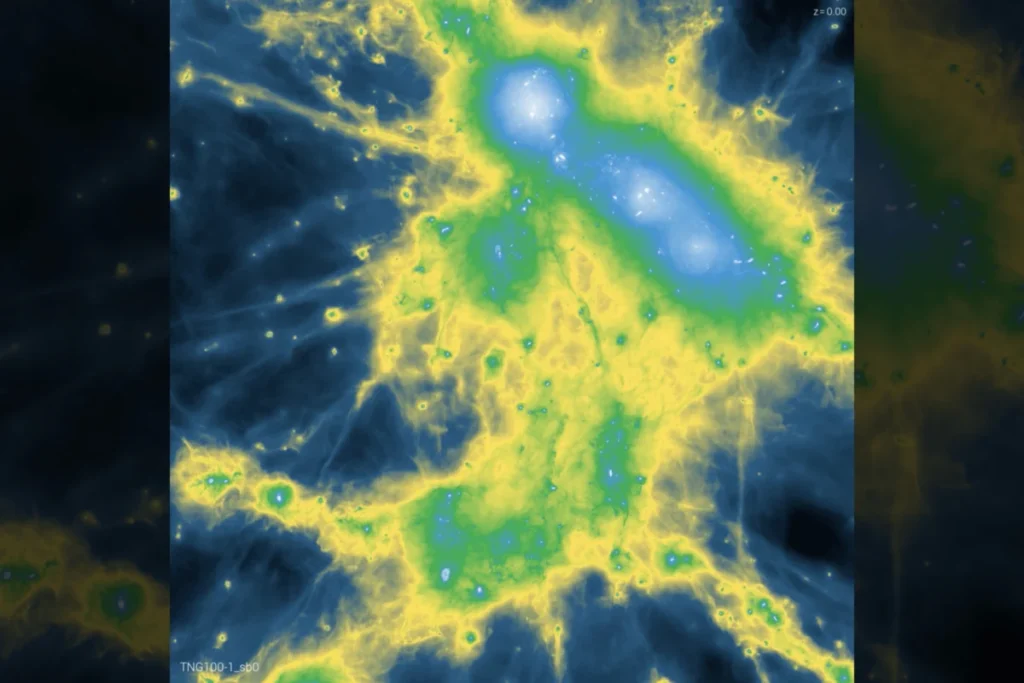
The analysis yielded a striking result: the missing baryonic matter is not randomly distributed throughout the void of space. Instead, it is concentrated around galaxies and galaxy clusters, but in a much more dispersed state than previously imagined.
While a typical galaxy might span 100,000 light-years in diameter, the researchers found that the surrounding clouds of missing matter extend as far as four million light-years into intergalactic space. This distance is significantly larger than what most standard cosmological simulations had predicted.
"We find that, overall, where there are more galaxies, there tends to be more missing matter around them," explained Haochen Wang, a graduate student at MIT’s Kavli Institute for Astrophysics and Space Research. "But it is not just sitting there. It is being pushed out."
This discovery supports the "galactic fountain" model of galaxy evolution. According to this theory, highly energetic processes within a galaxy—such as supernova explosions and the powerful relativistic jets emitted by supermassive black holes (Active Galactic Nuclei)—act as cosmic engines. These processes are so violent that they blow vast quantities of gas out of the galactic disk and into the surrounding halo and beyond.
The fact that the matter was found four million light-years away suggests that these "feedback" mechanisms are far more powerful than scientists had previously calculated. The activity of black holes and star formation is essentially "over-pressurizing" galaxies, flinging the building blocks of future stars into the deep cosmic suburbs.
Chronology of the Search for Missing Matter
The quest to resolve the Missing Baryon Problem has spanned several decades and multiple technological eras:
- 1990s: Theoretical models based on Big Bang Nucleosynthesis first suggested that the amount of baryonic matter in the early universe was much higher than the observable matter in the local universe.
- 2007: The first Fast Radio Burst (the "Lorimer Burst") was discovered in archival data, providing a potential new tool for measuring the density of the IGM.
- 2018: The CHIME telescope began full operations, dramatically increasing the rate of FRB detections from a handful per year to hundreds and eventually thousands.
- 2020: A study published in Nature used a small sample of five FRBs to provide the first direct evidence that the missing matter resided in the space between galaxies, confirming the "Dispersion-Fluctuation" theory.
- 2024: The MIT/CHIME/FRB collaboration published their findings in Physical Review Letters, using a massive statistical sample to map the specific "shape" and extent of this matter, revealing the four-million-light-year spread.
Implications for Galaxy Evolution and Cosmology
The implications of this study extend beyond simply balancing the cosmic checkbook. Understanding the distribution of baryonic matter is crucial for refining our models of how galaxies grow and change over billions of years. If gas is being ejected at such high velocities to such great distances, it limits the amount of material available for a galaxy to form new stars, effectively acting as a "braking" mechanism for galactic growth.
Furthermore, these findings provide a new benchmark for dark matter research. By precisely accounting for the location and behavior of ordinary matter, scientists can better isolate the gravitational effects of dark matter. This helps in mapping the "cosmic web"—the large-scale structure of the universe where galaxies are threaded along invisible filaments of dark matter.
"We are finding that the activity in galaxies is messier than we thought," Wang noted. This "messiness" is a vital clue in understanding the lifecycle of the universe. It suggests a dynamic, high-energy relationship between the microscopic world of subatomic particles and the macroscopic world of galactic structures.
Future Research and the Road Ahead
The success of this new method marks the beginning of a new era in "precision cosmology" using radio transients. As CHIME continues to operate and as new facilities like the Square Kilometre Array (SKA) in Australia and South Africa come online, the number of detected FRBs will swell into the tens of thousands.
"We got it to work for the first time, and will get it to work even more precisely as data gets better," said Kiyoshi Masui. Future studies will likely aim to differentiate between the matter ejected by black holes versus that ejected by supernovae, as each process leaves a unique "imprint" on the surrounding gas.
By turning the mysterious flashes of FRBs into a form of cosmic radar, astronomers are finally illuminating the dark corners of the universe. The "missing" matter was never truly gone; it was simply waiting for a bright enough light to reveal its presence in the vast, cold reaches between the stars. The discovery that galaxies are "fountains" pushing matter millions of light-years away reshapes our understanding of the universe as a violent, interconnected, and deeply dynamic system.