For over a century, the universe’s most energetic particles, cosmic rays, have presented one of astronomy’s most enduring enigmas. These incredibly powerful particles traverse the vast expanses of the cosmos at extreme energies, far surpassing anything achievable in terrestrial accelerators. Despite relentless research spanning decades, fundamental questions regarding their genesis and the mechanisms by which they attain such colossal energies have largely remained unanswered. A significant breakthrough has now emerged from researchers utilizing the Dark Matter Particle Explorer (DAMPE) space telescope. Their groundbreaking findings, meticulously detailed in a recent publication in the prestigious journal Nature, unveil a previously unrecognized common feature shared across various types of these enigmatic particles. This discovery is poised to provide scientists with a crucial new lens through which to understand the ultimate origins of cosmic rays, marking an important stride in unraveling one of the universe’s most profound mysteries.
The Century-Long Enigma: Tracing Cosmic Rays Back to Hess
The journey to understand cosmic rays began in the early 20th century. In 1912, Austrian physicist Victor Hess conducted a series of daring balloon flights, ascending to altitudes of over 5 kilometers, carrying electroscopes to measure atmospheric ionization. His meticulous observations revealed that ionization levels increased with altitude, contrary to expectations that background radiation would diminish further from Earth’s surface. Hess correctly inferred the existence of an unknown source of penetrating radiation originating from space, which he termed "Höhenstrahlung" (radiation from high altitudes). This phenomenon was later christened "cosmic rays" by Robert Millikan in 1925. Hess’s pioneering work earned him the Nobel Prize in Physics in 1936, laying the foundation for a century of intense study into these celestial messengers.
Initially, scientists believed cosmic rays were electromagnetic radiation, like gamma rays. However, subsequent experiments, particularly those involving cloud chambers, revealed them to be primarily charged particles, predominantly atomic nuclei, traveling at relativistic speeds. The sheer energy carried by these particles is staggering. While the Large Hadron Collider (LHC) at CERN, the most powerful particle accelerator on Earth, can achieve energies in the teraelectron-volt (TeV) range (1 TeV = 10^12 electron-volts), cosmic rays routinely reach energies of petaelectron-volts (PeV, 10^15 eV) and even exa-electron-volts (EeV, 10^18 eV). A single ultra-high-energy cosmic ray can carry the kinetic energy equivalent to a baseball thrown at 100 km/h, concentrated in a single subatomic particle. This immense energy immediately posed a formidable challenge: what astrophysical processes could possibly accelerate particles to such extreme velocities?
The prevailing theories suggest that cosmic rays are born in some of the most violent and energetic events in the universe. These include supernova remnants, the expanding shells of gas and dust left after a massive star explodes; the powerful jets emanating from active galactic nuclei (AGN) powered by supermassive black holes; and rapidly rotating neutron stars known as pulsars, which possess incredibly strong magnetic fields. Understanding precisely which of these sources, or combination thereof, are responsible for the various energy ranges of cosmic rays, and how the acceleration mechanism works, has been a central pursuit for astrophysicists.
DAMPE’s Mission: A New Window on the High-Energy Universe
The Dark Matter Particle Explorer (DAMPE), also known by its Chinese name "Wukong" (after the mythical Monkey King), was launched on December 17, 2015, from the Jiuquan Satellite Launch Center in China. Operating in a sun-synchronous orbit at an altitude of approximately 500 kilometers, DAMPE was conceived as a multi-purpose space-based observatory. Its primary scientific objectives are twofold: to search for signatures of dark matter annihilation or decay in the cosmic ray electron and positron spectra, and to precisely measure the energy spectra of high-energy cosmic rays, including protons, helium, and heavier nuclei, as well as electrons and gamma rays. The mission represents a significant international collaboration, with major contributions from institutions like the astrophysics group at the Department of Nuclear and Particle Physics (DPNC) at the University of Geneva (UNIGE).
DAMPE’s sophisticated instrument payload is designed for unparalleled precision in measuring the energy and direction of incoming cosmic particles. It consists of four main sub-detectors:
- Plastic Scintillator Detector (PSD): Used for charge measurement and anti-coincidence.
- Silicon-Tungsten Tracker (STK): Crucial for tracking particle trajectories and determining their charge, a key component developed with significant input from the Geneva team.
- BGO Calorimeter: The core instrument, a highly segmented Bismuth Germanate Oxide calorimeter, measures the energy of electrons, positrons, and gamma rays with excellent resolution.
- Neutron Detector (ND): Helps to distinguish between electrons and protons by detecting neutrons produced in hadronic showers.
This combination allows DAMPE to accurately identify different types of cosmic ray particles (protons, helium, carbon, oxygen, iron, etc.) and precisely determine their energies, covering a broad spectrum from a few GeV up to several TeV, and even extending to tens of TeV for some hadronic particles. The mission’s operational lifespan has exceeded expectations, continuously collecting high-quality data that has now led to this pivotal discovery.
The Discovery: A Universal Pattern in Cosmic Ray Spectra
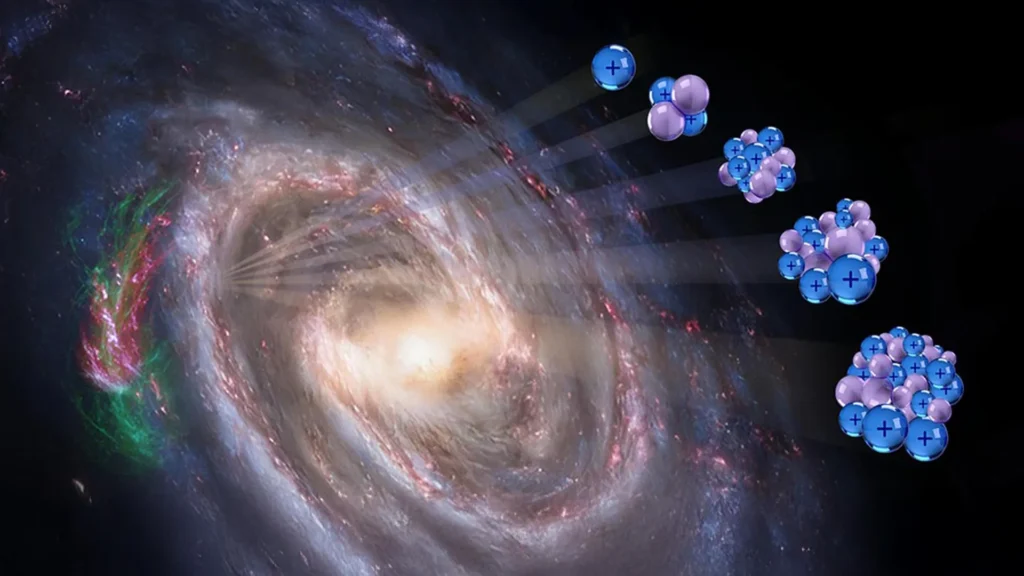
By meticulously analyzing the highly precise data accumulated by DAMPE, the international research team unearthed a remarkable and previously unrecognized universal pattern within the energy spectra of primary cosmic ray nuclei. This pattern manifests across a wide range of particles, from the lightest (protons) to much heavier nuclei such as helium, carbon, oxygen, and iron.
Andrii Tykhonov, an associate professor at the DPNC in the Faculty of Science at UNIGE and a co-author of the study, elaborated on the composition and energy categorization of these particles. "Cosmic rays are primarily composed of protons, but also of helium, carbon, oxygen, and iron nuclei," he explained. "These particles are also categorised according to their energy: low, up to a few billion electron-volts; intermediate, from a few billion to several hundred billion electron-volts; and high, from 1,000 billion electron-volts and beyond." The DAMPE observations focused on these higher energy regimes, where the most compelling clues to their origins are expected to reside.
The core finding is the observation of a "spectral softening" effect. For every type of nucleus studied, the number of observed particles begins to drop significantly faster after reaching a certain energy threshold. In the normal course of cosmic ray observation, it is expected that higher-energy particles are less common; their flux decreases as energy increases. However, the DAMPE data revealed a dramatic steepening of this decline beyond a specific threshold. This critical rigidity threshold was determined to be approximately 15 TV (teraelectron-volts).
Understanding Spectral Softening and Rigidity
To fully appreciate the significance of this discovery, it is crucial to understand the concept of "rigidity" in particle astrophysics. Rigidity is a fundamental property of a charged particle moving through a magnetic field. It is defined as the particle’s momentum divided by its charge (R = pc/Ze, where p is momentum, c is the speed of light, Z is the atomic number, and e is the elementary charge). In simpler terms, rigidity describes how strongly a particle’s path resists being bent by magnetic fields. A higher rigidity means the particle is less affected by magnetic fields. For a given kinetic energy, heavier nuclei with more charge (higher Z) will have a lower rigidity than a proton at the same energy, but at the same momentum, they will have the same rigidity.
The observation that this spectral softening occurs consistently at the same rigidity (approximately 15 TV) across various nuclei, rather than at the same total energy or the same energy per nucleon, is profoundly significant. This strong correlation with rigidity provides compelling evidence that the processes governing cosmic ray acceleration and their subsequent propagation through the galaxy are primarily dependent on this specific parameter.
The "Knee" and the Cosmic Ray Spectrum
The cosmic ray energy spectrum is famously characterized by several distinct features, often referred to as the "knee," "ankle," and "toe." The "knee" is a prominent feature observed around 3-5 PeV (3,000-5,000 TeV), where the flux of cosmic rays drops sharply, indicating a change in either their acceleration mechanism, their sources, or their escape from the galaxy. The DAMPE finding of a spectral softening at 15 TV (which corresponds to different total energies for different nuclei, e.g., 15 TeV for a proton, but 30 TeV for a helium nucleus, 60 TeV for carbon, and 390 TeV for iron) provides critical information that helps refine our understanding of the mechanisms leading up to the "knee."
Many theoretical models for cosmic ray acceleration, particularly the widely accepted diffusive shock acceleration (DSA) mechanism in supernova remnants, predict a maximum energy that particles can attain. This maximum energy often scales with the particle’s charge and the strength of the magnetic field in the acceleration region. The DAMPE results, linking the spectral softening to rigidity, strongly support models where the maximum acceleration energy per particle (and thus its rigidity) is the limiting factor, rather than the total energy of the nucleus or its energy per nucleon.
Challenging Competing Models: Energy Per Nucleon vs. Rigidity
Prior to this discovery, there were competing theoretical frameworks attempting to explain the spectral features of cosmic rays. One prominent alternative suggested that the acceleration and propagation might be governed by the "energy per nucleon" – the total energy of the particle divided by the number of protons and neutrons (nucleons) it contains. This would imply that all nuclei would exhibit similar spectral breaks at the same energy per nucleon. However, the DAMPE data, by showing the break at a universal rigidity, largely rules out these energy-per-nucleon-dependent explanations.
The statistical confidence level against these alternative models based on energy per nucleon is remarkably high, reaching 99.999%. This level of certainty makes the rigidity-dependent interpretation overwhelmingly favored by the observational evidence. This finding significantly constrains the theoretical landscape, guiding researchers towards models that inherently incorporate rigidity as the dominant factor in both particle acceleration at their sources and their subsequent journey through the complex magnetic fields of the interstellar medium.
Technological Prowess: Geneva’s Pivotal Role
The success of the DAMPE mission and the significance of this discovery owe much to the advanced technological contributions from the international collaboration, particularly the team from the University of Geneva. Researchers from Geneva played a major, multi-faceted role in the breakthrough, showcasing their expertise in both hardware development and sophisticated data analysis.
One of their key contributions was the development of highly sophisticated artificial intelligence (AI) methods. These AI algorithms were instrumental in reconstructing the intricate particle events detected by the telescope, sifting through vast amounts of raw data to accurately identify particle types, energies, and trajectories. Such advanced computational techniques are essential for extracting meaningful scientific insights from the complex signals produced by high-energy particle interactions within the detector.
Beyond AI, the Geneva group was deeply involved in critical measurements, contributing to the analysis of proton and helium fluxes, and playing a significant role in the analysis of carbon nuclei data. These precise measurements of individual cosmic ray species were foundational to identifying the universal spectral softening.
Furthermore, the Geneva team led the development of one of DAMPE’s most crucial instruments: the Silicon-Tungsten Tracker (STK). This detector is a marvel of engineering, composed of multiple layers of silicon strip detectors interleaved with tungsten converters. Its primary function is to accurately trace the paths of incoming charged particles and, crucially, to determine their electrical charge. The STK’s high spatial resolution and charge measurement capabilities were absolutely essential for distinguishing between different types of cosmic ray nuclei and for precisely determining their rigidity, making it indispensable for the current discovery. The successful design, construction, and operation of the STK underscore Geneva’s leading position in high-energy astrophysics instrumentation.
Implications for Cosmic Ray Origins and Propagation
The implications of DAMPE’s discovery are far-reaching for our understanding of cosmic ray physics. By establishing rigidity as the governing parameter for the observed spectral softening, the findings place tighter constraints on existing models of particle acceleration in astrophysical sources. This strongly suggests that the maximum energy to which particles can be accelerated by these cosmic engines is determined by their rigidity.
For instance, in the context of supernova remnants, the maximum energy achieved by a particle is generally thought to be limited by the size of the acceleration region and the strength of the magnetic fields within it. Particles with higher rigidity are more difficult to contain within these regions and are more likely to escape before reaching higher energies. The DAMPE results provide empirical evidence supporting this theoretical framework. It suggests that different cosmic ray sources, or even different phases within the same source, might contribute to the overall spectrum, but their output is universally characterized by this rigidity-dependent cutoff.
Moreover, the discovery refines our understanding of how high-energy particles propagate through the interstellar medium. The galaxy is permeated by a complex and turbulent magnetic field, which scatters and deflects charged cosmic rays as they journey from their sources to Earth. The rate at which particles escape the galaxy, or are scattered by these magnetic fields, is also rigidity-dependent. Particles with higher rigidity are less affected by magnetic fields and can escape the galaxy more easily, leading to a steeper decline in their observed flux at higher energies. The DAMPE results bolster models that describe cosmic ray diffusion and escape from the galactic halo as a rigidity-dependent process.
This finding paves the way for a more unified model of cosmic ray acceleration and propagation, which can now be refined to incorporate this universal rigidity-dependent behavior. It helps to bridge the gap between theoretical predictions and observational evidence, moving closer to a comprehensive picture of the cosmic ray lifecycle.
The Broader Search: Cosmic Rays and Dark Matter
While the current discovery focuses on the origin and propagation of known cosmic ray nuclei, it is important to remember DAMPE’s dual mission, which includes a crucial search for indirect signatures of dark matter. Dark matter, believed to constitute about 27% of the universe’s mass-energy content, interacts only gravitationally and weakly with ordinary matter, making it notoriously difficult to detect directly. However, if dark matter particles (such as WIMPs, Weakly Interacting Massive Particles) were to annihilate or decay in regions of high density, they could produce observable fluxes of standard model particles, including high-energy electrons, positrons, and gamma rays.
DAMPE’s unprecedented precision in measuring the electron and positron spectra was specifically designed to look for subtle anomalies or "bumps" that might indicate dark matter interactions. While the primary focus of the Nature paper was on hadronic cosmic rays, the ongoing analysis of DAMPE’s electron and positron data continues to yield important results in the dark matter search. Any definitive detection of such a signature would revolutionize our understanding of fundamental physics and cosmology. Even null results, setting tighter limits on dark matter properties, are incredibly valuable for guiding future experimental efforts.
Future Outlook and Unanswered Questions
The DAMPE collaboration’s latest finding represents a significant milestone in cosmic ray astrophysics. It provides a robust, data-driven constraint on the mechanisms of particle acceleration and propagation, favoring rigidity-dependent models. However, it also opens new avenues for inquiry. While the "what" (spectral softening at 15 TV rigidity) has been answered, the "why" in terms of the precise astrophysical conditions and source characteristics that lead to this specific rigidity threshold remains a subject of intense research.
Future investigations will likely involve integrating these new DAMPE results with data from other cosmic ray observatories, both space-based (like AMS-02, Fermi-LAT) and ground-based (like the Pierre Auger Observatory, HAWC). Combining data across different energy ranges and particle types will provide an even more comprehensive picture. Scientists will continue to refine theoretical models, testing them against this new universal feature. The ultimate goal is to pinpoint the exact sources responsible for cosmic rays across the entire energy spectrum, from the GeV range to the extreme EeV energies, and to fully understand the processes that imbue them with their extraordinary power. The DAMPE telescope, a testament to international scientific collaboration and technological innovation, has brought us a crucial step closer to unlocking the century-old secrets of cosmic rays.