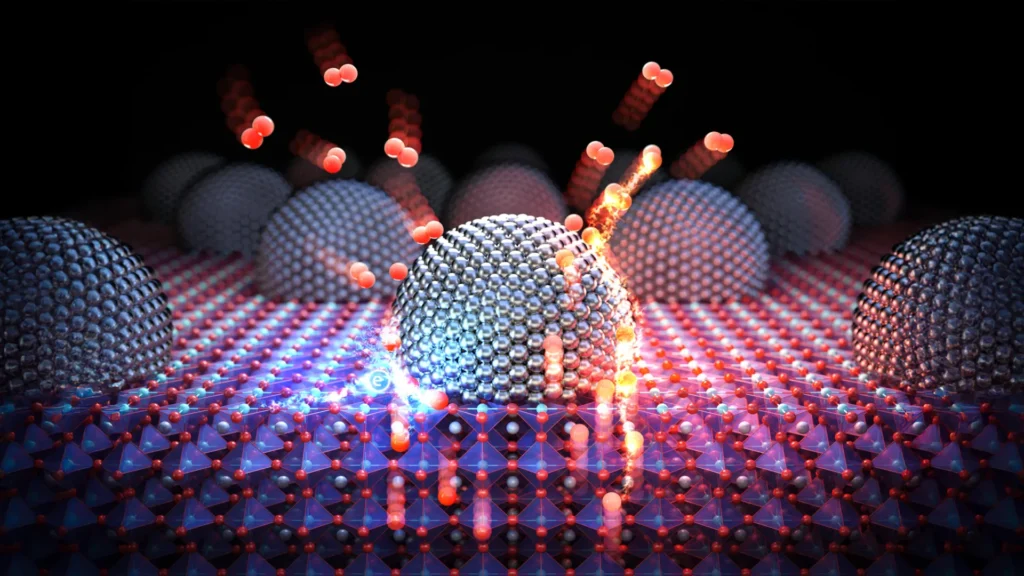
A collaborative research team in South Korea has achieved a significant breakthrough in the field of renewable energy by identifying that silver (Ag) nanocatalysts undergo a fundamental shift in their functional reaction sites depending on the operating mode of a solid oxide cell. This discovery, led by Professors WooChul Jung and Jeong Woo Han from the Department of Materials Science and Engineering at Seoul National University (SNU), in partnership with Professor Sang Ouk Kim’s team at the Korea Advanced Institute of Science and Technology (KAIST) and Dr. Beomgyun Jeong’s group at the Korea Basic Science Institute (KBSI), provides a critical roadmap for the design of next-generation electrochemical energy conversion devices. The study, which clarifies the complex mechanisms behind silver-enhanced electrodes, was recently published in the prestigious journal Energy & Environmental Science, where it was honored as an Outside Back Cover article due to its potential to revolutionize green hydrogen production and distributed power systems.
The Evolution of Solid Oxide Cell Technology
Solid oxide cells (SOCs) represent a versatile class of energy devices capable of operating in two distinct modes: as a fuel cell (SOFC) to generate electricity from chemical fuels and as an electrolysis cell (SOEC) to produce hydrogen by splitting water. Unlike traditional low-temperature fuel cells, SOCs utilize solid ceramic materials as electrolytes, allowing them to operate at high temperatures, typically between 500°C and 1,000°C. This high-temperature operation offers significant advantages, including higher thermodynamic efficiency and the ability to use non-precious metal catalysts.
The global push toward a "hydrogen economy" has placed SOCs at the forefront of energy research. In the fuel cell mode, these devices can provide high-efficiency power for industrial complexes and residential buildings, often utilizing waste heat for combined heat and power (CHP) systems. In the electrolysis mode, they are essential for producing "green hydrogen"—hydrogen generated using renewable energy sources like wind and solar—which is a cornerstone of global decarbonization strategies. However, the commercial viability of SOCs has long been hindered by the slow kinetics of oxygen reactions at the air electrode, a bottleneck that researchers have sought to overcome through the use of nanocatalysts.
Unmasking the "Black Box" of Nanocatalysis
For years, materials scientists have known that adding small amounts of metal nanoparticles to the surface of perovskite oxide electrodes can dramatically enhance the performance of SOCs. Among various candidates, silver has emerged as a particularly promising catalyst due to its high electrical conductivity and relative affordability compared to platinum or palladium. Despite these empirical successes, the exact mechanism by which these nanocatalysts improve reaction rates remained a subject of intense debate.
The primary challenge lies in the structural complexity of conventional electrodes. Standard electrodes are porous, three-dimensional structures with irregular grain boundaries and pores, making it nearly impossible to isolate where a specific reaction is occurring. Researchers struggled to determine whether the catalytic activity was happening on the exposed surface of the metal nanoparticle or at the "triple phase boundary" (TPB)—the specific line where the catalyst, the electrode, and the gas phase meet. Furthermore, it was unknown whether the catalyst behaved the same way when switching from electricity generation (oxygen reduction) to hydrogen production (oxygen evolution).
To solve this mystery, the SNU-KAIST-KBSI team moved away from traditional electrode designs. They developed a "model electrode" system utilizing advanced nanofabrication techniques. By creating highly ordered arrays of silver nanoparticles with uniform sizes and precisely controlled spacing on a thin-film perovskite surface, the researchers were able to create a controlled environment where every variable could be measured.
The Mechanism of Site-Switching: A Paradigm Shift
The team’s most striking finding is that the silver nanocatalyst is not a static component; rather, it is dynamic, shifting its primary reaction site based on the direction of the electrochemical current.
During the Oxygen Reduction Reaction (ORR), which occurs when the cell is generating electricity, the researchers observed that the reaction rate was directly proportional to the length of the interface between the silver nanoparticles and the electrode surface. This confirmed that in fuel cell mode, the interface—the boundary where the silver touches the perovskite—is the "hot spot" for catalytic activity. In this phase, the silver acts as an electronic bridge, facilitating the transfer of electrons to oxygen molecules, which then dissociate and incorporate into the electrode lattice as oxygen ions.
Conversely, during the Oxygen Evolution Reaction (OER), which occurs during hydrogen production via electrolysis, the behavior shifted entirely. The reaction rate no longer correlated with the interface length but instead scaled with the total surface area of the silver nanoparticles. This indicated that the silver surface itself becomes the primary site for the reaction. In this mode, the silver catalyst assists in the recombination of oxygen ions into oxygen gas molecules and their subsequent release into the atmosphere.
This "site-switching" phenomenon is a groundbreaking observation in the field of catalysis. It suggests that a catalyst’s effectiveness cannot be measured by a single metric; instead, its role is context-dependent, dictated by the specific chemical pathway of the operating mode.
Supporting Data and Technical Analysis
The research team utilized several high-tech diagnostic tools to validate their findings. A critical component of the study involved synchrotron-based Ambient Pressure X-ray Photoelectron Spectroscopy (AP-XPS) conducted at the KBSI-PAL 8A2 beamline at the Pohang Accelerator Laboratory. This technique allowed the scientists to observe the chemical state and electronic structure of the electrode surface in real-time while the cell was under actual operating conditions (in situ).
The AP-XPS data, combined with atomic-scale theoretical calculations (Density Functional Theory), revealed that the presence of silver nanoparticles modifies the electronic state of the underlying perovskite oxide. During electricity generation, the silver lowers the energy barrier for electron transfer. During electrolysis, the silver surface provides a lower-energy pathway for oxygen atoms to pair up and escape as gas.
When comparing silver to other noble and transition metals, the data showed that silver provided the most significant boost in performance. While platinum (Pt) and palladium (Pd) are traditionally viewed as superior catalysts in many chemical processes, the unique electronic interaction between silver and the specific perovskite electrodes used in SOCs made silver the more effective choice for this high-temperature application.
Strategic Implications for Clean Energy
The implications of this research extend far beyond the laboratory. By understanding that the catalyst interface and the catalyst surface serve different roles, engineers can now adopt a "dual-track" design strategy for SOC air electrodes.
- Optimizing Fuel Cells: For devices intended primarily for power generation, manufacturers should focus on maximizing the interface between the catalyst and the electrode. This might involve using smaller, more densely packed nanoparticles to increase the total boundary length.
- Optimizing Electrolyzers: For green hydrogen production, the focus should shift toward maximizing the available surface area of the catalyst, potentially through the use of porous or hierarchical nanoparticle structures.
- Reversible Systems: For Reversible Solid Oxide Cells (RSOCs)—which can act as a battery by storing excess renewable energy as hydrogen and then converting it back to electricity when needed—this research provides a blueprint for a balanced electrode design that performs efficiently in both directions.
This discovery is expected to lead to a significant reduction in the cost of green hydrogen. Currently, the high electricity demand of electrolysis is a major barrier to the widespread adoption of hydrogen fuel. By improving the efficiency of the oxygen evolution reaction, silver nanocatalysts can lower the voltage required for electrolysis, thereby reducing the operational costs of hydrogen production plants.
Official Responses and Future Directions
Professor WooChul Jung, the lead author of the study, emphasized the broader impact of their methodology. "This research is significant because it quantitatively evaluates the performance of nanocatalysts while also identifying their actual reaction sites and operating mechanisms," Jung stated. "The model electrode platform we developed allows us to look past the complexity of traditional materials and see the fundamental physics at play."
Dr. Jinwook Kim, who played a leading role in the experimental phase and is currently transitioning to a faculty position at the University of Seoul, noted that the platform could be applied to a wide range of technologies. "We plan to further establish this as a new design principle that can be applied to various energy conversion materials and catalytic systems, including oxygen separation membranes and other electrochemical devices," Kim said.
The research was a multi-institutional effort, reflecting the interdisciplinary nature of modern energy science. It received substantial support from the South Korean Ministry of Science and ICT and the National Research Foundation of Korea. The involvement of the Pohang Accelerator Laboratory was also instrumental, providing the high-energy light source necessary to "see" the atomic interactions on the catalyst surface.
Conclusion: A New Era for Catalytic Design
The discovery that silver nanocatalysts switch reaction sites based on operating modes represents a fundamental shift in how scientists view chemical additives in energy systems. For decades, catalysts were often treated as "black boxes"—added to a system to speed up a reaction without a full understanding of the spatial dynamics involved.
By pinpointing the exact locations of chemical activity, the SNU, KAIST, and KBSI researchers have provided the industry with a precision tool for engineering better electrodes. As the world moves toward a decentralized and decarbonized energy grid, the ability to efficiently generate power and produce hydrogen within the same system will be paramount. This study ensures that silver, an ancient metal, will play a modern and vital role in the clean energy transition of the 21st century.