Every second, an incomprehensible number of electrical charges surge through the human body, facilitating the very essence of life. These microscopic signals are not merely incidental; they are the fundamental drivers of cellular communication, energy production, and metabolic regulation. The biological machinery that sustains life relies entirely on the precision-controlled movement of these charges across cell membranes and within intracellular environments. In this context, charge transport functions as the primary control system for biology, a complex network of "highways" that allow for the rapid exchange of information and energy. At the heart of this network lies phosphoric acid and its derivatives, compounds that have long puzzled scientists regarding their extraordinary efficiency in conducting protons.
In a landmark study, researchers from the Department of Molecular Physics at the Fritz Haber Institute of the Max Planck Society, in collaboration with experts from the University of Leipzig and several institutions in the United States, have finally unmasked the structural secrets of these proton pathways. By focusing on the deprotonated dimer of phosphoric acid, the team has provided the first clear look at the initial steps of proton transfer, a discovery that carries profound implications for both evolutionary biology and the future of renewable energy technology.
The Ubiquity of Phosphoric Acid in Living Systems
Phosphoric acid ($H_3PO_4$) and its related phosphate compounds are among the most prevalent and essential molecules in the biosphere. They serve as the structural backbone of DNA and RNA, the genetic blueprints of all known life. Furthermore, they are integral components of phospholipids, which form the semi-permeable membranes that define the boundaries of cells. Perhaps most critically, phosphate groups are central to Adenosine Triphosphate (ATP), the universal "energy currency" of the cell. The storage and release of energy in ATP depend on the formation and breaking of phosphate bonds, a process inherently linked to the movement of protons.
Beyond its biological ubiquity, phosphoric acid is a cornerstone of modern industrial chemistry and green technology. It is a preferred material for high-temperature proton exchange membrane fuel cells (PEMFCs). Unlike water-based systems, which fail at temperatures above the boiling point, phosphoric acid maintains exceptional proton conductivity at high temperatures, making it indispensable for the next generation of clean energy converters. Despite its widespread use, the "how" behind its conductivity—specifically at the molecular level—has remained a subject of intense scientific debate for decades.
The Mechanics of Proton-Shuttling: The Grotthuss Mechanism
To understand the significance of the new research, one must first understand how protons move through a medium. In most substances, ions move through "diffusion," physically traveling through a solvent. However, in phosphoric acid and water, protons move via a unique process known as the Grotthuss mechanism, or "proton-shuttling."
Instead of a single proton traveling the entire distance from point A to point B, the charge is passed along a chain of hydrogen bonds. It is often compared to a "bucket brigade" or a relay race. A molecule accepts a proton at one end and almost simultaneously releases a different proton from its other end. This allows the electrical charge to move through the material much faster than the molecules themselves could ever travel. This efficiency is why phosphoric acid is often referred to as "Nature’s proton highway."
However, the "shuttling" process is incredibly fast and occurs at a scale so small that observing it in real-time has proven nearly impossible. The exact arrangement of molecules during the moment of transfer—the "transition state"—has been the missing piece of the puzzle.
A Breakthrough at Absolute Zero: The Chronology of the Experiment
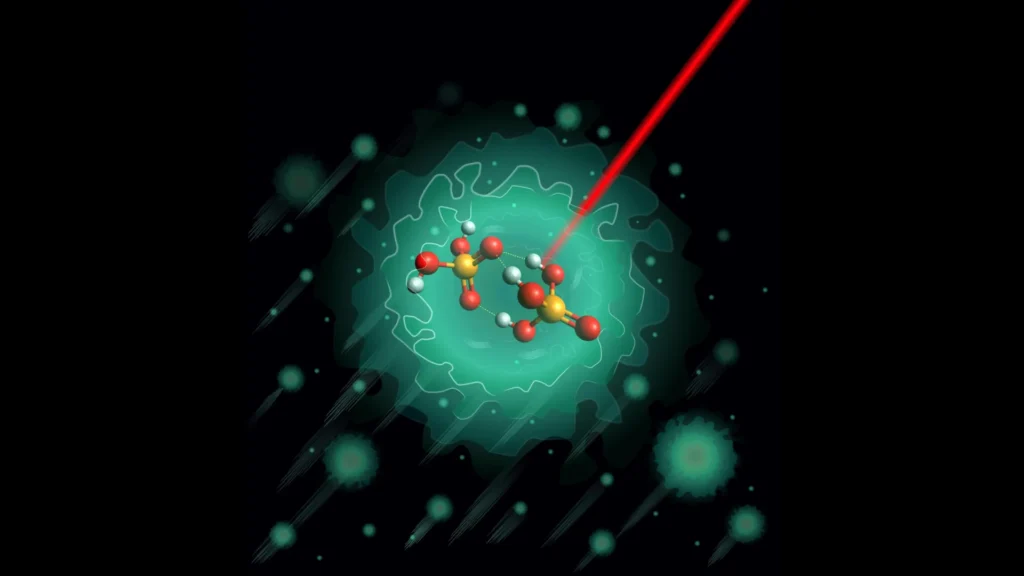
The research team set out to isolate the most basic unit of this highway: the deprotonated dimer, $H_3PO_4 cdot H_2PO_4^-$. This molecule consists of two phosphoric acid units sharing a single negative charge and a shifting proton. Scientists believed that this specific structure held the key to the earliest steps of the proton-shuttling process.
To study this elusive structure, the researchers employed a sophisticated chronological sequence of experimental steps:
- Molecular Synthesis: The team first synthesized the $H_3PO_4 cdot H_2PO_4^-$ dimer in a controlled vacuum environment to prevent contamination from other atmospheric molecules.
- Cryogenic Isolation: The molecules were then embedded into "helium nanodroplets." Helium, when cooled sufficiently, becomes a superfluid with zero viscosity. By placing the dimer inside these droplets, the researchers were able to cool the molecule to a staggering 0.37 Kelvin—just a fraction of a degree above absolute zero.
- Spectroscopic Analysis: At this extreme temperature, all thermal "noise" and molecular vibrations are effectively frozen. This allowed the team to perform infrared (IR) spectroscopy with unprecedented clarity. By hitting the molecule with infrared light and measuring which frequencies were absorbed, they could map the positions of the atoms and the strength of the bonds between them.
- Quantum Comparison: Finally, the experimental data was compared against advanced quantum chemical calculations. These mathematical models predict how atoms should theoretically arrange themselves based on the laws of physics.
Reconciling Theory and Reality: The Emergence of a Single Structure
The results of the experiment yielded a major surprise that challenged existing theoretical frameworks. Prior to this study, advanced quantum chemical models suggested that the $H_3PO_4 cdot H_2PO_4^-$ dimer was dynamic and could exist in two different, equally stable structural configurations. These models predicted that the proton would flip-flop between different positions, creating a "blurred" average structure.
However, the experimental data from the Fritz Haber Institute told a different story. The infrared "fingerprint" of the molecule revealed only one stable configuration. Contrary to the idea of a fluid, ever-changing shape, the dimer was found to be relatively rigid.
This single structure is characterized by a specific arrangement where three hydrogen bonds are connected through a shared oxygen atom. This creates a high energy barrier, meaning the proton does not move as freely within this specific unit as previously thought. Instead, the rigidity of this "building block" provides the stable framework required for the highway to function. This structural pattern has since been identified in larger phosphoric acid clusters, suggesting it is a universal motif in phosphate-based charge transport.
Supporting Data and Technical Analysis
The precision of the infrared spectroscopy was the deciding factor in this discovery. The researchers observed specific absorption peaks corresponding to "O-H" stretching and bending vibrations. In the two-structure model predicted by theory, these peaks should have been broad or split into multiple signals. Instead, the researchers observed sharp, distinct peaks that could only correspond to a single, well-defined geometric arrangement.
The implications of this discrepancy between theory and experiment are significant for the field of computational chemistry. It suggests that even the most advanced "Ab Initio" (from first principles) molecular dynamics simulations may struggle to accurately account for the subtle electronic correlations in hydrogen-bonded systems. The experimental verification provides a vital "benchmark" or reference point that theorists will now use to refine their models, leading to more accurate predictions in the future.
Implications for Green Technology and Energy Storage
While the study is rooted in fundamental physics and chemistry, its practical applications are far-reaching. The world is currently in a transition toward hydrogen-based energy, and fuel cells are a critical component of that transition.
Fuel cells generate electricity by stripping electrons from hydrogen atoms. The remaining protons must then pass through a membrane to complete the circuit. Phosphoric acid-doped membranes are favored because they can operate at temperatures between 150°C and 200°C. At these temperatures, fuel cells are more efficient and less susceptible to "poisoning" by impurities like carbon monoxide.
By understanding the rigid, single-structure nature of the phosphate dimer, materials scientists can now design new synthetic membranes that mimic this "proton highway" more effectively. If researchers can engineer materials that lower the energy barriers identified in this study, they could potentially create fuel cells with significantly higher power densities and longer lifespans.
Biological Significance: Understanding Life’s Energy Flux
On the biological side, this discovery sheds light on how enzymes and proteins manage proton gradients. In the mitochondria—the "powerhouse" of the cell—a gradient of protons is used to drive the synthesis of ATP. This process, known as chemiosmosis, relies on the rapid and directed movement of protons through protein channels that often contain phosphate groups.
The identification of a stable, rigid structure in phosphate dimers helps explain how biological systems maintain directionality in proton transport. It prevents the "leakage" of charges and ensures that the energy flux is channeled exactly where it is needed for metabolic work.
Official Responses and Scientific Consensus
While the study was led by the Fritz Haber Institute, the broader scientific community has responded with high interest. Dr. Knut Asmis from the University of Leipzig, a key collaborator, noted that the ability to isolate these molecules in helium nanodroplets was the "game-changer" that allowed them to see what had been hidden for decades.
Independent experts in the field of spectroscopy have lauded the study for its "surgical precision." The consensus among physical chemists is that this work settles a long-standing debate regarding the equilibrium of phosphate ions. It serves as a reminder that in the era of "Big Data" and AI-driven simulations, direct experimental observation remains the ultimate arbiter of scientific truth.
Conclusion: A New Foundation for Molecular Science
The discovery of a single, stable structure for the $H_3PO_4 cdot H_2PO_4^-$ dimer marks a turning point in our understanding of phosphoric acid’s unique properties. By combining the extreme conditions of absolute zero with the precision of infrared spectroscopy, the researchers have provided a clear map of "Nature’s proton highway."
This research does more than just solve a molecular puzzle; it provides the foundational knowledge necessary to improve quantum chemical modeling, enhance the efficiency of green energy technologies, and deepen our grasp of the fundamental processes that sustain life. As scientists continue to explore the microscopic world of charge transport, the rigid yet efficient phosphate dimer will stand as a testament to the complex, beautiful engineering that underpins the natural world.