The search for extraterrestrial life has historically been governed by a "follow the water" mantra, a strategy predicated on the assumption that life requires an environment mirroring Earth’s temperate, aqueous conditions. However, a groundbreaking study from the Massachusetts Institute of Technology (MIT) is challenging this geocentric paradigm. Researchers have demonstrated that the building blocks of life—specifically short chains of amino acids known as peptides—can not only survive but also adopt complex, functional structures within the hyper-acidic environment of Venus’s cloud layers. This discovery, published in the Proceedings of the National Academy of Sciences, suggests that the concentrated sulfuric acid clouds of our neighboring planet, long dismissed as a biological wasteland, could potentially harbor a unique form of biochemistry.
The research, led by senior authors Mei Hong, a professor of chemistry at MIT, and Sara Seager, a professor of planetary sciences, reveals that peptides remain stable in 98 percent sulfuric acid for extended periods. More significantly, the study found that these molecules can fold into "omega loops," a structural motif essential for biological activity. This finding fundamentally expands the definition of habitability, suggesting that scientists should not rule out planets with atmospheres that appear hostile by terrestrial standards.
The Venusian Atmosphere: A Corrosive Frontier
Venus is often described as Earth’s "evil twin." While similar in size and composition, its surface is a hellscape of crushing pressure and temperatures hot enough to melt lead. However, approximately 30 to 40 miles above the scorched surface lies a temperate layer of clouds. While the temperature in this region is hospitable, the chemistry is not. These clouds are composed of concentrated sulfuric acid droplets, a substance that, on Earth, is used to dissolve metals and destroy organic tissue.
For decades, the consensus among astrobiologists was that the extreme acidity of these clouds would cause immediate hydrolysis—a chemical reaction where water breaks down the bonds holding biological molecules together. Because sulfuric acid is a powerful dehydrating agent, it was assumed that any complex molecule, such as a protein or a strand of DNA, would be stripped of its structure and functionality.
The MIT team’s investigation began with a provocative question: What if the very harshness of the acid is what allows life to persist? By exploring how biological building blocks behave in the absence of significant water, the researchers have uncovered a chemical loophole that could allow for "acid-stable" life.
Methodology: Probing Molecular Resilience via NMR Spectroscopy
To test the resilience of peptides, the researchers utilized advanced nuclear magnetic resonance (NMR) spectroscopy at MIT’s Department of Chemistry Instrumentation Facility (DCIF). This technology measures the magnetic properties of atomic nuclei, allowing scientists to map the precise three-dimensional structure of molecules at a sub-nanoscale level.
The team focused on several specific peptides:
- HHQ: A synthetic peptide consisting of seven amino acids, previously studied for its ability to form catalytic structures in water.
- HHQ13: A longer variation of the HHQ sequence.
- K7: A different seven-amino acid peptide.
These molecules were submerged in a solution of 98 percent sulfuric acid—mimicking the concentration found in Venusian cloud droplets. The researchers monitored the samples for several weeks, expecting to see the rapid degradation of the peptide bonds.
To their surprise, the peptides remained entirely intact. The lack of water in the concentrated acid proved to be the key factor. In a typical acidic environment on Earth, water acts as a medium that facilitates the breaking of peptide bonds. However, at 98 percent concentration, the sulfuric acid is so "thirsty" for water that it sequesters any available moisture, preventing the hydrolysis reaction from occurring. As Mei Hong noted, without water, an acid that is traditionally considered a harsh solvent becomes a stabilizing medium.
The Discovery of the Omega Loop
Survival was only half of the equation. For a peptide to be biologically relevant, it must be able to fold into a specific shape. In biology, "structure equals function." If a molecule remains a limp string, it cannot catalyze reactions or act as a messenger.
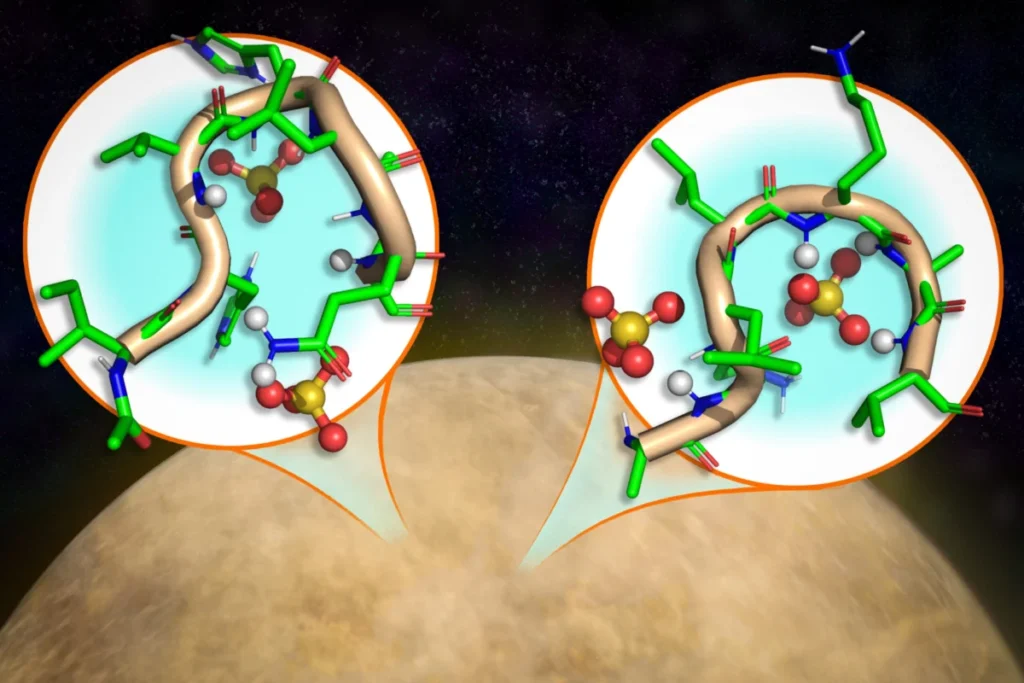
Under the 800-megahertz NMR spectrometer, the researchers observed that the peptides in sulfuric acid did not merely survive; they folded into a specific geometry known as an omega loop. This loop, named for its resemblance to the Greek letter $Omega$, is a common feature in terrestrial proteins, often serving as a bridge between other structural motifs like alpha-helices and beta-sheets.
The data suggests that the sulfuric acid molecules themselves act as a chemical "scaffold." The acid molecules slide into the center of the peptide loop, holding it in a rigid, defined shape through hydrogen bonding. This was a revelation for the team. In water, the HHQ peptide typically forms flat "beta sheets" that aggregate into long fibers. The transition to an omega loop in acid demonstrates that the environment can dictate entirely different, yet still highly organized, molecular architectures.
Timeline of Discovery and Context
The current study is the latest in a series of investigations sparked by a controversial 2020 announcement. In September of that year, an international team of astronomers reported the detection of phosphine gas in the Venusian atmosphere. On Earth, phosphine is primarily produced by anaerobic bacteria, leading to intense speculation about life in the clouds of Venus.
While the phosphine discovery remains a subject of debate within the scientific community, it reignited interest in Venusian astrobiology. Since 2020, Sara Seager’s lab at MIT has systematically tested the stability of various biological components in sulfuric acid:
- 2021-2022: Initial studies confirmed that nucleic acid bases (the "letters" of the genetic code) are stable in concentrated acid.
- 2023: Research demonstrated that lipids and certain amino acids could withstand the corrosive environment.
- 2024 (Current): The discovery that peptides not only survive but fold into functional shapes.
This timeline reflects a step-by-step reconstruction of the "prebiotic soup," showing that the fundamental components required for life are chemically viable in a non-aqueous, acidic solvent.
Reactions from the Scientific Community
The findings have sent ripples through the fields of chemistry and planetary science. Adriaan Bax, chief of the Section on Biophysical NMR at the National Institutes of Health (NIH), who was not involved in the study, described the results as "important and unexpected." He noted that the degree of conformational order retained by these peptides raises the genuine prospect that folded proteins could exist in atmospheric conditions radically different from those on Earth.
Within the MIT community, the collaboration between the Department of Chemistry and the Department of Earth, Atmospheric and Planetary Sciences (EAPS) is being hailed as a model for interdisciplinary research. Sara Seager, who is set to join the University of Toronto faculty in late 2024, emphasized that these findings should broaden the scope of exoplanet surveys. She argued that the search for "Earth twins" might be too narrow, as "Venus twins" might be equally capable of supporting complex chemistry.
Implications for Future Exploration: The Morning Star Missions
The laboratory evidence gathered by Seager and Hong provides a critical scientific foundation for upcoming space missions. Seager is currently leading the "Morning Star Missions to Venus," a series of privately funded endeavors aimed at searching for signs of life and organic molecules directly within the Venusian clouds.
The first of these missions, scheduled for launch in the coming years, will deploy a small probe designed to spend several minutes descending through the cloud layers. Equipped with an autofluorescing nephelometer, the probe will look for the presence of organic compounds within the acid droplets. The knowledge that peptides can maintain their structure in these droplets allows mission scientists to refine their instruments to look for specific molecular signatures.
Furthermore, the study opens the door to the concept of "alternative biochemistry." Seager’s team is now investigating Peptide Nucleic Acids (PNA). Unlike DNA, which has a sugar-phosphate backbone that is sensitive to acid, PNA uses a peptide-like backbone. If double-stranded PNA proves stable in sulfuric acid, it could serve as a theoretical blueprint for a genetic system that thrives where Earth-style DNA would perish.
Analysis of Broader Impacts
The MIT study serves as a pivot point for astrobiology. For decades, the "Habitable Zone" was defined strictly by the distance from a star where liquid water could exist on a planet’s surface. This research suggests that habitability may be more about "chemical stability" than "water availability."
If complex molecules like folded peptides can exist in sulfuric acid, the number of potentially habitable environments in the universe increases exponentially. Many exoplanets previously categorized as "hostile" due to their thick, acidic atmospheres may now be viewed as candidates for aerial biospheres.
Moreover, this research has implications for the study of the origins of life on Earth. It suggests that prebiotic chemistry is far more robust than previously imagined. If peptides can survive the extreme conditions of Venusian clouds, it is plausible that the early Earth, which also possessed a volatile and harsh atmosphere, could have supported the development of life through various chemical pathways, not all of which were necessarily water-dependent.
As the scientific community prepares for a new era of Venus exploration—including NASA’s upcoming DAVINCI and VERITAS missions—the realization that the "acidic hell" of Venus might actually be a protective cradle for complex molecules will undoubtedly reshape the hypotheses tested in the clouds of our neighbor planet. The study confirms that in the search for life, the most hostile environments may hold the most surprising secrets.