A series of groundbreaking experiments conducted at the Relativistic Heavy Ion Collider (RHIC) has provided the first experimental evidence for a "gluon junction," a theoretical structure that may fundamentally alter our understanding of how the most basic building blocks of matter are organized. For decades, the scientific consensus held that the baryon number—a fundamental quantum property that defines protons and neutrons—was carried by the three valence quarks that reside within these particles. However, new findings from the STAR (Solenoidal Tracker at RHIC) detector collaboration suggest that this property is instead carried by a complex, Y-shaped arrangement of gluons that acts as a structural anchor for the quarks. This discovery, recently published in the journal Science, offers a new perspective on the stability of the universe and the mysterious imbalance between matter and antimatter.
The Evolution of the Proton Model: From Quarks to Junctions
The traditional "naive" quark model, which has been a staple of physics textbooks for half a century, describes the proton as a relatively simple composite particle. In this model, three valence quarks are bound together by the strong force, mediated by gluons. Each of these quarks is assigned a baryon number of exactly one-third, such that the total baryon number of the proton equals one. This integer value is a conserved quantity in the Standard Model of particle physics, meaning that in any subatomic reaction, the total baryon number remains constant.
While this model successfully explains many properties of matter, it has long been recognized as an oversimplification. At the high energies explored at Brookhaven National Laboratory’s RHIC facility, protons are revealed to be far more chaotic. They are not merely three quarks, but a "sea" of virtual quarks and antiquarks that constantly pop in and out of existence, alongside a dense forest of gluons.
The concept of the "gluon junction" emerged in the 1970s as a theoretical framework to explain how the strong force, described by the theory of Quantum Chromodynamics (QCD), manages to confine three quarks into a single baryon. The theory posited that gluons form a Y-shaped junction where the three color-coded flux tubes from the quarks meet. In 1996, theoretical physicist Dmitri Kharzeev of Stony Brook University and Brookhaven Lab hypothesized that this junction was more than just a structural connector; he proposed it was the actual carrier of the baryon number itself. The STAR collaboration’s latest results provide the first robust experimental support for this nearly 30-year-old hypothesis.
Experimental Methodology: Smashed Atoms and the Search for Midrapidity Excess
To test whether the baryon number resides with the quarks or the junction, researchers at RHIC utilized high-energy collisions of gold nuclei. RHIC is uniquely suited for this task because it can accelerate heavy ions to 99.9% the speed of light. When these ions collide, the enormous kinetic energy is converted into matter, creating a "quark-gluon plasma"—a state of matter that mimics the conditions of the universe microseconds after the Big Bang.
The research team, led by scientists from Kent State University, Brookhaven National Laboratory, Rice University, and the University of Science and Technology of China, focused on the "stopping" of particles. When two nuclei collide, most of the valence quarks continue moving forward at nearly the speed of light along the beamline. However, some of the baryon number is "stopped" and redirected perpendicular to the beam—a region known as "midrapidity."
If the baryon number were tied strictly to the valence quarks, then the "stopped" baryons detected at midrapidity should be accompanied by a proportional amount of electric charge, since quarks carry both properties. If the baryon number were instead tied to the gluon junction, which has no electric charge, one would expect to see an excess of baryons at midrapidity without a corresponding amount of stopped electric charge.
Analyzing the Data: A Striking Mismatch
The STAR detector recorded thousands of these collisions, measuring the distribution of protons (baryons) and their electric charge. The results revealed a significant discrepancy that the traditional quark model could not explain. The researchers observed that the number of baryons emerging at midrapidity was roughly twice as high as the amount predicted based on the amount of electric charge that had been stopped.
"Measuring the electric charge coming out perpendicular to the collision gives you a definitive way of measuring how many quarks are stopped and transformed into new particles," explained Zebo Tang, a professor at the University of Science and Technology of China. The data showed that while the valence quarks were largely continuing their forward trajectory, the baryon number was being left behind in the center of the collision zone.
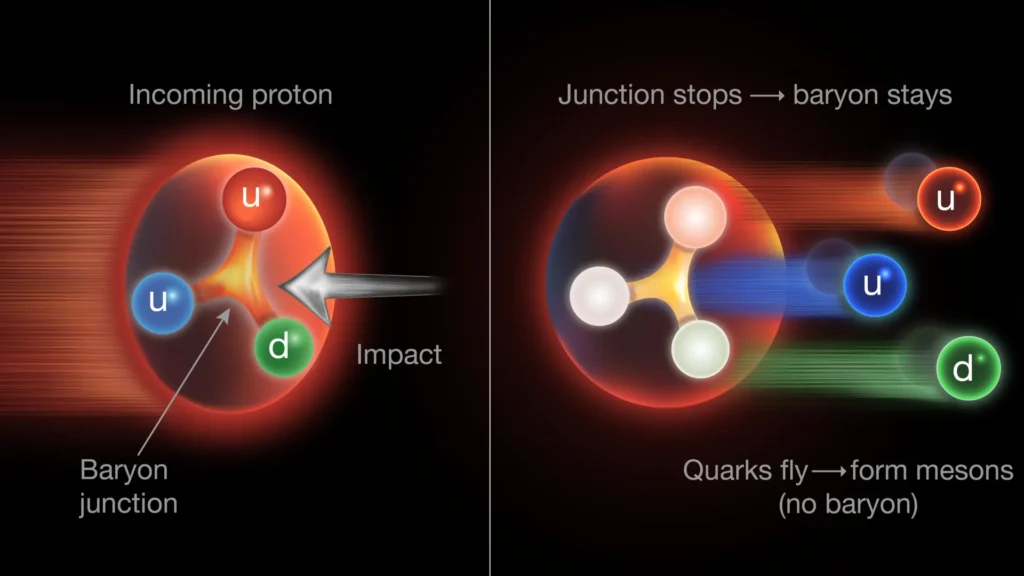
This finding suggests that the gluon junction is far easier to "stop" than the quarks it connects. As a proton is accelerated to high energies, the gluons inside it multiply and split, spreading the particle’s momentum across a larger number of constituents. While the valence quarks retain most of the momentum and "punch through" the collision, the Y-shaped gluon junction, which carries a smaller fraction of the momentum, is more likely to be snagged and halted during the impact.
The Mechanics of Particle Reconstruction
Once the gluon junction is stopped in the collision zone, it cannot remain isolated due to the laws of color confinement. In the chaotic, energy-rich environment of the quark-gluon plasma, the stopped junction acts as a sort of "vacuum cleaner," drawing in three newly created quarks from the surrounding energy to form a brand-new baryon.
Meanwhile, the original valence quarks that continued down the beampipe eventually pair up with antiquarks to form mesons—two-quark particles that carry no baryon number. This process explains how the baryon number can be "transported" or "shifted" away from the original quarks that entered the collision.
"In the collision, the baryon junction gets held behind, and the quarks continue on," noted Prithwish Tribedy, a STAR physicist at Brookhaven Lab. This mechanism provides a clear physical explanation for why the STAR detector consistently sees an excess of baryons (matter) over antibaryons (antimatter) in the midrapidity region, despite the massive energy-to-matter conversions taking place.
Broader Implications: From Proton Stability to the Big Bang
The confirmation of the gluon junction has profound implications for our understanding of the universe. One of the most significant relates to the conservation of baryon number and the stability of matter. Protons are famously stable; experiments have shown their lifespan to be at least 10^34 years—much longer than the current age of the universe. This stability is what allows atoms to exist. If baryon number is tied to a topological structure like a gluon junction rather than individual, volatile quarks, it may provide a deeper explanation for why protons do not easily decay.
Furthermore, the discovery touches on the "baryon asymmetry" problem. According to the Big Bang theory, equal amounts of matter and antimatter should have been created. Yet, the observable universe is made almost entirely of matter. Understanding how baryon number is carried and transported is a critical step in solving why matter ultimately triumphed over antimatter in the early universe.
"The reasons for this conservation are not well understood," said Nicole Lewis, a STAR physicist at Rice University. "It’s one of the mysteries of the universe, related to why we have more matter than antimatter."
Chronology of Research and Future Directions
The journey toward this discovery spanned several decades of theoretical and experimental work:
- 1970s: Theoretical physicists first propose the existence of gluon junctions to satisfy the requirements of QCD in three-quark systems.
- 1996: Dmitri Kharzeev publishes the hypothesis that the junction is the true carrier of baryon number.
- 2000: RHIC begins operations at Brookhaven National Laboratory, providing a venue to test high-energy QCD.
- 2020: Researchers including Nicole Lewis and Tommy Tsang begin a dedicated analysis of STAR data to look for the baryon-charge mismatch.
- 2024: The STAR collaboration officially publishes their findings in Science, marking a major milestone in nuclear physics.
The implications of this research will likely be a primary focus for the next generation of particle accelerators. While RHIC is scheduled to conclude its operations in the coming years, the upcoming Electron-Ion Collider (EIC)—also to be built at Brookhaven—will allow scientists to peer even deeper into the proton’s interior. The EIC will use high-energy electrons to "probe" the gluon structure with unprecedented precision, potentially allowing for the direct imaging of the gluon junction.
Conclusion: A New Chapter in Nuclear Physics
The STAR detector’s findings represent a paradigm shift in how scientists visualize the most fundamental components of the atom. By demonstrating that the baryon number is likely tied to a collective gluon structure rather than individual quarks, the research team has solved a long-standing puzzle regarding particle distributions in high-energy collisions.
"Our research challenges the long-held idea that baryon number is simply divided among and carried by the three quarks," said Rongrong Ma, a Brookhaven Lab physicist. "This new understanding reshapes how we think about the structure of matter and deepens our knowledge of the most fundamental element that is responsible for the universe in its current form."
As the scientific community digests these results, the focus turns to how this "junction" model fits into the broader Standard Model and what it reveals about the forces that hold our world together. Far from being simple spheres of charge, protons are now seen as complex, dynamic systems where the "glue" is just as important as the particles it binds.