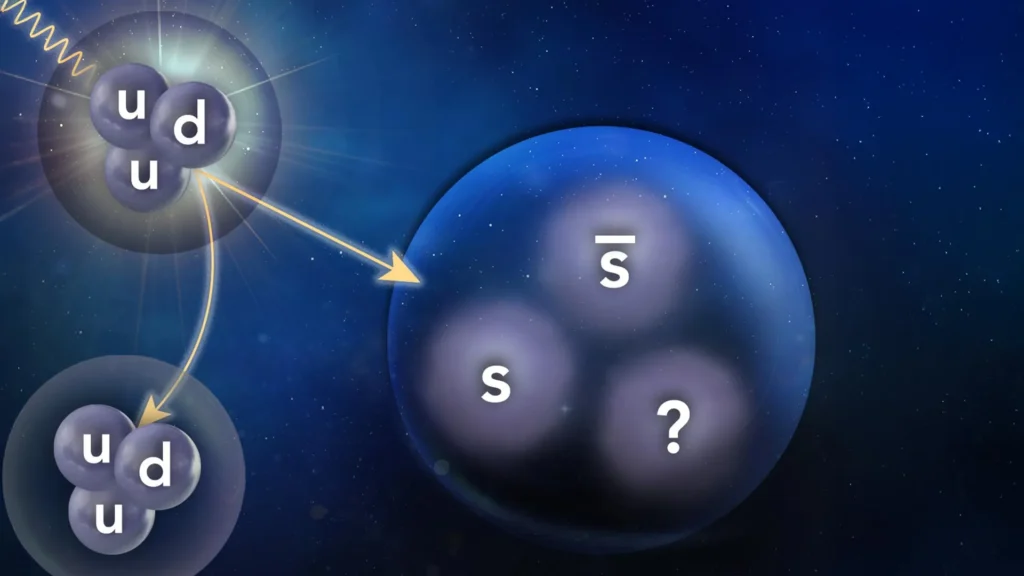
The boundaries of the subatomic world have expanded once again as researchers at the U.S. Department of Energy’s Thomas Jefferson National Accelerator Facility (Jefferson Lab) announced the discovery of two unexpected particle structures. These findings, emerging from the Gluonic Excitations (GlueX) Collaboration, provide critical new data in the ongoing effort to map the "XYZ states"—a mysterious class of hadrons that defy the traditional classifications of the Standard Model of particle physics. Published recently in the prestigious journal Physical Review Letters, the study details how high-energy photon beams interacting with proton targets revealed signals for two new states, designated Y(2240) and X(1830), while notably failing to find a previously confirmed particle in the same region.
The Evolution of the Subatomic Landscape
To understand the significance of the GlueX findings, one must look back at the mid-20th century, a period often referred to as the "era of the particle zoo." Starting in the 1950s, the development of early particle accelerators allowed physicists to smash atoms together with increasing force, revealing a bewildering array of short-lived subatomic particles known as hadrons. Hadrons are composite particles held together by the strong nuclear force, the most powerful of the four fundamental forces of nature.
By 1964, physicists Murray Gell-Mann and George Zweig independently proposed the quark model to bring order to this chaos. They suggested that all hadrons were composed of smaller fundamental entities called quarks. In this original framework, quarks came in three "flavors": up, down, and strange. Protons and neutrons, the building blocks of atomic nuclei, were identified as baryons, each containing three quarks. Other particles, known as mesons, were identified as pairs consisting of one quark and one antiquark.
The landscape shifted again in 1974 during the "November Revolution," when the discovery of the charm quark proved that the quark model was more expansive than previously thought. Eventually, the model grew to include six flavors: up, down, strange, charm, bottom, and top. This framework became the cornerstone of the Standard Model, which describes how quarks and leptons interact via the strong, weak, and electromagnetic forces.
The Emergence of the XYZ Mystery
For decades, the quark model successfully predicted the properties of nearly every hadron discovered. However, as experimental sensitivity improved in the 21st century, researchers began encountering "exotic" states that did not fit the simple three-quark (baryon) or quark-antiquark (meson) descriptions.
In 2003, the Belle experiment in Japan discovered a particle named X(3872). It was a meson-like object, but its mass and decay properties suggested it might be something more complex—perhaps a "tetraquark" (four quarks) or a "hadronic molecule" (two mesons loosely bound together). This discovery triggered a wave of similar finds, collectively labeled "XYZ states."
These states are particularly prevalent in the charmonium region (particles containing charm and anti-charm quarks) and the strangeonium region (particles containing strange and anti-strange quarks). Understanding these states is vital because they offer a direct window into the behavior of gluons—the particles that carry the strong force. While the Standard Model accounts for gluons, it is notoriously difficult to calculate exactly how they bind quarks together, a field of study known as non-perturbative Quantum Chromodynamics (QCD).
Searching for Strangeonium: The Y(2175) Candidate
The GlueX experiment’s recent investigation focused on the strangeonium sector. In 2006, the BaBar experiment at the SLAC National Accelerator Laboratory identified a potential XYZ state with a mass of approximately 2.175 billion electron volts (GeV), labeled Y(2175). This particle was produced through electron-positron ($e^+e^-$) annihilation, a process where matter and antimatter collide to create a burst of energy that then condenses into new particles.
The Y(2175) was considered a prime candidate for a "hybrid meson"—a state where the gluonic field itself is excited and contributes to the particle’s overall quantum numbers. Subsequent experiments at the Beijing Spectrometer (BESIII) in China and the Belle experiment in Japan confirmed the signal. However, a lingering question remained: would this particle appear if produced through a different physical process?
The GlueX Collaboration sought to answer this by using photoproduction. Unlike $e^+e^-$ annihilation, photoproduction involves hitting a stationary target with a beam of high-energy photons. If the Y(2175) were a robust, fundamental structure, it should theoretically be visible regardless of the "production mechanism," provided the energy was sufficient.
The GlueX Experiment: A Unique Tool for Discovery
Located in Experimental Hall D at Jefferson Lab, the GlueX experiment is uniquely equipped for this task. It utilizes the Continuous Electron Beam Accelerator Facility (CEBAF), which provides a high-intensity electron beam. To create the necessary photons, the electron beam is directed through an ultrathin diamond wafer. Through a process called coherent bremsstrahlung, the electrons produce a beam of "linearly polarized" photons.
These photons carry significant energy—up to 12 GeV—and strike a target of liquid hydrogen. When a photon interacts with a proton in the hydrogen target, the exchange of energy can produce a variety of short-lived particles. A massive, high-precision spectrometer surrounding the target then tracks the trajectories, energies, and identities of the resulting "spray" of particles.
"No other experiment has a facility with a photon beam of this intensity at the energy we have available," noted Malte Albrecht, a staff scientist at Jefferson Lab. This intensity allows researchers to collect massive amounts of data, searching for rare signals that would be invisible in less powerful experiments.
Unexpected Results: The Arrival of Y(2240) and X(1830)
When the GlueX team analyzed the data from their initial runs, they were surprised to find that the Y(2175) signal was absent. Despite the high sensitivity of the detector, the expected peak at 2.175 GeV did not materialize in the photoproduction data.
Instead, the researchers identified two distinct, previously unobserved structures at different masses. The first, designated Y(2240), appeared at a mass of 2.24 GeV. This signal was detected with a statistical significance of five sigma ($5sigma$). In the world of particle physics, five sigma is the "gold standard" for discovery, indicating a 99.99994% confidence level that the signal is not a random statistical fluke.
The second structure, X(1830), appeared at a lower mass of approximately 1.82 GeV. This signal reached a three-sigma ($3sigma$) significance. While three sigma is generally considered "evidence" rather than a "discovery," it is a strong indication that a real physical phenomenon is occurring at that energy level.
The absence of Y(2175) and the presence of Y(2240) and X(1830) suggest that the internal structure of these particles is highly sensitive to how they are created. This "production-dependent" behavior is a hallmark of exotic states and suggests that these structures may be more complex than simple quark-antiquark pairs.
Analyzing the Implications: Hybrid Mesons and Gluonic Fields
The discovery of Y(2240) and X(1830) has significant implications for theoretical physics. One of the primary goals of the GlueX experiment is to find evidence of hybrid mesons. In a standard meson, the gluons act merely as the "glue" holding the quarks together. In a hybrid meson, the gluonic field is in an excited state, possessing its own angular momentum and quantum numbers.
The existence of such states is a direct prediction of Quantum Chromodynamics, but they have proven notoriously difficult to isolate. "Excited gluonic fields are what could be in these mesons where you have more than just the quark-antiquark pair," explained Justin Stevens, a physics professor at William & Mary and spokesperson for GlueX. "That’s one of the investigations, to try to understand whether there is a gluonic contribution to the structure we see."
The fact that these new signals were found using photoproduction provides theorists with a new set of constraints. By comparing the results from Jefferson Lab with those from $e^+e^-$ colliders like BESIII, physicists can begin to "triangulate" the true nature of these particles. If a state appears in one type of collision but not another, it tells scientists a great deal about the particle’s "wavefunction"—the mathematical description of its internal components.
Chronology of Recent Exotic Particle Research
The GlueX findings are part of a broader timeline of discovery that has accelerated over the last two decades:
- 2003: The Belle experiment discovers X(3872), the first major XYZ state.
- 2005: The BaBar experiment identifies Y(4260) in the charmonium sector.
- 2006: BaBar reports the Y(2175) in the strangeonium sector.
- 2013: The BESIII and Belle experiments independently observe the $Z_c(3900)$, a charged state that must contain at least four quarks (a tetraquark).
- 2015: The LHCb experiment at CERN announces the discovery of "pentaquarks"—particles containing five quarks.
- 2021-2023: Jefferson Lab’s GlueX collaboration begins high-statistics runs following the CEBAF 12 GeV upgrade.
- 2024: GlueX publishes the discovery of Y(2240) and X(1830) in Physical Review Letters.
Future Outlook: Sorting Through the Data
The discovery of Y(2240) and X(1830) is not the end of the story, but rather the beginning of a new phase of analysis. The GlueX experiment produces an immense amount of data—enough to fill a standard laptop hard drive in a matter of minutes. As the collaboration continues to sift through this information, they expect to find even more subtle signals.
The next steps involve more than just identifying the mass of these particles. Researchers need to determine their "quantum numbers"—properties like spin, parity, and charge conjugation. These properties act as a fingerprint, allowing physicists to determine if a particle is a standard meson, a tetraquark, a hybrid, or something else entirely.
"The next step is to figure out which exotic quark configurations nature might have realized here," said Frank Nerling, a collaborator from the GSI Helmholtz Centre for Heavy Ion Research. "Theorists may come to further conclusions and identify measurements that could help pin down the real nature of these particular states."
Furthermore, the study established an upper limit on the photoproduction cross-section for Y(2175). This means that even though the particle wasn’t seen, physicists now know exactly how "rare" it must be in these types of interactions, which helps refine future searches at other facilities like the upcoming Electron-Ion Collider (EIC) at Brookhaven National Laboratory.
As the international physics community continues to grapple with the "exotic zoo," the findings at Jefferson Lab underscore the importance of using multiple experimental approaches to probe the fundamental nature of matter. By looking at the same subatomic landscape through the different "lens" of high-energy photons, the GlueX collaboration has revealed that the world of quarks and gluons is even more vibrant and complex than previously imagined.