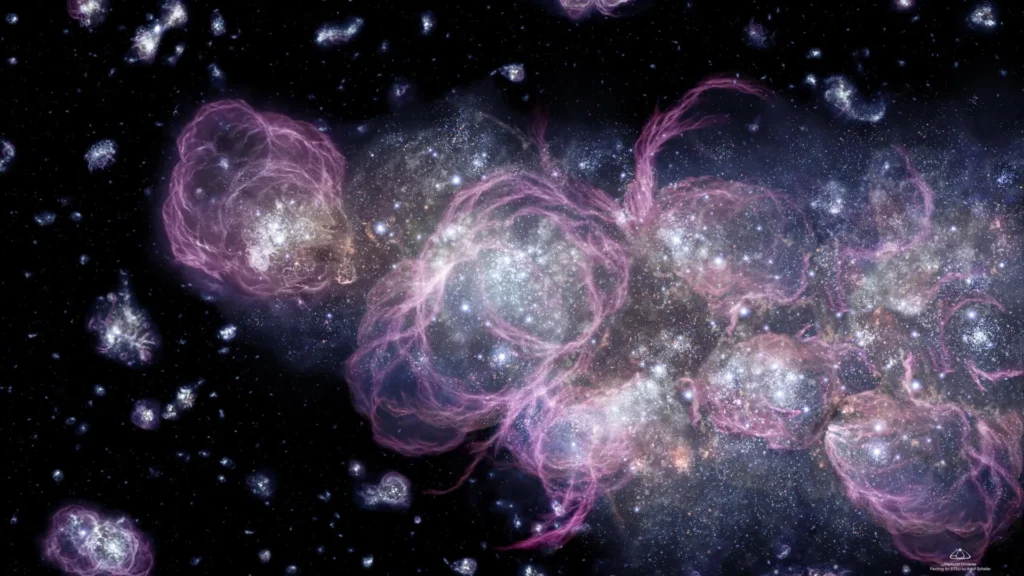
Astronomers are finding that the first generations of galaxies do not always behave the way existing models predict. One possible reason is that their most massive stars may have evolved very differently from massive stars in the modern Milky Way. A new survey led by the University of Utah, utilizing the unparalleled capabilities of the Hubble Space Telescope, is now shedding crucial light on these discrepancies, potentially reshaping our understanding of cosmic evolution.
Unveiling the Universe’s Infancy Through TEMPOS
The project, known as the Treasury of Extremely Metal-Poor O Stars (TEMPOS), is meticulously examining massive stars in nearby galaxies that mimic the harsh, element-scarce environments of the early universe. By leveraging ultraviolet (UV) measurements from Hubble’s Cosmic Origins Spectrograph (COS), researchers are gaining unprecedented insights into the physical properties and evolutionary paths of these ancient stellar giants. The unusually large and detailed TEMPOS dataset is poised to significantly refine current models of massive star behavior and, by extension, illuminate how these powerful celestial engines profoundly influenced the formation and development of the universe’s nascent galaxies.
This research takes on heightened significance with the ongoing discoveries of the James Webb Space Telescope (JWST). Since its launch in late 2021, JWST has consistently uncovered galaxies from the universe’s early history that are far more complex and structured than anticipated, challenging established cosmological paradigms. "Webb opened up a whole bunch of new questions about the evolution of these early galaxies — they’re weird," stated Grace Telford, assistant professor in the Department of Physics & Astronomy at the University of Utah and lead author of the study. "That’s the scientific motivation behind the TEMPOS program: to help understand what is going on in these early galaxies."
The comprehensive findings from the TEMPOS survey were published on September 21, 2026, in The Astrophysical Journal Supplement Series, marking a significant milestone in observational astronomy.
The Immense Influence of Massive Stars on Galactic Evolution
Stars more than ten times as massive as our Sun, while relatively rare, are cosmic powerhouses whose influence reverberates throughout entire galaxies. They are prodigious emitters of radiation, constantly shed vast quantities of material through powerful stellar winds, and ultimately meet their dramatic ends in cataclysmic supernova explosions. These events are not merely spectacular finales; they are critical drivers of galactic evolution.
"They burn very hot, bright and fast and they end their short lives as supernova explosions that deposit a lot of energy and material into the surrounding gas," explained Dr. Telford. "They govern the evolution of their host galaxies by heating and essentially regulating the gas that’s then available to cool and form into new stars." This intricate feedback loop, driven by massive stars, dictates the rate of star formation and the overall chemical enrichment of a galaxy over cosmic time.
Metallicity: A Key Differentiator Between Ancient and Modern Galaxies
A fundamental distinction between the galaxies of the early universe and those we observe today lies in their chemical composition. Astronomers quantify this by measuring "metallicity," which refers to the abundance of elements heavier than hydrogen and helium present within a star or galaxy. The primordial universe, fresh from the Big Bang, was composed almost entirely of hydrogen and helium. It took generations of stars to forge the heavier elements like carbon, oxygen, and iron, which are then dispersed into the cosmos through stellar winds and supernovae.
Consequently, the earliest galaxies were significantly less enriched with these heavier elements compared to galaxies like our own Milky Way today. This stark difference in chemical makeup means that the massive stars born during that epoch likely possessed physical properties—such as temperature, luminosity, and stellar wind characteristics—that diverged substantially from those of massive stars we can study in our cosmic neighborhood.
"Massive stars at low metallicity are particularly important for building accurate models of early galaxies," Dr. Telford emphasized. "And we can’t just study how metal-rich massive stars in the Milky Way behave to interpret those observations." This highlights the critical need for direct observation of stars that more closely resemble their ancient counterparts.
Dwarf Galaxies: Cosmic Time Capsules for Early Universe Conditions
Directly observing and analyzing individual massive stars in the extremely distant early universe, billions of light-years away, presents immense observational challenges. Their faintness and the vast distances involved make it difficult to gather the detailed spectroscopic data required to measure their properties. To circumvent this limitation, the TEMPOS survey ingeniously turned its focus to relatively nearby dwarf galaxies. These galaxies, while closer, possess chemical compositions that serve as excellent proxies for the conditions prevalent in the early universe.
The TEMPOS survey meticulously examined 29 massive stars distributed across six local dwarf galaxies. Each galaxy in this carefully selected sample exhibits a metallicity below one-fifth of that found in the Sun. This makes the stars within them invaluable stand-ins for astronomers seeking to understand the physics of stars that existed much earlier in cosmic history.
The Power of Ultraviolet Spectroscopy
Ultraviolet (UV) light plays a pivotal role in this investigation. The UV spectra of stars are rich with "fingerprints" of the chemical elements present in their atmospheres, providing crucial information about their composition. Furthermore, UV observations are instrumental in characterizing the powerful stellar winds that continuously expel material from a star’s surface. These winds are not just a passive loss of mass; they are dynamic processes that carry away vital elements and energy, shaping the surrounding interstellar medium.
However, obtaining these detailed UV measurements is a technically demanding feat. Massive stars beyond our own Milky Way are exceptionally luminous, but they are also incredibly distant, rendering them extremely faint in our telescopes. Studying them often requires many hours of dedicated observing time on some of the world’s most advanced astronomical instruments.
"It’s a sample of 29 stars, which doesn’t sound like a lot, but when each one costs up to 35 hours of Hubble time to observe, it gets really expensive," Dr. Telford noted, underscoring the significant investment of resources and scientific effort behind the TEMPOS project. The TEMPOS team judiciously combined newly acquired observations of 12 stars with previously gathered measurements, resulting in a more robust and consistent dataset, thereby enhancing the statistical power of their findings.
A Surprising Discovery: Stellar Winds Slow Dramatically at Low Metallicity
Massive stars are known to gradually shed material through powerful stellar winds, streams of charged particles ejected outwards. The strength and velocity of these winds are intrinsically linked to a star’s metallicity. Metal ions within the stellar atmosphere act as crucial intermediaries, helping to efficiently transfer energy from the star’s intense radiation to the surrounding gas, propelling it outwards. Therefore, astronomers have long theorized that stars with fewer heavy elements would produce weaker winds and consequently lose less mass over their lifetimes.
The TEMPOS observations largely confirmed this anticipated trend. The survey data revealed a general pattern: as metallicity decreases, the maximum speed of stellar winds also tends to decline. This aligns with theoretical expectations, suggesting a smoother, more predictable relationship between metal content and wind strength.
However, at the extreme low-metallicity end of their sample, the TEMPOS data revealed a striking anomaly. For stars with metallicities below approximately 10% of the Sun’s, the wind speeds dropped much more sharply than predicted by trends observed at higher metallicities. This abrupt deceleration was an unexpected and exciting discovery.
"There’s sort of a smooth trend and then suddenly for lowest-metallicity stars, the wind speed really drops off," Dr. Telford exclaimed, highlighting the significance of this finding. "I was so excited to find that fun surprise in the data."
Implications of Altered Stellar Winds
This sharp decline in stellar wind speed at very low metallicities has profound implications for how massive stars evolve and conclude their lives. If these extremely metal-poor stars lose significantly less mass through their winds, they could retain a much larger proportion of their initial mass throughout their stellar lifespans. This increased mass retention could fundamentally alter their evolutionary trajectories, influencing their internal processes, their eventual explosive deaths, and the quantity and type of energy and material they eject back into the surrounding galaxy.
Given that massive stars are instrumental in regulating the gas available for subsequent generations of star formation, even subtle changes in the behavior of individual stars can ultimately cascade to influence the development and structure of entire galaxies. This discovery suggests that our current models may be underestimating the mass retained by the most ancient stars, potentially leading to an incomplete picture of early galactic evolution.
The Crucial Role of Iron: A Missing Piece in the Metallicity Puzzle
Among the myriad of heavy elements present in stars, iron is believed to play a particularly vital role in shaping the behavior of massive stars. Iron ions are potent drivers of stellar winds and significantly influence a star’s internal evolution and the complex processes leading to supernova explosions. Despite its importance, accurately measuring iron abundance in extremely metal-poor environments is notoriously challenging.
Astronomers commonly estimate a star’s or galaxy’s overall metallicity by measuring the abundance of oxygen. Oxygen ions emit bright emission lines when illuminated by the intense radiation of massive stars, making them relatively easy to detect. Researchers often operate under the assumption that iron abundance closely tracks oxygen abundance. However, this assumption may not always hold true, as the formation and dispersal of iron and oxygen can follow somewhat different pathways.
The TEMPOS survey provided a unique opportunity to investigate this relationship more directly. By meticulously analyzing extremely faint iron absorption features within the ultraviolet spectra, the team was able to quantify how much UV light was being absorbed by iron atoms compared to the amount of light that would have otherwise passed through.
Their findings revealed a clear trend: massive stars in galaxies with higher oxygen content (higher metallicity) generally exhibited substantially stronger iron absorption compared to stars in oxygen-poor (low metallicity) galaxies. Crucially, however, the range of iron absorption measured by TEMPOS also indicated that these metal-poor stars could contain surprisingly diverse amounts of iron, defying a simple correlation with oxygen levels.
"This is the first time we’ve had the statistical power to see that trend across a large sample of stars in six galaxies, all with different chemical compositions," Dr. Telford stated, underscoring the significance of this new level of insight. "TEMPOS gives us the foundation for determining how massive-star physics changes as iron abundance changes in the very low-metallicity regime." This suggests that iron, rather than just being a generic "metal," may act as a unique and critical factor modulating stellar winds and evolution in the early universe.
Expanding the Sample Size: Unveiling Hidden Trends
Prior to the TEMPOS initiative, Dr. Telford had conducted detailed modeling of just three massive stars that are now part of the larger survey. While these initial studies provided valuable groundwork, the small sample size proved insufficient to reveal the broader, more subtle patterns that are now emerging with observations of dozens of stars.
"With only three, you don’t see these trends," she reflected. "We’ve always just been stuck in this low number statistics regime, so this is our very best attempt to build a big enough sample to do something more useful." The expanded TEMPOS dataset has been instrumental in overcoming this statistical limitation, allowing for the identification of robust trends that were previously obscured.
Future Directions and Broader Impact
The TEMPOS team is not resting on its laurels. They plan to further enhance their analysis by integrating Hubble’s UV measurements with visible-light observations already collected at the W. M. Keck Observatory in Hawaii. This synergistic approach, combining data across different wavelengths, will enable scientists to construct more detailed and accurate models of these massive stars. These advanced models will allow for the precise calculation of crucial properties such as their detailed chemical abundances and the rates at which their stellar winds strip away mass.
These refined measurements are expected to significantly improve the theoretical models used to interpret the puzzling observations of early galaxies being made by the JWST. By providing a more accurate understanding of the stellar engines that powered these nascent galaxies, the TEMPOS findings can help resolve the discrepancies between observations and current theoretical frameworks.
In a move to foster further scientific inquiry, the TEMPOS science-ready UV spectra will be made publicly accessible through the Mikulski Archive for Space Telescopes. This open-access policy will empower other researchers worldwide to delve into the data, investigate additional questions about massive stars, and explore their profound influence on galaxy evolution, accelerating the pace of discovery in this vital field.
The collaborative effort behind the TEMPOS survey involved a distinguished group of astronomers from various institutions, including Christiana Erba of California State University, Fresno, and the Dowing Planetarium; Kristen McQuinn of the Space Telescope Science Institute (STScI) and Rutgers University; Calum Hawcroft, Julia Roman-Duval, and Claus Leitherer of STScI; Andreas Sander of Christian-Albrechts-Universität zu Kiel and the Astronomisches Rechen-Institut (ARI); John Chisholm and Danielle Berg of The University of Texas at Austin and the Cosmic Frontier Center; Varsha Ramachandran of ARI; Yong Zheng of Rensselaer Polytechnic Institute; Abby Mintz of Princeton University; and Evan Kirby of the University of Notre Dame.
The research was generously supported by NASA through grant numbers GO-16767, GO-16920, and GO-17491, and was based on observations made with the NASA/ESA Hubble Space Telescope, a testament to the enduring legacy of this iconic observatory in pushing the boundaries of our cosmic understanding.