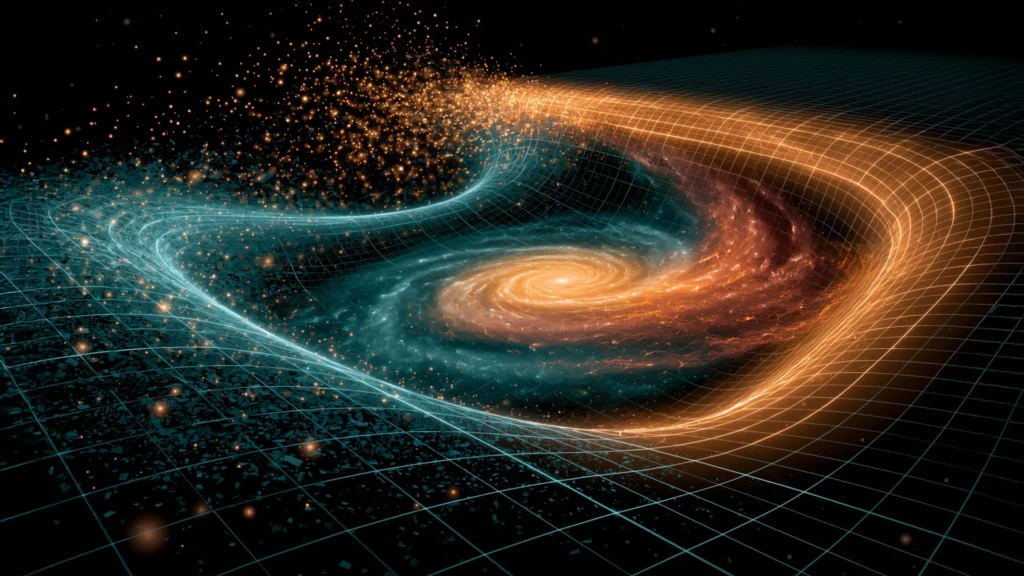
The fundamental laws of physics often appear to be in direct conflict with the observable reality of the cosmos, specifically regarding the relationship between the inevitable rise of disorder and the intricate organization of celestial bodies. For decades, a central paradox has occupied the minds of cosmologists: how the Universe, governed by the Second Law of Thermodynamics, could transition from a hot, dense, and relatively uniform state into a complex tapestry of galaxies, stars, planets, and biological life. A groundbreaking theoretical study led by Professor Ginestra Bianconi, a mathematician at Queen Mary University of London, now offers a potential resolution to this mystery. Published in the journal Physical Review D, the research explores the framework of "Gravity from Entropy" (GfE) to explain how local complexity can flourish even as the total entropy of the Universe continues its relentless climb.
The Thermodynamic Paradox of Cosmic Evolution
To understand the significance of Professor Bianconi’s work, one must first grasp the weight of the Second Law of Thermodynamics. Albert Einstein famously lauded this principle as the "premier law of all of science," asserting that it was the only physical theory of universal content which would never be overthrown. In its simplest form, the law dictates that the total entropy of an isolated system—in this case, the entire Universe—must increase over time. Entropy is frequently characterized as a measure of "disorder," but in a more technical sense, it describes the number of ways energy and information can be distributed within a system. High entropy represents a state of equilibrium where energy is spread out and no longer available to do work, while low entropy represents a state of high organization and potential.
The standard cosmological model, the Big Bang theory, suggests that the Universe began in a state of remarkably low entropy. As the Universe expanded and cooled, the Second Law required that entropy increase. However, observation reveals that the Universe has simultaneously become more structured. Gravity pulled primordial gases into stars; stars forged heavy elements; those elements coalesced into planets; and on at least one planet, chemistry evolved into the extreme complexity of life. This apparent contradiction—the simultaneous rise of total entropy and local order—is what Professor Bianconi’s research seeks to address through a radical reinterpretation of gravity itself.
Gravity as an Emergent Phenomenon
At the heart of the new study is the theory of Gravity from Entropy (GfE). Traditional Newtonian physics treats gravity as a fundamental force of attraction between masses, while Einstein’s General Relativity describes it as the curvature of spacetime caused by mass and energy. GfE, however, approaches gravity from the perspective of statistical mechanics and information theory. It posits that gravity is not a fundamental force but an "emergent" property, similar to how temperature emerges from the collective motion of trillions of molecules or how elasticity emerges from the microscopic bonds in a rubber band.
The concept of emergent gravity gained significant traction in the 1970s, following the seminal work of Jacob Bekenstein and Stephen Hawking. Their research into black hole thermodynamics revealed that black holes possess entropy proportional to their surface area rather than their volume, and that they emit radiation (Hawking Radiation). This discovery suggested a profound, underlying link between the geometry of spacetime and the laws of heat and information.
Professor Bianconi’s research builds upon this foundation by utilizing the "Quantum Geometric Relative Entropy" (QGRE). This mathematical framework describes gravity as the result of an informational "tension" between two distinct metrics: the actual physical spacetime metric and a reference metric produced by matter fields and curvature. In this view, the gravitational dynamics we observe are essentially the Universe’s way of reconciling the distribution of information across the fabric of spacetime.
The Volumetric Solution: Why Local Order Persists
The most striking finding of Bianconi’s analysis involves the relationship between entropy and the expansion of the Universe. While the Second Law remains intact—meaning the total entropy of the entire cosmic system increases—the study identifies a crucial distinction in how that entropy is distributed.
According to the GfE framework, as the Universe expands, the physical volume increases at a rate that outpaces the generation of entropy in specific regions. Bianconi’s calculations show that while total entropy grows, the amount of entropy per unit of volume (entropy density) actually decreases. This "dilution" of entropy across an ever-expanding space creates the thermodynamic "room" necessary for complexity to emerge.
"This work reveals how the Gravity from Entropy theory can tackle the challenging question to reconcile the second principle of thermodynamics with the emergence of complexity in our Universe," Professor Bianconi stated. She noted that the results suggest that the expansion of the Universe is not just a backdrop for cosmic history, but the very mechanism that allows for "cosmological irreversibility" and the eventual emergence of life. By spreading the total entropy across a larger volume, the Universe maintains low-entropy "pockets" where stars can form and biological systems can evolve without violating the fundamental laws of physics.
A New Perspective on Dark Energy and the Cosmological Constant
Beyond the entropy puzzle, Professor Bianconi’s research provides a fresh look at one of the greatest mysteries in modern science: Dark Energy. Since the late 1990s, observations of distant supernovae have shown that the expansion of the Universe is not slowing down under the pull of gravity, but is instead accelerating. This acceleration is typically attributed to a "cosmological constant" ($Lambda$) or Dark Energy, which acts as a repulsive force.
In the GfE model, the equations reproduce the successes of Einstein’s General Relativity under conditions of weak gravity and low energy. However, as the conditions become more extreme or are viewed on a truly cosmological scale, the GfE equations diverge from classical predictions. The theory naturally produces a term that mimics the effects of Dark Energy. Crucially, in this model, this energy contribution is dynamic—it changes over time rather than remaining a static constant.
The study applied these thermodynamic effects to Friedmann-Robertson-Walker (FRW) spacetimes, the standard mathematical models used to describe a homogeneous and isotropic expanding Universe. The results indicated that the emerging Dark Energy acts effectively as "internal energy" within the system, while the Quantum Geometric Relative Entropy acts as the local entropy per unit volume. This suggests that the vacuum of space itself has an inherent thermal character, with its own effective temperature and pressure derived from quantum informational states.
Chronology of Theoretical Development
The path to Professor Bianconi’s current research is marked by several key milestones in the history of physics:
- 1915: Albert Einstein publishes the General Theory of Relativity, linking gravity to the geometry of spacetime.
- 1973: Jacob Bekenstein proposes that black holes have a finite entropy, suggesting a link between gravity and information.
- 1974: Stephen Hawking calculates that black holes emit radiation, confirming the thermodynamic nature of gravitational objects.
- 1995: Physicist Ted Jacobson demonstrates that Einstein’s field equations can be derived from thermodynamic principles, treating spacetime as a medium.
- 2010: Erik Verlinde proposes "Entropic Gravity," arguing that gravity is an entropic force arising from the information content of space.
- 2024: Professor Ginestra Bianconi publishes her work in Physical Review D, providing a mathematical bridge between GfE, cosmic expansion, and the emergence of complexity.
Implications for the Future of Physics
The implications of this research extend far beyond theoretical mathematics. If gravity and spacetime are indeed thermodynamic and informational in nature, it suggests that the "Theory of Everything"—the long-sought unification of General Relativity and Quantum Mechanics—may be found in the language of information theory.
By providing a mechanism where Dark Energy is dynamic and linked to entropy, the GfE theory offers a testable alternative to the standard $Lambda$CDM (Lambda Cold Dark Matter) model. Future cosmological observations, such as those conducted by the Euclid space telescope or the James Webb Space Telescope, may be able to detect the subtle shifts in expansion rates predicted by a dynamic Dark Energy term, potentially confirming Bianconi’s theoretical framework.
Furthermore, this research provides a scientific basis for understanding the "Arrow of Time." The irreversible transition from a simple, high-density state to a complex, low-density state is driven by the thermodynamic evolution of the spacetime metric itself. It suggests that life is not an accident or a violation of physical laws, but a natural consequence of a Universe that manages its information and entropy through expansion.
While the theory remains in its early stages, it represents a significant step forward in reconciling the foundations of gravitational dynamics with the observable reality of a structured, living Universe. As researchers continue to probe the quantum state underlying Gravity from Entropy, they may finally solve the riddle of how a Universe destined for disorder could produce the breathtaking order of the cosmos.