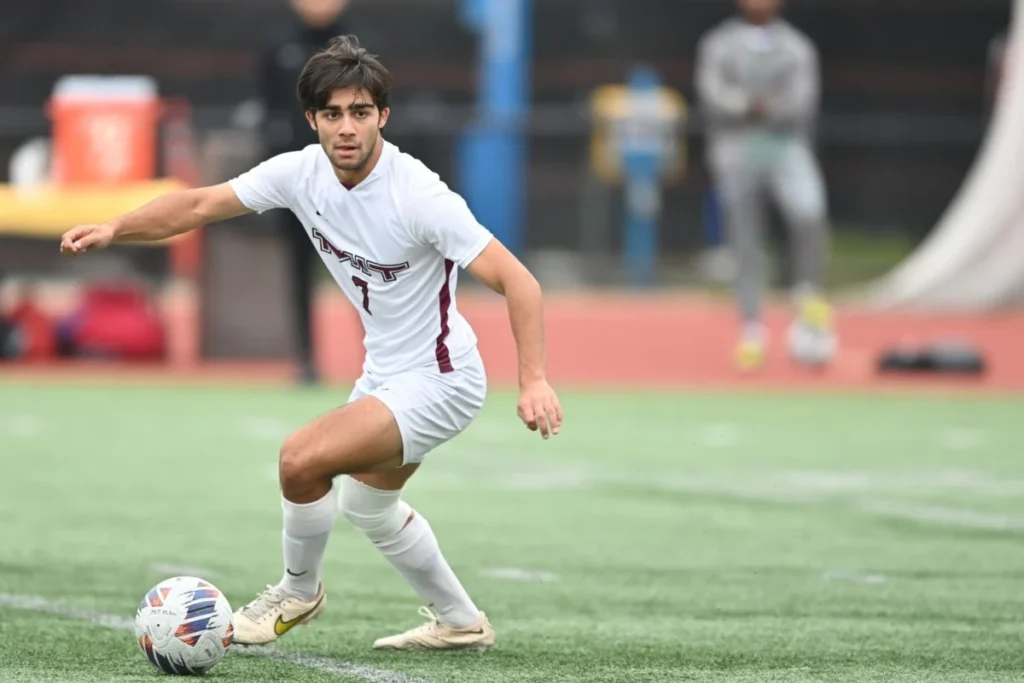
Dilin Meloni, a rising senior at the Massachusetts Institute of Technology (MIT), exemplifies the dual identity of the modern student-athlete, balancing a rigorous double major in nuclear science and physics with a leadership role on the soccer pitch and within the university’s administrative framework. A former Massachusetts Boys Soccer Player of the Year and high school All-American, Meloni’s trajectory from Needham High School to the forefront of fusion energy research and campus governance offers a unique lens into the high-pressure, high-reward environment of one of the world’s most prestigious academic institutions. Currently serving as an attacking midfielder for the MIT Engineers and a key leader in the Student Athlete Advisory Council (SAAC), Meloni is navigating the complexities of institutional change while preparing for a career in the burgeoning field of nuclear fusion.
The Path to MIT: A Convergence of Athletics and Innovation
Meloni’s journey to Cambridge was not merely a result of athletic recruitment but a calculated decision driven by a specific academic spark. While many top-tier high school athletes prioritize athletic facilities or conference prestige, Meloni’s interest was piqued by a research paper from MIT’s Plasma Science and Fusion Center (PSFC). As a junior at Needham High School, this exposure to the potential of carbon-free energy through fusion technology anchored his desire to attend MIT.
The transition from a standout high school career to the collegiate level involved a deliberate choice to pursue a Division III environment where the "student" in student-athlete is given equal, if not greater, weight. MIT, a member of the New England Women’s and Men’s Athletic Conference (NEWMAC), provides a platform where elite competition meets world-class research. For Meloni, the "Engineer" moniker of the MIT athletic teams is more than a mascot; it is a professional identity.
Academic Rigor and the Fusion Frontier
At MIT, Meloni has pursued a double major in Course 22 (Nuclear Science and Engineering) and Course 8 (Physics). This combination is widely regarded as one of the most demanding academic paths at the Institute. Nuclear science at MIT is deeply integrated with the global effort to achieve sustainable fusion power, a goal that Meloni is currently pursuing through a summer internship at Commonwealth Fusion Systems (CFS).
CFS, an MIT spin-off company, is currently working on the SPARC project—a compact, high-field fusion device designed to produce net energy. Meloni’s role within this ecosystem highlights the integration of MIT students into high-stakes industrial applications. He notes that while his academic and athletic lives often occupy separate spheres, the discipline required for one fuels the other. In the laboratory, he collaborates with diverse teams of researchers, many of whom have no background in competitive sports. This contrast allows him to act as a bridge between different subcultures within the MIT community, preventing the "siloing" that often occurs in specialized academic environments.
Leadership in the Student Athlete Advisory Council (SAAC)
Beyond the classroom and the soccer field, Meloni has taken on a significant role in student governance. His involvement with the Student Athlete Advisory Council (SAAC) began in his freshman year, prompted by his coach’s encouragement to involve younger players in the administrative process. Meloni was no stranger to governance, having served on his town’s school committee and larger Massachusetts state school committees during his high school years.
The SAAC at MIT is tasked with representing the interests of approximately 800 student-athletes across 33 varsity sports. This is one of the largest athletic programs in NCAA Division III, necessitating a sophisticated approach to representation. Meloni, alongside the SAAC co-president, implemented a proactive outreach strategy, meeting with coaches and athletes before the preseason to identify "pain points" within the athletic experience.
Key Advocacy Areas for SAAC
Under Meloni’s leadership, the SAAC has focused on several critical areas of student life:
- Facility Allocation: With 33 teams vying for space, the management of the new Sports Performance Facility and the limited turf fields is a primary concern. Meloni works to ensure that access is allocated fairly, balancing the needs of high-traffic sports like soccer and football with those of aquatic or indoor teams.
- Nutritional Standards: The quality and availability of food, particularly during the grueling preseason and late-night practice windows, has been a recurring theme in student feedback.
- Administrative Communication: A significant portion of Meloni’s role involves translating student demands into realistic requests that the Department of Athletics, Physical Education, and Recreation (DAPER) can implement. This requires an understanding of the logistical and budgetary constraints of the university.
- NCAA Legislation: The council also reviews and discusses national changes in NCAA policy, ensuring that MIT’s athletic department remains compliant while advocating for the specific needs of high-achieving academic students.
Institutional Impact and Administrative Synergy
Meloni describes the current era at MIT as a "tipping point" for student-athlete relations. Historically, varsity athletes at high-intensity academic institutions can feel marginalized or "unloved" when their schedules clash with academic requirements or when facility access is restricted by non-varsity club bookings. Meloni’s work has been instrumental in opening a more transparent channel of communication with the DAPER and Student Life staff.
Administrators have begun to view the SAAC not just as a forum for complaints, but as a valuable advisory body for broader campus issues. The willingness of the administration to overhaul certain procedures based on SAAC input suggests a growing recognition of the student-athlete’s role in the campus ecosystem. Meloni emphasizes that while perfection is unattainable, the existence of an open communication channel allows for small, incremental changes that eventually lead to systemic improvements.
Supporting Data: The MIT Athletic Landscape
To understand the scope of Meloni’s leadership, one must look at the statistics governing MIT athletics. MIT supports 33 varsity programs, which is significantly higher than the national average for Division III schools. Approximately 20% of the undergraduate population participates in varsity sports.
Furthermore, MIT student-athletes maintain a collective GPA that often rivals or exceeds the general student body, challenging the "dumb jock" stereotype. In the 2022-2023 academic year, MIT led all NCAA divisions with the most Academic All-Americans, a testament to the rigorous standards Meloni and his peers uphold. Meloni’s own path—pursuing a double major in the hardest sciences while playing a starting role on the soccer team—is a microcosm of this institutional excellence.
Broader Implications and Future Outlook
Meloni’s experience highlights a critical trend in higher education: the integration of leadership skills developed through sports into professional and academic spheres. The "attacking midfielder" mindset—defined by vision, distribution, and the ability to see the entire field—translates directly to his role in student governance and his work in nuclear physics.
As he enters his senior year, Meloni is focused on mentoring the next generation of "Engineers." He actively encourages incoming players to pursue challenging majors like nuclear science and physics, aiming to break down the perceived barriers between elite athletics and the most difficult academic tracks.
His work at Commonwealth Fusion Systems also points toward a future where the skills of the student-athlete are applied to global challenges. The discipline of the pitch and the rigor of the laboratory are, in Meloni’s view, two sides of the same coin. By finding the "middle ground" between administrative needs and student desires, he is not only improving the experience for current athletes but also setting a precedent for how student-led governance can effect change at a world-class institution.
In the final analysis, Dilin Meloni’s tenure at MIT serves as a blueprint for the modern student-athlete. It demonstrates that with the right infrastructure and a commitment to communication, it is possible to excel at the highest levels of both physical competition and scientific inquiry. As the global community looks toward fusion as a potential solution to the climate crisis, the next generation of leaders—tempered by the pressures of the field and the lab—will be those who, like Meloni, understand the value of compromise, the necessity of hard work, and the power of a clear vision.