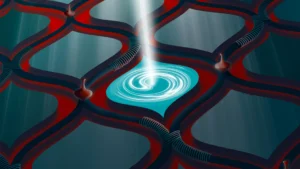
The study of quantum mechanics has long been confined to the microscopic realm, where the behavior of subatomic particles is governed by the Schrödinger equation. However, a significant experimental breakthrough submitted on July 10, 2026, has successfully bridged the gap between the quantum and classical worlds. A research team, led by Dr. Georgi Gary Rozenman, has announced the successful experimental realization of a parabolic potential barrier for surface gravity water waves. By leveraging the mathematical analogies between fluid dynamics and quantum wave functions, the team has provided a macroscopic window into the Inverted Harmonic Oscillator (IHO), an iconic scattering model in quantum physics.
This experiment marks a pivotal moment in the field of analogue physics, where classical systems are used to simulate complex quantum phenomena that are otherwise difficult to observe directly. The researchers utilized a specialized water tank environment to mimic the behavior of a quantum-mechanical wave packet encountering a potential "hill," revealing the intricate phase-space dynamics that define the boundary between transmission and reflection.
Theoretical Foundations: The Inverted Harmonic Oscillator
To understand the significance of this experiment, one must first look at the role of the Inverted Harmonic Oscillator in theoretical physics. Unlike the standard harmonic oscillator—which describes a particle trapped in a stable "well" (like a marble in a bowl)—the IHO describes a particle at the top of an unstable "hill" (a parabolic potential barrier). In quantum mechanics, this model is fundamental for understanding scattering processes, tunneling, and the decay of metastable states.
The Schrödinger equation for an IHO is mathematically identical to certain formulations of the wave equation for surface gravity water waves under specific conditions. Specifically, when water waves propagate over a varying bottom topography, the change in depth acts as a "potential." By precision-engineering a parabolic hump at the bottom of a wave tank, the researchers created a physical manifestation of the IHO potential barrier. This allowed them to observe how classical "wave packets" of water mimic the probability density functions of quantum particles.
Chronology of Analogue Physics Development
The journey toward this 2026 breakthrough began over a century ago, but accelerated significantly in the last few decades:
- 1920s: Erwin Schrödinger and other pioneers of quantum mechanics develop the fundamental equations governing wave functions. The IHO is identified as a key theoretical model for unstable systems.
- 1981: Physicist William Unruh proposes "Analogue Gravity," suggesting that sound waves in a moving fluid could mimic the behavior of light near a black hole. This opens the door for fluid dynamics to serve as a laboratory for high-energy physics.
- 2000s-2010s: Experiments with "bouncing droplets" and water wave tanks begin to demonstrate quantum-like properties, such as diffraction, interference, and even orbital quantization at a macroscopic scale.
- 2020-2025: Rapid advancements in high-speed imaging and laser-based surface sensing allow researchers to measure wave heights and momentum with unprecedented precision.
- July 10, 2026: Dr. Georgi Gary Rozenman submits the findings on the parabolic potential barrier, successfully mapping the phase-space dynamics and the "separatrix" of the IHO using surface gravity waves.
Experimental Setup and Methodology
The experiment was conducted in a highly controlled wave flume. The core of the apparatus was a meticulously machined parabolic barrier placed at the base of the tank. The researchers generated surface gravity waves in the form of wave packets—short bursts of waves with a defined average energy and momentum.
The team focused on the interaction between these packets and the peak of the parabolic barrier. In quantum mechanics, a particle’s behavior is determined by its energy relative to the height of the potential barrier. If the energy is lower than the barrier’s peak, the particle is typically reflected (though quantum tunneling allows for a small probability of passage). If the energy is higher, it is transmitted.
Using advanced optical measurement techniques, the researchers recorded the evolution of these water wave packets. They were able to plot the results in "phase space"—a coordinate system that tracks both the position and the momentum of the wave. This allowed them to identify the "separatrix," a critical boundary in the phase space that separates two distinct types of physical behavior.
Key Findings and Supporting Data
The data gathered from the experiment provided a clear visualization of the separatrix. The researchers observed two primary regimes:
- Sub-barrier Dynamics (Blocking): When the wave packets were generated with an average energy lower than the "potential" created by the parabolic barrier, the packets were effectively blocked. As they approached the barrier, their forward momentum decreased until they were reflected back toward the source. The experimental measurements showed a high degree of correlation with the predicted quantum-mechanical reflection coefficients.
- Super-barrier Dynamics (Transmission): When the wave packets possessed energy exceeding the maximum height of the parabolic potential, they successfully traversed the barrier. However, the researchers noted a distinct variation in momentum during the transit. As the packet climbed the "hill," its momentum decreased, and as it descended the other side, it accelerated—mirroring the behavior of a classical particle or a quantum wave packet passing over a potential peak.
The precision of the momentum measurements was particularly noteworthy. By analyzing the frequency shift and the envelope of the wave packets, the team quantified the momentum exchange between the wave and the underlying topography. The results demonstrated that the water waves followed the trajectories predicted by the Hamilton-Jacobi equations, which serve as the classical limit of the Schrödinger equation.
Scientific Analysis and Implications
The implications of this research extend far beyond the study of water waves. By proving that a macroscopic fluid system can accurately model the IHO, the team has provided a new tool for exploring "quantum-inspired" engineering and fundamental physics.
1. Visualization of Quantum States
One of the greatest challenges in quantum mechanics is that the wave function is a mathematical abstraction. This experiment allows students and researchers to "see" how a wave packet deforms, slows down, and splits when encountering a barrier. The visualization of the separatrix provides a tangible example of how phase-space boundaries dictate the evolution of a system.
2. Advancements in Wave Engineering
The ability to manipulate surface gravity waves using bottom topography has practical applications in coastal engineering and naval architecture. Understanding how parabolic barriers reflect or transmit wave energy could lead to more effective sea walls or harbor designs that can mitigate the impact of powerful swells by "scattering" wave energy in a controlled manner.
3. Testing Non-Linear Physics
While the current experiment focused on the linear regime (where the water waves most closely resemble the Schrödinger equation), the IHO model in water allows for the introduction of non-linear effects by increasing the wave amplitude. This could provide insights into "non-linear quantum mechanics," a field that remains largely theoretical.
Reactions from the Scientific Community
While formal peer reviews are ongoing following the July 10 submission, the initial reaction from the physics community has been one of significant interest.
"The use of surface gravity waves as an analogue for quantum scattering is an elegant demonstration of the universality of wave physics," noted a senior researcher in fluid mechanics who was not involved in the study. "Capturing the separatrix in a phase-space measurement is a technical triumph. It confirms that the underlying mathematics of the Inverted Harmonic Oscillator are not just confined to the world of the very small, but are a fundamental property of wave-matter interactions."
Dr. Rozenman’s team has highlighted that this experiment is part of a broader trend toward "benchtop physics," where complex cosmological or quantum events are simulated in a lab. This approach is significantly more cost-effective than using particle accelerators or deep-space telescopes and allows for repeatable, controlled experimentation.
Future Research Directions
Following the successful realization of the parabolic barrier, the research team plans to investigate the phenomenon of "analogue tunneling." In quantum mechanics, a particle with energy below the barrier height can occasionally pass through it—a process known as tunneling. In classical water waves, this does not typically happen unless there are specific evanescent wave couplings.
The team is also looking into the "Hawking-Peierl" effect, where the IHO model is used to describe the stability of vacuum states in expanding universes. By modulating the height of the parabolic barrier over time, they hope to simulate the "stretching" of spacetime and observe how it affects wave packet propagation.
Conclusion
The experimental realization of a parabolic potential barrier for surface gravity water waves represents a landmark achievement in the study of wave dynamics. By successfully mapping the phase-space trajectories and identifying the separatrix of an Inverted Harmonic Oscillator in a macroscopic fluid system, Dr. Georgi Gary Rozenman and his colleagues have reinforced the profound connection between classical and quantum physics.
As the scientific community continues to analyze the data from this July 2026 submission, the experiment stands as a testament to the power of analogue models. It provides a robust framework for future explorations into the most elusive corners of quantum theory, all while utilizing the familiar and observable motion of water. This work not only enriches our understanding of the Schrödinger equation but also paves the way for new innovations in how we manipulate and control wave energy in the physical world.