The landscape of cinematic creation is undergoing a profound transformation, driven by technological advancements that blur the lines between physical and digital realities. At the forefront of this revolution is virtual production, a methodology famously spearheaded by James Cameron’s groundbreaking film “Avatar.” This cinematic masterpiece not only transported audiences to the vibrant moon of Pandora but also propelled the film industry into a new era of digital craftsmanship. Today, an innovative collaboration between Emerson College and the Massachusetts Institute of Technology (MIT) is democratizing access to these cutting-edge techniques, equipping the next generation of filmmakers with the skills to navigate and shape this evolving frontier.
The Dawn of Virtual Production: From Green Screen to Real-Time Worlds
Virtual production represents a paradigm shift from traditional filmmaking, which historically relied on physical sets, locations, and extensive post-production visual effects. Before the advent of virtual production, complex visual effects sequences often involved shooting actors against green or blue screens, with digital environments painstakingly added in post-production. This method presented significant creative and logistical challenges: directors and actors had to imagine their surroundings, and creative decisions made on set often had unforeseen implications months later in the editing suite.
“Avatar,” released in 2009, was a watershed moment, showcasing the immense potential of what was then a nascent field. Its production involved pioneering technologies such as performance capture (a more advanced form of motion capture), real-time rendering, and virtual cameras that allowed director James Cameron to "shoot" scenes within a digital world as if it were a physical set. This innovation brought unprecedented immersion and creative control, allowing filmmakers to visualize and interact with their digital environments instantaneously.
Since “Avatar,” virtual production has evolved exponentially, integrating a wide array of technologies. These include massive LED virtual environments that display hyper-realistic digital backdrops in real-time, sophisticated 3D imaging, advanced game engines (like Unreal Engine and Unity) for rendering virtual worlds, and increasingly refined performance capture systems. The benefits are manifold: enhanced creative spontaneity on set, reduced need for costly and time-consuming location shoots, more predictable post-production pipelines, and a more immersive experience for actors and crew. Major productions like Disney’s “The Mandalorian,” “The Batman,” and “House of the Dragon” have further cemented virtual production’s status as an industry standard, demonstrating its versatility across genres and scales. The global virtual production market, valued at approximately $2.5 billion in 2022, is projected to grow to over $10 billion by 2030, underscoring the industry’s rapid adoption and demand for skilled professionals.
Bridging the Gap: Education Meets Innovation
Despite its growing prominence, the specialized knowledge and high-end equipment required for virtual production remain largely inaccessible to many aspiring filmmakers. This is where the pioneering efforts of individuals like Daniel Pillis SM ’24, an alumnus of the MIT Media Lab and now an assistant professor at Emerson College, become critical. Pillis recognized this educational void and sought to bridge it by leveraging the unique capabilities of the MIT.nano Immersion Lab.
Pillis’s journey began during his graduate studies in Professor Hiroshi Ishii’s Tangible Media group at the MIT Media Lab. There, he collaborated with colleague Georine Pierre SM ’24 on a groundbreaking project focused on Haitian folklore dance. This initiative utilized motion capture technology within the Immersion Lab to create a digital archive of traditional Haitian dance forms, specifically the sacred Yanvalou dance. The project culminated in an interactive, AI-driven ancestral avatar animation, allowing participants to engage with and preserve cultural heritage through cutting-edge technology. This experience not only showcased the artistic potential of motion capture but also cemented Pillis’s understanding of the Immersion Lab’s unparalleled capabilities.
Upon joining the faculty at Emerson College, renowned for its strong programs in film and media arts, Pillis immediately saw an opportunity to integrate this advanced technology into his filmmaking curriculum. “Motion capture, like that in ‘Avatar,’ bridges real human movement with digital technology,” Pillis explains. “In this digital age, and as artificial intelligence becomes more involved in film studios, technology that enables the authenticity of human expression and performance is becoming increasingly important.” His vision was to expose his students to the practical application of virtual production, moving beyond theoretical discussions to hands-on creation.
The MIT.nano Immersion Lab: A Sanctuary for Creative Exploration
At the heart of this educational initiative lies the MIT.nano Immersion Lab, a facility described by many as truly singular. Located just across the Charles River from Emerson College, the lab is a testament to MIT’s commitment to interdisciplinary innovation, extending its reach beyond traditional scientific research into the realms of art and performing arts.
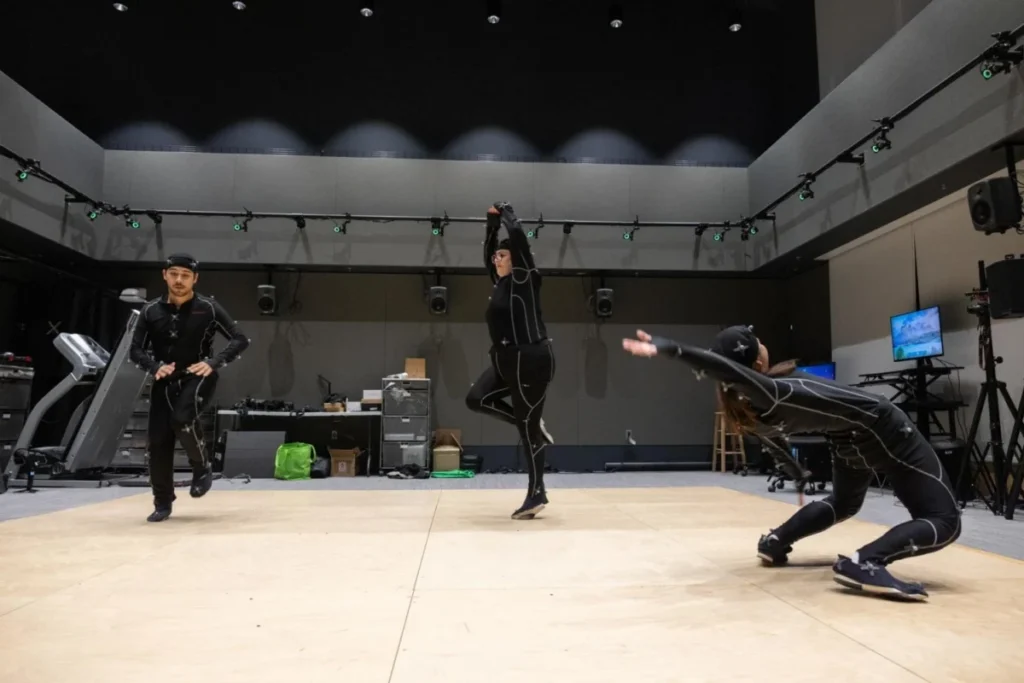
Talis Reks, who manages the MIT.nano Immersion Lab, highlights its unique positioning: “This class highlights the range of what our lab can offer, extending well beyond research and into art and the performing arts.” The lab is equipped with a state-of-the-art 28-camera OptiTrack system, capable of capturing highly precise motion data. This system works in conjunction with full-body motion-capture suits, transforming students into digital puppeteers of their own virtual characters. The data is processed in real-time, allowing students to see their animated avatars dance, fight, or even play musical instruments instantaneously on a computer screen. This immediate feedback loop is crucial for the creative process, enabling iterative adjustments and spontaneous artistic decisions.
Pillis emphasizes the lab’s significance: “The level of high-end film production that the Immersion Lab supports is out of reach for so many students who would benefit from this technology in their practice. The facility is unique, well-equipped, and even accessible to those outside of MIT — there really is nothing else like it in the Boston area.” This accessibility to professional-grade tools is a cornerstone of the Emerson-MIT collaboration, democratizing a technology that typically requires substantial investment and specialized infrastructure.
Each semester, Pillis’s filmmaking students embark on this trans-river journey, immersing themselves in the lab’s capabilities. They don the motion-capture suits, becoming their own digital avatars, experimenting with character movements, and generating animation data that forms the backbone of their final projects. Back at Emerson, they integrate this data into short films, culminating in productions that often exceed their initial expectations. Reks observes, “They really get into it. These students are not necessarily trained as actors, but the moment they see themselves as virtual characters, the realistic, granular movement enabled by motion capture, they get fully into performing.” This hands-on, experiential learning fosters not just technical proficiency but also a deep understanding of performance and storytelling in a digital context.
Cultivating Professionalism and Inspiring Future Leaders
Over the past two years, more than 60 Emerson College students have benefited from this unique partnership, gaining invaluable experience that sets them apart in a competitive industry. The impact is tangible, with student projects achieving recognition and opening doors to further opportunities.
One notable success story is Emerson undergraduate Nick Forsch, whose project, “Enter,” earned an EVVY Award nomination. The EVVYs, Emerson College’s equivalent of the Emmy Awards, celebrate student excellence in creativity, quality, and professionalism, judged by a panel of industry experts. Forsch’s film, which explored the narrative of a human transported into a digital world to encounter an artificial intelligence, was significantly elevated by his use of the Immersion Lab. “Being able to use the MIT.nano Immersion Lab really elevated my project,” Forsch states. “I was excited to submit it for an EVVY, knowing the technology behind my work was on a professional level.” This recognition underscores the professional caliber that students can achieve when given access to advanced tools and expert guidance.
Another compelling example comes from undergraduate Evan Costa, who undertook an ambitious virtual recreation of The Beatles’ iconic performance on “The Ed Sullivan Show.” Costa meticulously captured individual musician performances and reconstructed a simulated 1950s television environment, showcasing both technical prowess and creative vision. His experience in the Immersion Lab proved to be a pivotal moment, deepening his passion for virtual production. Costa’s talent and enthusiasm did not go unnoticed; he will be joining the MIT Learning Engineering and Practice Group, led by principal research scientist John Liu in the Department of Mechanical Engineering, as an intern this summer. This opportunity will allow him to continue exploring virtual production, further bridging his academic learning with cutting-edge research. “Having the opportunity to gather motion-capture data within the Immersion Lab gave me more than advanced technology for my project; it provided insight into an often-unseen world of creativity,” says Costa. “Modern storytelling exists across a wide range of mediums, from film to video games, and witnessing the inner workings of this process has deepened my passion for virtual production.”
The Broader Impact and Future Horizons
The collaboration between Emerson College and MIT, spearheaded by Daniel Pillis and supported by Talis Reks, exemplifies a forward-thinking approach to higher education. It addresses the critical need for interdisciplinary training in an era where technology and art are inextricably linked. By providing hands-on access to advanced virtual production tools, the program prepares students not just for current industry demands but for future innovations. Graduates equipped with these skills are poised to fill roles such as Virtual Production Supervisors, Real-time Technical Artists, Mocap Animators, and Immersive Content Creators, roles that are increasingly sought after across film, television, gaming, and interactive media.
The initiative also has broader implications for educational models. It demonstrates the immense value of cross-institutional partnerships, particularly when one institution possesses unique research infrastructure and the other excels in creative arts education. This synergy creates a robust learning environment that would be difficult for either institution to replicate alone. Such collaborations foster a vibrant ecosystem of innovation, turning Boston into a burgeoning hub for media technology and creative talent.
Looking ahead, Pillis and Reks are already planning to expand the curriculum. In the coming academic year, they aim to delve into even more advanced Immersion Lab technologies, incorporating facial animation, intricate hand and finger tracking, and multi-modal data capture. They also intend to explore further advancements in interactive generative motion capture, pushing the boundaries of what students can achieve and create. These plans reflect a commitment to staying at the vanguard of virtual production technology, ensuring that Emerson students continue to receive an education that is not only relevant but also anticipates the future needs of the creative industries.
In an age where digital tools are continuously reshaping how stories are told and experiences are crafted, the partnership between Emerson College and the MIT.nano Immersion Lab stands as a powerful testament to the transformative potential of collaborative education. It is not merely teaching students about virtual production; it is empowering them to become the architects of tomorrow’s cinematic and immersive worlds, ensuring that the magic behind the scenes is not just understood, but actively created.