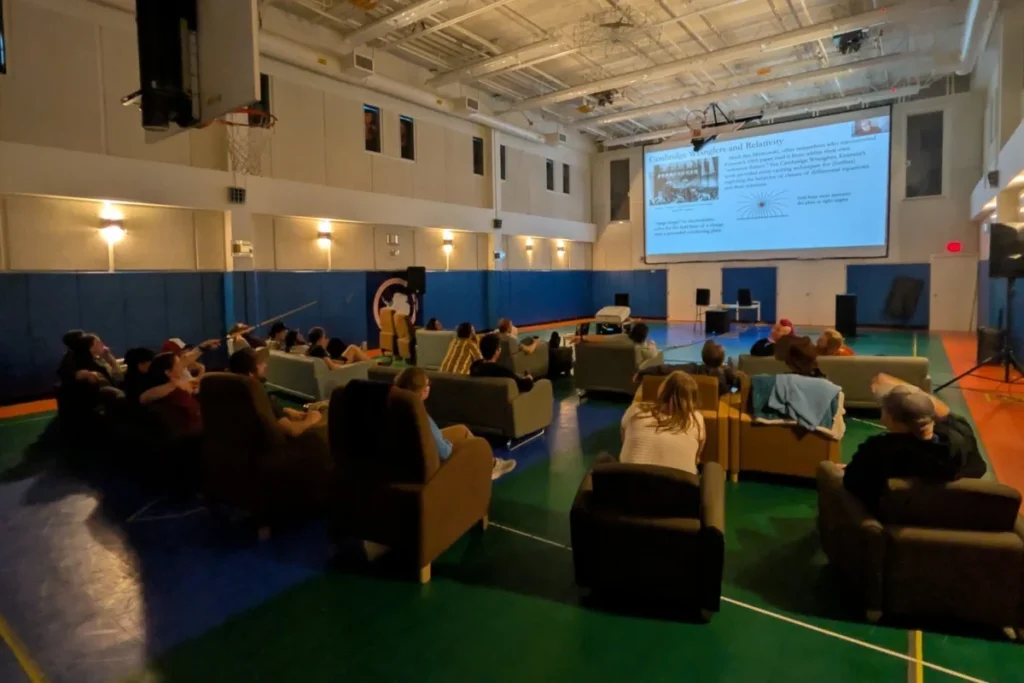
At the Amundsen–Scott South Pole Station, one of the most isolated human outposts on Earth, the pursuit of fundamental knowledge transcends the physical barriers of ice and extreme cold. John Della Costa, a dedicated researcher working on the Background Imaging of Cosmic Extragalactic Polarization (BICEP) project, has transformed the long, dark Antarctic winter into a period of intellectual communal growth. By utilizing MIT OpenCourseWare (OCW), a flagship initiative of MIT Open Learning, Della Costa and his colleagues have established "Fysics Fridays," a weekly seminar series that brings the rigorous curriculum of the Massachusetts Institute of Technology to the literal end of the world.
The centerpiece of these gatherings is the course STS.042/8.225, titled "Einstein, Oppenheimer, Feynman: Physics in the 20th Century." Taught by MIT Professor David Kaiser, the course explores the historical and theoretical evolution of modern physics. For the BICEP team, the course is more than just academic enrichment; it is a vital link to the scientific heritage that informs their current groundbreaking research into the origins of the universe.
The BICEP Collaboration and the Quest for Cosmic Inflation
The BICEP project represents one of the most ambitious endeavors in modern observational cosmology. Operating from the Dark Sector Lab at the South Pole, the collaboration utilizes a series of sophisticated radio telescopes to scan the heavens for the Cosmic Microwave Background (CMB). The CMB is the "afterglow" of the Big Bang, consisting of the oldest light in the universe, emitted approximately 380,000 years after the initial expansion.
The primary objective of the BICEP team is to detect B-mode polarization patterns in the CMB. These patterns are theorized to be the "smoking gun" evidence of primordial gravitational waves—ripples in the fabric of spacetime created during the epoch of cosmic inflation. Cosmic inflation, a theory pioneered by MIT Professor Alan Guth in 1980, suggests that the universe underwent an exponential expansion in the first trillionth of a trillionth of a trillionth of a second.
While inflation explains why the universe appears uniform and flat on a large scale, definitive empirical evidence remains the "holy grail" of cosmology. Della Costa emphasizes the significance of this work, noting that while inflation is essential for making sense of current observations, the BICEP team is specifically tasked with finding the gravitational wave signatures that would prove the theory beyond a doubt. The South Pole is the ideal location for this research due to its extremely dry, stable, and thin atmosphere, which minimizes interference with the sensitive radio signals from deep space.
The Genesis of Fysics Fridays
The initiative to bring MIT-level education to the Antarctic ice began with Della Costa’s own history with digital learning. As a graduate student at San Diego State University, Della Costa found his academic path altered by the COVID-19 pandemic. With traditional schedules disrupted, he turned to MIT OpenCourseWare to supplement his astrophysics studies. His first foray into the platform was course 22.01, "Introduction to Nuclear Engineering and Ionizing Radiation," taught by Professor Michael Short.
The high quality and accessibility of the materials left a lasting impression. When Della Costa prepared for his current deployment—a grueling stint that includes a full "winter-over" from November 2025 to December 2026—he recognized the need for structured mental stimulation. Life at the South Pole station is characterized by extreme isolation. Once the station "closes" in mid-February, no planes can fly in or out for nearly nine months because temperatures drop so low that aircraft fuel can jellify and hydraulic systems fail.
Given the severely limited internet bandwidth at the station, which relies on a few aging satellites for brief windows of connectivity, Della Costa took the proactive step of downloading several entire courses before his departure. His digital library included foundational physics courses like 8.02 (Electricity and Magnetism) and 8.03 (Vibrations and Waves), as well as Professor Guth’s 8.286 (The Early Universe).
Upon arriving, Della Costa realized that his personal study habits could benefit the broader station community. The South Pole station houses approximately 45 people during the winter months, ranging from specialized scientists and engineers to cooks, electricians, and support staff. To foster community and combat the psychological toll of the "winter-over" syndrome—a condition marked by irritability and cognitive fatigue due to prolonged darkness and confinement—he launched "Fysics Fridays."
Bridging History and Science: The Role of David Kaiser
The selection of "Einstein, Oppenheimer, Feynman" for the Friday series was strategic. Unlike purely mathematical physics courses, STS.042/8.225 integrates the technical aspects of 20th-century breakthroughs with the historical, social, and philosophical contexts that shaped them. This multidisciplinary approach makes the content accessible to non-physicists on the station while remaining "meaty" enough for the researchers.
Professor David Kaiser, who co-directs a research group on early-universe cosmology with Alan Guth, was deeply moved to learn that his lectures were being viewed at the South Pole. Kaiser’s course itself was a product of the same pandemic-era shifts that led Della Costa to OCW. Originally an in-person seminar, Kaiser adapted the course for a global remote audience in the fall of 2020, eventually refining it for a permanent home on the OpenCourseWare platform in 2022.
The course tracks the trajectory of physics from the classical era of the mid-19th century through the revolutions of relativity and quantum mechanics, eventually culminating in modern cosmology—the very field Della Costa is currently advancing. Kaiser noted that receiving an email from the South Pole was a highlight of his career, acknowledging the "enormous effort and dedication" required to conduct research in such a harsh environment.
Community Building Through Experimental Science
The "Fysics Fridays" sessions have evolved beyond mere video screenings. To deepen the engagement, the team has begun performing physical experiments to accompany the lectures. They have successfully conducted the double-slit experiment, a cornerstone of quantum mechanics that demonstrates the wave-particle duality of light. There are also plans to construct a cloud chamber, a particle detector used to visualize the passage of ionizing radiation, such as cosmic rays, through the station.
These activities serve a dual purpose: they provide a structured social outlet and democratize the high-level science happening at the station. By involving support staff in the intellectual life of the base, Della Costa is helping to maintain morale and a sense of shared mission.
Broader Implications and Official Responses
The success of this initiative has sparked a new connection between the Antarctic research community and MIT. In response to Della Costa’s outreach, Professor Kaiser has arranged to provide a special Zoom colloquium for the South Pole station residents, providing a rare opportunity for live interaction between the researchers on the ice and the faculty in Cambridge.
This collaboration highlights the growing importance of Open Educational Resources (OER) in supporting scientific advancement in remote areas. MIT OpenCourseWare, which has reached over 500 million visitors since its inception in 2001, serves as a critical infrastructure for the global scientific community.
The BICEP project’s work, supported by institutions like the National Science Foundation (NSF), Harvard, Caltech, and Stanford, represents the "front line" of human knowledge. The fact that these researchers are simultaneously looking back at the history of their field via MIT’s open platforms underscores a unique synergy between education and exploration.
Chronology of Key Events
- 2001: MIT launches OpenCourseWare, making its entire curriculum available for free online.
- 1980s-Present: The theory of Cosmic Inflation is developed and refined by Alan Guth and colleagues.
- Fall 2020: COVID-19 forces Professor David Kaiser to adapt STS.042 for remote learning.
- August 2022: The refined version of "Einstein, Oppenheimer, Feynman" is officially launched on MIT OCW.
- Early 2024: John Della Costa arrives at the South Pole and initiates "Fysics Fridays" using pre-downloaded MIT materials.
- February 14, 2024: The South Pole station officially "closes" for the winter, beginning the period of total isolation.
- Late 2024: Professor Kaiser and Della Costa establish contact, leading to plans for a live virtual colloquium.
- November 2025: Della Costa is scheduled to begin a full-year winter-over deployment through December 2026.
Analysis: The Democratization of Discovery
The intersection of the BICEP project and MIT OpenCourseWare at the South Pole is a testament to the power of open-access education. In the 20th century, the specialized knowledge required for polar research was confined to those with physical access to elite libraries and universities. In the 21st century, a researcher at the most remote point on the planet can access the same lectures as a student sitting in a classroom in Cambridge, Massachusetts.
This case study also emphasizes the "human element" of big science. While the BICEP telescopes are marvels of engineering, the success of the mission depends on the psychological resilience of the human beings operating them. Initiatives like "Fysics Fridays" demonstrate that intellectual curiosity is not just a professional requirement for scientists, but a fundamental tool for human connection and mental well-being in the face of extreme adversity.
As the BICEP team continues to scan the cosmic horizon for the echoes of the Big Bang, they do so with the support of a global educational network that ensures no researcher, no matter how far they travel, is ever truly isolated from the community of knowledge.