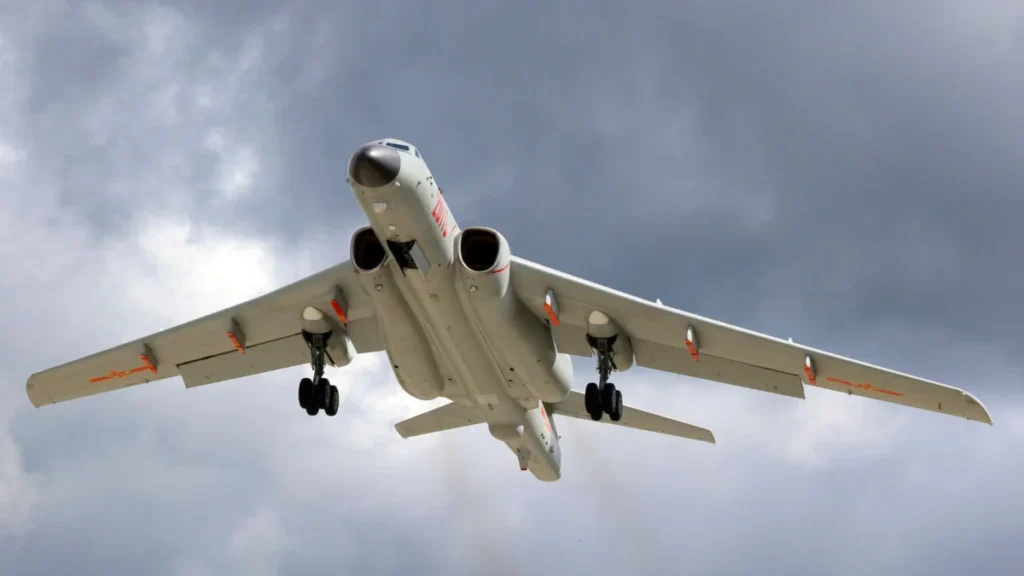
Recent developments in China’s strategic military capabilities have brought its H-6N strategic bomber into sharper focus, with new footage confirming the aircraft’s integration of the nuclear-capable Jing Lei-1 (JL-1) air-launched ballistic missile (ALBM). This pairing marks a pivotal advancement, providing Beijing with a robust airborne nuclear strike option that complements its existing land-based intercontinental ballistic missiles (ICBMs) and submarine-launched ballistic missiles (SLBMs), thereby solidifying its nuclear triad. The H-6N, a heavily modified variant of the long-serving H-6 strategic bomber, itself derived from the Soviet Tu-16, represents a strategic leap designed specifically to carry oversized weapons externally. With its reported combat radius of over 2,175 miles, augmented by aerial refueling capabilities, the H-6N significantly enhances China’s flexibility in a retaliatory nuclear scenario and potentially extends its strategic reach far beyond the confines of the Western Pacific, projecting influence globally.
The Evolution of China’s Strategic Air Power: The H-6 Legacy
The H-6 bomber has served as the backbone of China’s strategic air force for more than six decades, a testament to its adaptability and continuous modernization. Its origins trace back to the Soviet Union’s Tu-16 "Badger" bomber. In 1957, following an agreement with Moscow, China commenced licensed production of the aircraft, with the first Chinese-assembled Tu-16 making its maiden flight in 1959. This early period of cooperation was crucial for laying the groundwork of China’s indigenous aerospace industry.
However, the geopolitical landscape shifted dramatically with the Sino-Soviet split in the early 1960s. This ideological and political schism forced China to pursue independent development and production of its strategic assets, including the H-6 program, without Soviet assistance. Despite the formidable challenges of operating in isolation, Chinese engineers and scientists persevered, leading to the maiden flight of the first fully domestically produced H-6 in December 1968. This milestone underscored China’s determination to forge its own path in military aviation.
Over the ensuing decades, more than 230 H-6 aircraft have reportedly been produced, evolving through numerous versions tailored for diverse missions. Early variants were primarily configured for conventional bombing, but later iterations saw specialized roles emerge. For instance, the contemporary H-6K and naval H-6J variants are primarily designed as conventional strike platforms, capable of carrying a wide array of precision-guided munitions and cruise missiles. These aircraft play a critical role in power projection within the Asia-Pacific region, often featuring upgraded avionics, improved engines, and advanced electronic warfare systems. The H-6K, for example, is known for its extended range and ability to carry six YJ-12 anti-ship cruise missiles or CJ-10 cruise missiles, significantly boosting China’s stand-off strike capabilities. The naval H-6J variant further enhances maritime strike operations, designed to target surface vessels.
The H-6N, however, represents a departure from these conventional roles, embodying a very different strategic requirement. It is purpose-built to carry large, nuclear-capable air-launched ballistic missiles, a capability that effectively restores and significantly upgrades the airborne component of China’s nuclear triad. This strategic shift reflects a broader modernization effort aimed at ensuring the survivability and credibility of China’s nuclear deterrent.
Key Design Modifications for the H-6N
The H-6N distinguishes itself from earlier H-6 variants through several critical design modifications, all geared towards its specialized mission. Most notably, its traditional internal bomb bay has been either removed entirely or substantially reconfigured. In its place, the fuselage incorporates a recessed area underneath the aircraft. This design change is crucial, as it allows the H-6N to accommodate oversized external weapons, specifically the JL-1 ALBM, which is considerably larger than the conventional cruise missiles carried by other H-6 variants. This external carriage method is similar in concept to how some other strategic bombers carry large, specialized munitions.
Another significant enhancement to the H-6N is the inclusion of a nose-mounted aerial refueling probe. This feature enables the bomber to refuel from China’s domestically developed YY-20A tanker aircraft, a derivative of the Y-20 transport plane. The addition of aerial refueling dramatically extends the H-6N’s operational range and combat radius, mitigating one of the primary limitations of what is fundamentally a relatively old airframe design. While the H-6 platform has seen continuous upgrades, its fundamental aerodynamic design dates back to the 1950s. Aerial refueling transforms its operational envelope, allowing for longer patrols, deeper penetration into enemy airspace, and greater loitering capabilities, thereby increasing its strategic utility.
These modifications underscore a focused effort by the People’s Liberation Army Air Force (PLAAF) to adapt existing platforms to meet emerging strategic requirements, rather than solely relying on the development of entirely new, more expensive bomber designs. The H-6N’s unique configuration and capabilities position it as a critical asset in China’s evolving nuclear posture.
The JL-1 Air-Launched Ballistic Missile: A New Dimension to Deterrence
The Jing Lei-1 (JL-1) is the centerpiece of the H-6N’s strategic capability, adding a potent new layer to China’s nuclear deterrence. This air-launched ballistic missile is understood to be derived, at least in part, from China’s well-established DF-21 medium-range ballistic missile family. The DF-21, known for its land-based conventional and anti-ship variants, provides a proven technological foundation for the ALBM. The JL-1 is designed to be launched from the bomber at high altitude, rather than from a fixed or mobile ground launcher, offering distinct advantages in terms of launch flexibility and survivability.
While publicly available information about the JL-1 remains limited, reports have placed its maximum range at an impressive 5,000 miles (approximately 8,000 kilometers). This substantial range, combined with the H-6N’s own combat radius of more than 2,175 miles (approximately 3,500 kilometers) and its aerial refueling capability, creates a formidable intercontinental strike option for China. The effective operational range of the H-6N/JL-1 system would depend on various factors, including the mission’s flight profile, payload, and the extent of tanker support, but the potential for extended reach is clear.
The strategic value of an ALBM like the JL-1 lies in several key areas. Firstly, it enhances the survivability of China’s nuclear deterrent. A mobile, air-launched system is inherently more difficult to track and target than fixed land-based silos or even mobile ground launchers, which can be vulnerable during pre-launch preparations. Secondly, it provides increased targeting flexibility. The H-6N can be deployed to various operational areas, launching its missile from unexpected vectors, complicating adversary missile defense systems. Thirdly, ALBMs offer a distinct advantage in terms of launch speed and trajectory compared to air-launched cruise missiles. Ballistic missiles typically follow a faster, higher-altitude trajectory, making them harder to intercept in the boost phase and allowing for shorter flight times to target. This combination of speed, range, and evasiveness adds significant credibility to China’s second-strike capability.
China’s Evolving Nuclear Doctrine and Triad
The integration of the H-6N and JL-1 missile is a critical step in the ongoing modernization and expansion of China’s nuclear forces, particularly in solidifying its nuclear triad. A nuclear triad, consisting of land-based ICBMs, submarine-launched ballistic missiles (SLBMs), and strategic bombers capable of delivering nuclear weapons, is considered the gold standard for nuclear powers. The primary rationale behind maintaining a triad is to enhance the survivability and credibility of a nation’s nuclear deterrent by ensuring that at least one leg of the triad would survive a first strike and be capable of launching a retaliatory attack. This "second-strike capability" is paramount for deterrence, as it assures a potential aggressor that any nuclear attack would result in unacceptable retaliation.
Historically, China’s nuclear doctrine has been based on a "No First Use" (NFU) policy, pledging not to be the first to use nuclear weapons in a conflict. This policy, while officially maintained, is continuously underpinned by investments in its nuclear arsenal to ensure a credible retaliatory capability. The H-6N/JL-1 system fits directly into this framework by bolstering China’s ability to deliver a devastating second strike, thereby reinforcing its NFU posture through enhanced deterrence.
China’s land-based ICBMs, primarily the DF-31, DF-41, and older DF-5 series, form the core of its nuclear deterrent. These missiles are deployed in silos and on mobile launchers, offering a mix of survivability and rapid deployment. The naval leg of the triad consists of Type 094 Jin-class nuclear-powered ballistic missile submarines (SSBNs), which carry JL-2 SLBMs. These submarines provide a highly survivable, stealthy platform for nuclear retaliation, capable of operating undetected for extended periods in international waters. The re-establishment and enhancement of a credible airborne leg with the H-6N/JL-1 system complete this triad, offering a diverse and resilient set of options for nuclear deterrence.
Recent estimates, such as those from the Stockholm International Peace Research Institute (SIPRI) and other reputable defense intelligence organizations, indicate that China’s nuclear arsenal is undergoing significant expansion. While precise numbers are often subject to estimation, it is reported that China possesses approximately 20 H-6Ns in service, with a corresponding number of nuclear warheads potentially assigned to this force. This expansion is part of a broader trend where China is increasing the size and sophistication of its nuclear inventory, moving away from a historically smaller, "minimum deterrence" posture towards a more comprehensive and diversified arsenal.
Strategic Implications and Regional Dynamics
The integration of the H-6N and JL-1 missile carries profound strategic implications, both regionally and globally. For China, it significantly enhances the credibility and flexibility of its nuclear deterrent. The ability to launch a nuclear ballistic missile from an airborne platform introduces an additional layer of complexity for any adversary contemplating a first strike, as it complicates targeting and increases the uncertainty of successful pre-emption. This strengthened deterrence posture is likely viewed by Beijing as essential for safeguarding its national security interests and maintaining strategic stability in an increasingly complex geopolitical environment.
Regionally, the development is likely to be met with concern by neighboring countries and major powers. Nations such as Japan, South Korea, Taiwan, India, and Australia, as well as the United States, will closely monitor the operational deployment and capabilities of the H-6N/JL-1 system. The extended reach provided by this combination means that more targets across the Indo-Pacific region, and potentially beyond, fall within China’s strategic strike envelope. This could lead to a reassessment of defense postures, investments in missile defense systems, and potentially contribute to an acceleration of regional arms races as countries seek to counter perceived threats.
For the United States, the H-6N/JL-1 system represents a direct challenge to its strategic superiority and complicates its defense planning in the Pacific. While the U.S. maintains a robust nuclear triad with advanced strategic bombers like the B-52, B-2, and the forthcoming B-21 Raider, the proliferation of sophisticated nuclear delivery systems by China necessitates constant vigilance and adaptation. The H-6N, though based on an older design, has been continuously upgraded and optimized for its role, making it a viable component of China’s strategic force.
Globally, the expansion of China’s nuclear capabilities, particularly the operationalization of an airborne ballistic missile launch platform, contributes to a shifting balance of power. It places China firmly alongside the United States and Russia as a major nuclear power with a fully functional and diversified nuclear triad. This development inevitably raises questions about global strategic stability and the future of arms control. While China has historically resisted engaging in bilateral arms control treaties, the increasing sophistication and size of its arsenal may exert pressure for greater transparency and dialogue on strategic stability issues.
Expert Analysis and International Reactions
Military analysts and defense observers worldwide have largely acknowledged the H-6N/JL-1 combination as a significant strategic advancement for China. Analysts like Dr. Jeffrey Lewis from the Middlebury Institute of International Studies have noted that such developments underscore China’s commitment to building a robust and survivable nuclear force, moving beyond a "minimum deterrence" posture. They emphasize that an airborne leg enhances the survivability of China’s nuclear arsenal by providing a mobile platform that can be dispersed and launched from various locations, making it harder for an adversary to neutralize in a first strike.
Furthermore, the operational flexibility offered by the H-6N’s aerial refueling capability means that China could project its strategic bomber force to areas further afield, potentially increasing its influence in regions like the Indian Ocean or even parts of the Arctic, depending on operational profiles and tanker support. This capability complicates defensive planning for potential adversaries and adds to the overall deterrent effect.
While Beijing has not issued specific official statements regarding the H-6N’s role in its nuclear triad beyond general declarations about national defense, its actions speak volumes. The consistent showcasing of these capabilities through state media footage and military exercises sends a clear message about China’s growing military might and its determination to protect its national interests. International observers interpret this development as a strategic move to ensure China possesses a credible and resilient nuclear retaliatory capability, aligning with its broader goal of achieving "great power" status on the global stage. Concerns from Western nations, particularly the United States, often revolve around the lack of transparency in China’s nuclear buildup and the potential for miscalculation in an increasingly tense geopolitical environment.
Conclusion
The integration of the Jing Lei-1 air-launched ballistic missile onto the H-6N strategic bomber represents a crucial milestone in China’s ongoing military modernization. By completing its nuclear triad with a sophisticated airborne component, China significantly bolsters its second-strike capability, enhances the survivability of its nuclear deterrent, and projects its strategic reach further than ever before. This development reinforces China’s position as a formidable nuclear power, impacting regional power balances and contributing to the evolving dynamics of global strategic stability. As China continues to expand and refine its nuclear arsenal, the H-6N/JL-1 system will undoubtedly remain a key element in its strategic calculus, warranting close observation and analysis from the international community.