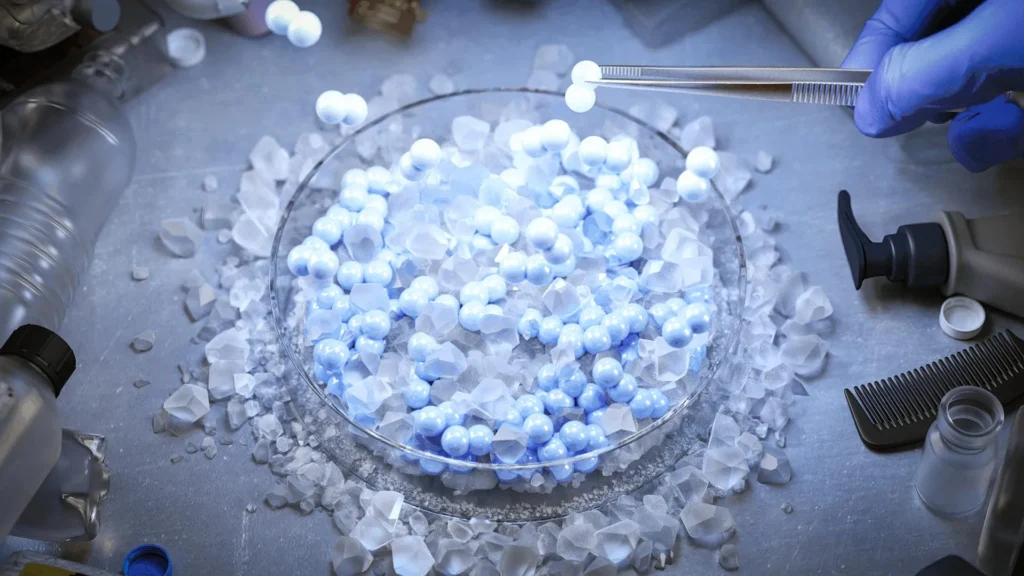
The global plastic crisis has reached a critical juncture, with synthetic polymers permeating every facet of modern existence, from the fundamental infrastructure of healthcare to the consumer goods that drive the global economy. However, the very durability that makes plastic an ideal material for water bottles, vehicle components, and packaging also renders it an environmental catastrophe once it enters the waste stream. Conventional recycling infrastructure is currently ill-equipped to handle the sheer volume and complexity of discarded materials, leading to a systemic failure in waste management. In a landmark development that addresses this dual challenge of waste accumulation and the need for sustainable energy, researchers from the UCLA Samueli School of Engineering and Ewha Womans University in South Korea have unveiled a chemical process capable of converting mixed plastic waste into high-purity hydrogen fuel while simultaneously capturing carbon emissions in solid form.
The Staggering Reality of Global Plastic Waste
To understand the significance of this breakthrough, one must look at the current state of global plastic management. Current data suggests that humanity produces over 400 million tonnes of plastic waste annually. Despite decades of public awareness campaigns and the implementation of curbside recycling programs, the efficiency of these systems remains remarkably low. Statistics indicate that a mere 9% of all plastic ever produced has been recycled. The vast majority—approximately 79%—ends up in landfills or as litter in the natural environment, where it can take centuries to decompose, often breaking down into microplastics that infiltrate the food chain.
The remaining 12% is typically incinerated. While incineration reduces the physical volume of waste, it introduces a secondary environmental hazard: the release of massive quantities of carbon dioxide and potentially toxic byproducts into the atmosphere. The primary barrier to improving these numbers is the complexity of sorting. Most consumer products are composed of a mix of different plastics—such as polyethylene terephthalate (PET), polyethylene (PE), and polypropylene (PP)—which must be meticulously separated before they can be processed by conventional mechanical recycling methods. This sorting process is labor-intensive, expensive, and often renders recycling economically unviable compared to the production of "virgin" plastic from fossil fuels.
A Paradigm Shift: Alkaline Thermal Treatment
The research team, co-led by Ah-Hyung "Alissa" Park, the Ronald and Valerie Sugar Dean of UCLA Samueli, and Woo-Jae Kim, a professor at Ewha Womans University, has pioneered a method that bypasses the sorting bottleneck entirely. Their findings, published in the Proceedings of the National Academy of Sciences (PNAS), utilize a technique known as alkaline thermal treatment (ATT).
Unlike traditional gasification, which requires extreme temperatures often exceeding 1,000 degrees Celsius to break molecular bonds, the ATT process operates at significantly lower thermal thresholds. By introducing sodium hydroxide (a common alkaline compound) to the plastic mixture under controlled heat, the researchers triggered a series of chemical reactions that liberated hydrogen gas. The most striking result of the study was the purity of the output; the process yielded hydrogen that was more than 90% pure, a level of quality that is essential for use in hydrogen fuel cells and other clean energy applications.
Chronology of Development: From Seaweed to Synthetic Polymers
The evolution of this technology did not begin with plastic. The intellectual framework for the process was originally established by Professors Park and Kim as a method for extracting energy from biomass. In their earlier research, they successfully demonstrated that alkaline thermal treatment could be used to produce hydrogen from organic matter such as seaweed in a carbon-neutral manner.
Recognizing the chemical similarities between the long-chain hydrocarbons found in biomass and those in synthetic plastics, the team began adapting the ATT process for the waste management sector. The transition required a series of iterative laboratory tests to determine how different types of plastic would react under alkaline conditions.
- Initial Testing (PET Focus): The researchers first discovered that PET, commonly used in beverage bottles, responded exceptionally well to ATT. It produced high yields of hydrogen at temperatures 300 to 400 degrees Celsius lower than those required for steam gasification.
- The Polyolefin Challenge: However, the team encountered an obstacle when processing polyethylene (PE) and polypropylene (PP). These plastics, known as polyolefins, are composed of robust carbon-hydrogen bonds that are notoriously resistant to chemical breakdown.
- The Pretreatment Breakthrough: To solve this, the researchers developed a "thermal oxidation" step. By briefly heating the plastics in the presence of air at mild temperatures before the main reaction, they were able to introduce oxygen-containing functional groups into the polymer chains.
- Integration: This activation step rendered the previously "inert" plastics reactive, allowing the entire mixture—PET, PE, and PP—to be processed simultaneously in a single reactor without prior sorting.
Solving the Carbon Dilemma through Mineralization
One of the most profound implications of this research is its approach to carbon management. In traditional waste-to-energy processes, the carbon content of the plastic is lost to the atmosphere as CO2. The UCLA-Ewha method effectively "traps" the carbon within the system.
During the reaction, the sodium hydroxide reacts with the carbon released from the plastics to form sodium carbonate (a solid salt). The researchers’ analysis confirmed that more than 75% of the carbon originally present in the plastic waste was successfully sequestered into stable carbonate compounds or liquid organic residues. Less than 13% of the carbon entered the gas phase, and the amount of CO2 released directly into the atmosphere during the reaction was negligible.
Furthermore, the process allows for the conversion of sodium carbonate into calcium carbonate through a secondary recovery cycle. Calcium carbonate is a stable mineral with high industrial value, frequently used in the production of cement, paper, and pharmaceuticals. By turning waste carbon into a usable mineral, the process supports a "circular economy" where the byproducts of one industry become the raw materials for another.
Comparative Analysis: ATT vs. Existing Technologies
The researchers have positioned ATT as a superior alternative to other emerging low-temperature recycling methods. For instance, solar-driven photoreforming and electrochemical conversion have shown promise in laboratory settings, but they are generally limited to oxygen-containing plastics like PET. This limitation excludes PE and PP, which constitute the largest portion of the global plastic waste stream.
While high-temperature gasification can handle mixed plastics, its energy intensity and high carbon footprint make it an environmentally expensive solution. The ATT method bridges this gap by offering a low-energy, mixed-plastic solution that achieves carbon sequestration.
"We are solving two urgent global problems at the same time," Dean Ah-Hyung Park stated regarding the study’s impact. "Plastic waste is accumulating at alarming rates, and clean hydrogen is essential for decarbonizing energy. This technology tackles both of these challenges in a creative and scalable way."
Economic and Industrial Implications
The economic potential of this technology lies in its ability to reduce the "green premium"—the additional cost associated with choosing a clean technology over a fossil-fuel-based one. By eliminating the need for expensive sorting and operating at lower temperatures, the ATT process could significantly lower the operational costs of hydrogen production.
Industry analysts suggest that if this technology can be scaled, it could provide a decentralized source of hydrogen fuel for local transport fleets or industrial plants, using the very waste generated by the surrounding community. This would reduce the logistical costs of transporting hydrogen, which currently remains one of the primary hurdles to the widespread adoption of the "hydrogen economy."
Furthermore, the production of calcium carbonate as a byproduct offers an additional revenue stream. The global market for calcium carbonate is valued at several billion dollars, and a source of the mineral that also serves as a carbon sink would be highly attractive to companies looking to meet Environmental, Social, and Governance (ESG) targets.
Future Outlook and Path to Commercialization
Despite the success of the laboratory trials, the transition from a university setting to industrial-scale application requires further rigorous testing. The research team has indicated that the next phase of their work will focus on optimizing the thermal oxidation pretreatment to make it even more energy-efficient. Additionally, they must determine the long-term durability of the reactors and the economics of the sodium hydroxide recovery cycle at a massive scale.
The study received support from the National Research Foundation of Korea and involved a multi-disciplinary team of experts from several institutions, including Korea Aerospace University, Kangwon National University, and Sogang University. This collaborative effort underscores the global nature of the plastic crisis and the international commitment required to solve it.
Professor Woo-Jae Kim emphasized that by reducing process complexity—a major barrier to commercialization—this technology has the potential to become a "next-generation core technology." As nations strive to reach net-zero emissions by mid-century, innovations like alkaline thermal treatment provide a vital roadmap for transforming environmental liabilities into sustainable assets. While the road to widespread deployment remains long, the ability to turn a discarded plastic bottle into clean fuel and stable minerals represents a significant leap forward in the quest for a truly circular and decarbonized global economy.