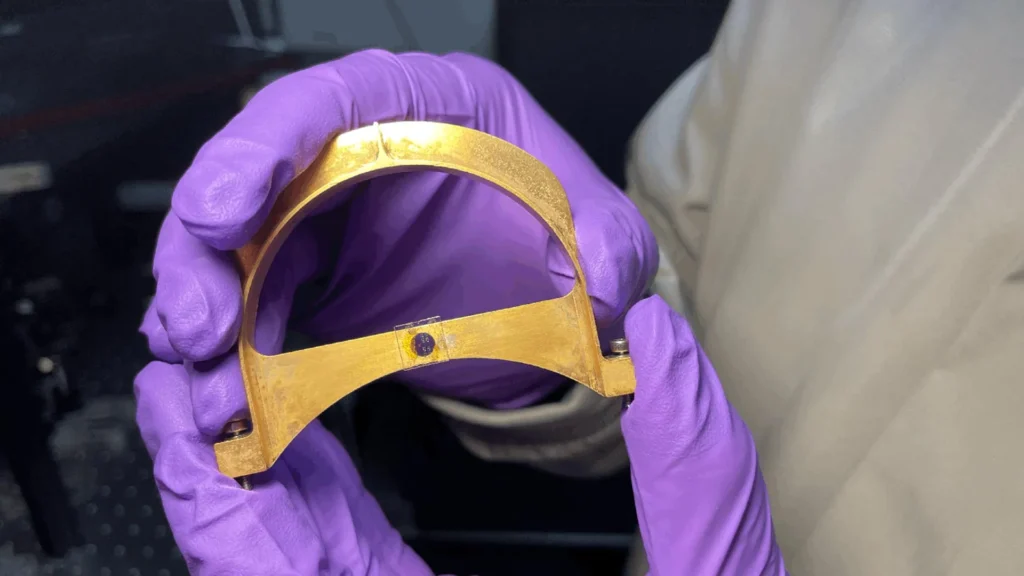
A groundbreaking development from Stanford University promises to revolutionize the notoriously challenging field of quantum computing and communication. Researchers have engineered a nanoscale optical device that functions effectively at room temperature, a significant departure from the ultra-cold environments currently required for most quantum systems. This innovative device establishes a quantum link between light and electrons, a fundamental prerequisite for the next generation of quantum technologies, particularly those focused on transmitting information over long distances. The advance could dramatically reduce the cost and complexity associated with quantum infrastructure, moving it from specialized, cryogenically cooled laboratories towards more practical and widespread applications.
The Cryogenic Conundrum of Quantum Computing
Quantum computers today are synonymous with extreme conditions. The vast majority operate at temperatures near absolute zero, hovering around -459 degrees Fahrenheit (approximately 0.01 Kelvin). This frigid environment is not merely a preference but a necessity, serving as a shield against the phenomenon known as "decoherence." Decoherence occurs when the fragile quantum states, which underpin the processing and storage of information in qubits (quantum bits), interact with their environment, causing them to lose their quantum properties and revert to classical states. Maintaining these delicate quantum states, such as superposition (where a qubit can be both 0 and 1 simultaneously) and entanglement (where two or more qubits become linked, sharing the same fate regardless of distance), is paramount for quantum computation and communication.
The engineering challenges and operational expenses associated with these cryogenic requirements are immense. Dilution refrigerators, often towering several feet high, are complex machines that utilize mixtures of helium-3 and helium-4 isotopes to achieve millikelvin temperatures. These systems are costly to acquire, operate, and maintain, consuming substantial energy and requiring highly specialized infrastructure. This reliance on extreme cold has severely limited the scalability, portability, and widespread deployment of quantum technologies, confining them largely to university research labs and well-funded corporate R&D divisions. Overcoming this fundamental hurdle has been a central focus for quantum researchers globally, with various approaches being explored to achieve quantum coherence at higher temperatures.
Stanford’s Ambient-Temperature Quantum Bridge
Now, a team at Stanford University, led by Professor Jennifer Dionne of materials science and engineering and Dr. Feng Pan, a postdoctoral scholar in her lab, has published their findings in Nature Communications, detailing a novel solution. Their nanoscale optical device bypasses the need for cryogenic cooling by establishing a stable quantum connection between photons (particles of light) and electrons at standard room temperatures. This breakthrough is not achieved through a fundamentally new material but rather a sophisticated new application of existing ones.
"The material in question is not really new, but the way we use it is," explains Jennifer Dionne, the senior author of the study. "It provides a very versatile, stable spin connection between electrons and photons that is the theoretical basis of quantum communication. Typically, however, the electrons lose their spin too quickly to be useful." The key innovation lies in the device’s architecture and the precise manipulation of light to stabilize these quantum interactions. This capability to entangle photons and electrons, crucial for robust quantum information transfer, at ambient conditions marks a significant leap forward.
The Mechanics of "Twisted Light" and Quantum Spin
The device is ingeniously constructed, combining a thin, patterned layer of molybdenum diselenide (MoSe2) with a specially nanopatterned silicon substrate. Molybdenum diselenide is a member of the transition metal dichalcogenides (TMDCs) family, materials that have garnered considerable interest in recent years due to their exceptional optical and quantum properties. These materials exhibit strong light-matter interactions and possess unique electronic band structures, making them ideal candidates for optoelectronic and quantum applications.
The true innovation, however, lies in the role of the silicon nanostructures. These precisely engineered patterns on the silicon substrate are responsible for generating what the researchers term "twisted light." Feng Pan, the paper’s first author, elaborates, "The Silicon nanostructures enable what we call ‘twisted light.’ The photons spin in a corkscrew fashion, but more importantly, we can use these spinning photons to impart spin on electrons that are the heart of quantum computing." This "twisted light" carries orbital angular momentum, a property that can be transferred to electrons, influencing their spin state. The ability to precisely control and transfer spin between photons and electrons is critical, as electron spin is a natural candidate for encoding quantum information.
Professor Dionne emphasizes the minute scale of these structures. "The patterned nanostructures are imperceptible to the human eye, about the size of the wavelength of visible light," she adds. "But they help us manipulate photons very precisely to make them spin – to twist them – in a specific direction, for example, up or down." This meticulous control at the nanoscale is what allows for the stable and efficient coupling necessary for quantum entanglement without the need for extreme cooling. The collaboration with Stanford researchers Fang Liu and Tony Heinz, specialists in TMDC materials, was instrumental in optimizing the selection and integration of these materials into the device.
Entanglement: The Cornerstone of Quantum Information
Entanglement, one of the most counter-intuitive and powerful phenomena in quantum mechanics, is a linchpin for advanced quantum technologies. When two particles are entangled, they become inextricably linked, such that measuring the quantum state of one instantaneously influences the state of the other, regardless of the physical distance separating them. This "spooky action at a distance," as Albert Einstein famously called it, is not only a profound scientific curiosity but also the bedrock for constructing qubits, the fundamental units of quantum information.
In conventional computing, information is encoded as bits, represented by either a 0 or a 1. Qubits, however, leverage quantum mechanical effects such as superposition and entanglement to represent and process information in radically different ways. A qubit can exist in a superposition of both 0 and 1 simultaneously, and entangled qubits can exhibit correlations that are impossible in classical systems. These properties enable quantum computers to perform certain calculations exponentially faster than classical computers and facilitate fundamentally secure communication protocols.
The challenge has always been maintaining these fragile quantum states long enough for useful computation or communication. Decoherence is the enemy, rapidly destroying entanglement and superposition. Existing solutions often involve isolating qubits in near-perfect vacuums and chilling them to temperatures just fractions of a degree above absolute zero. The Stanford device’s ability to enable entanglement between photons and electrons at room temperature directly addresses this primary obstacle, offering a pathway to significantly more robust and accessible quantum systems. As Dr. Pan notes, "Together, they efficiently confine and enhance the twisting of light to create a strong coupling of spin between photons and electrons. This stabilizes the quantum state that makes quantum communication possible."
A Simpler Path to Quantum Communication and Beyond
The implications of a room-temperature quantum device are far-reaching and transformative. By eliminating the need for expensive and complex cryogenic systems, this technology could dramatically reduce the barrier to entry for developing and deploying quantum technologies.
- Quantum Communication: This is arguably the most immediate beneficiary. Secure quantum communication systems, such as those based on Quantum Key Distribution (QKD), currently face challenges in long-distance transmission due to photon loss and the need for trusted relays. A room-temperature device that can entangle light and electrons could enable more robust quantum repeaters, essential components for building a global quantum internet capable of transmitting information with unparalleled security across vast distances. Future quantum networks could leverage this technology to create unhackable communication channels for sensitive data.
- Distributed Quantum Computing: While the device itself is not a quantum computer, it provides a critical component for connecting quantum processors. Future quantum architectures may involve linking smaller, specialized quantum computers into a larger network. Room-temperature entanglement interfaces would be invaluable for creating these distributed quantum computing systems, allowing for more powerful computations by pooling resources.
- Advanced Sensing: Quantum sensors leverage quantum properties to achieve unprecedented precision in measurements. Room-temperature quantum components could lead to highly sensitive and portable sensors for medical diagnostics, geological surveying, navigation, and fundamental scientific research, operating in diverse environments without specialized cooling.
- Artificial Intelligence: The promise of quantum computing extends to accelerating complex AI algorithms, particularly in areas like machine learning and optimization. Accessible quantum interfaces could help integrate quantum capabilities into future AI platforms.
- Economic Impact and Accessibility: The compact design and ambient operating conditions promise a significant reduction in the cost and footprint of quantum devices. This could democratize access to quantum technology, fostering innovation in smaller companies and research institutions that currently lack the resources for cryogenic infrastructure. The shift from multi-million dollar, room-sized setups to potentially chip-scale devices could open entirely new markets and applications.
Timeline and Future Outlook
While the immediate impact is significant, the researchers acknowledge that fully realizing the vision of widespread quantum technology will require continued development. The work represents a crucial "step" towards a future where quantum components are miniaturized enough to be incorporated into everyday electronics.
The Stanford team is actively working to improve the device’s performance, exploring additional TMDC materials and other material combinations that could deliver even greater efficiency and stability. They are also investigating whether these systems might unlock entirely new quantum capabilities that are currently impossible to achieve at room temperature.
A longer-term goal involves integrating devices like this into larger quantum networks. This ambitious vision will necessitate advancements in supporting technologies, including more efficient light sources, high-speed modulators, ultra-sensitive detectors, and robust interconnects capable of handling quantum information. The journey from a laboratory prototype to a commercially viable and scalable technology typically spans many years, involving rigorous engineering, standardization, and industrialization efforts.
"If we can do that, maybe someday we could do quantum computing in a cell phone," Pan says with a smile, acknowledging the aspirational nature of the goal. "But that’s a 10-plus-year plan." This perspective highlights the iterative nature of scientific progress, where fundamental breakthroughs lay the groundwork for a future that was once considered science fiction. The development at Stanford University, however, brings that future significantly closer, marking a pivotal moment in the quest to make quantum technology more accessible, practical, and pervasive. It represents a tangible stride in the "second quantum revolution," moving beyond theoretical concepts and into the realm of deployable, real-world applications that could reshape industries and redefine the boundaries of what is computationally possible.