The global energy landscape is currently witnessing a paradigm shift as researchers at the Institute of Science and Technology Austria (ISTA) have unraveled a decades-old mystery regarding lead-halide perovskites, a class of materials poised to revolutionize the solar power industry. For years, the scientific community has been perplexed by the "perovskite paradox": how a material riddled with structural defects and impurities can achieve energy conversion efficiencies that rival those of ultra-pure, multi-billion-dollar silicon technology. In a landmark study published in the journal Nature Communications, ISTA researchers Dmytro Rak and Zhanybek Alpichshev provide the first comprehensive physical explanation for this phenomenon, identifying a hidden network of "internal highways" that allow electrical charges to bypass defects and travel with unprecedented ease.
The Silicon Standard and the Perovskite Paradox
To understand the magnitude of this discovery, one must first consider the incumbent technology. For over half a century, silicon-based solar cells have dominated the market. However, silicon’s efficiency is hard-won. To function effectively, silicon must be refined to an extreme level of purity—often referred to as "nine nines" (99.9999999% pure). Any structural flaw or stray atom in a silicon wafer acts as a "trap" for electrical charges, causing them to recombine and disappear before they can be harvested as electricity. Consequently, manufacturing silicon cells requires massive energy inputs, high-temperature furnaces, and clean-room environments.
In stark contrast, lead-halide perovskites are the "rough-and-tumble" cousins of the semiconductor world. These materials can be manufactured using relatively simple, low-temperature solution processing—essentially "printing" or "painting" the solar cell onto a substrate. Despite being chemically "messy" and structurally imperfect, their efficiency has skyrocketed from under 4% in 2009 to over 26% today, a trajectory of improvement far faster than any other material in history. This efficiency, despite the presence of numerous defects, has remained one of the most significant unanswered questions in materials science until now.
A Decades-Long Scientific Chronology
The journey to this discovery began in the late 19th century when the mineral perovskite (calcium titanate) was first discovered. However, it wasn’t until the 1970s that lead-halide perovskites—the specific hybrid organic-inorganic compounds used in modern solar research—were first synthesized and characterized. At the time, they were viewed as little more than laboratory curiosities.
The timeline of their emergence as a clean energy powerhouse is remarkably condensed:
- 2009: Tsutomu Miyasaka and his team first incorporate perovskites into a liquid-electrolyte solar cell, achieving 3.8% efficiency.
- 2012: Solid-state perovskite cells are developed, pushing efficiencies past 10% and sparking a global research boom.
- 2015-2020: Researchers focus on "chemical tuning," tweaking the ratio of lead, iodine, and organic molecules to stabilize the material.
- 2024: The ISTA study shifts the focus from chemistry to internal structural physics, explaining the underlying mechanism of charge transport.
The Mechanism: Breaking the Recombination Barrier
The fundamental challenge of any solar cell is to manage the behavior of electrons and "holes" (the positive charge left behind when an electron is excited by light). When sunlight hits a solar cell, it creates a bound pair called an exciton. In most materials, these opposite charges are attracted to each other and quickly recombine, releasing energy as heat rather than electricity.
The ISTA team, led by Dmytro Rak and Zhanybek Alpichshev, suspected that something inside the perovskite crystal was actively pulling these charges apart. To test this, they employed advanced nonlinear optical techniques. By injecting charges deep into the bulk of a single perovskite crystal, they observed a consistent electrical current flowing in a specific direction, even in the absence of an external power source.
"This observation clearly indicated that even deep inside single crystals of unmodified, as-grown perovskites, there are internal forces that separate opposite charges," explains Alpichshev. This finding contradicted previous assumptions that the material’s crystal structure was symmetrical and therefore incapable of generating such internal fields.
Visualizing the Invisible: The Silver Ion Breakthrough
The team’s most significant hurdle was proving where these internal forces were located. They hypothesized that the forces were concentrated at "domain walls"—microscopic boundaries where the orientation of the crystal structure shifts slightly. These walls are not visible through standard surface-level microscopy because they exist deep within the three-dimensional volume of the material.
To solve this, Dmytro Rak utilized a technique inspired by medical angiography. Recognizing that perovskites are ionic conductors, he introduced silver ions into the material. These ions acted as markers, naturally migrating through the crystal and accumulating along the domain walls. Once the ions were converted into metallic silver, they formed a visible roadmap of the material’s internal architecture.
Under the microscope, this revealed a dense, interconnected network of domain walls threading through the entire crystal. This qualitative technique, developed at ISTA, provided the first visual evidence of what the researchers call "charge highways."
Implications: A New Era of Structural Engineering
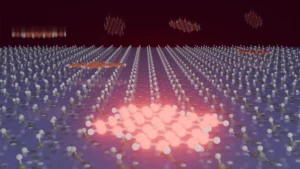
The discovery of these domain walls changes the way scientists approach solar cell design. The ISTA study shows that when an electron-hole pair is generated near a domain wall, the local electric field at that boundary pulls the charges apart. The electron moves to one side of the wall, and the hole moves to the other. Because they are separated by a physical and electrical barrier, they cannot recombine. Instead, they "drift" along the domain walls for a duration that, on the scale of subatomic particles, feels like "eons."
This explains why perovskites are so forgiving of defects. As long as the charge carriers are on the "highway" (the domain wall), they are shielded from the "potholes" (the defects) in the surrounding material.
"With this comprehensive picture, we are finally able to reconcile many previously conflicting observations about lead-halide perovskites," says Rak. This insight suggests that instead of trying to eliminate every defect—a costly and difficult task—engineers should focus on optimizing the density and orientation of these domain walls to maximize charge collection.
Economic and Industrial Analysis
The economic implications of this research are profound. Currently, the solar industry is dominated by crystalline silicon (c-Si), which accounts for roughly 95% of the market. However, the high capital expenditure required for silicon manufacturing facilities creates a barrier to rapid scaling in developing nations.
Perovskites offer a path toward "democratized" solar energy. Because they can be produced using solution-based methods, the energy payback time (the time it takes for a solar panel to generate the energy used in its production) is significantly lower for perovskites—estimated at just a few months, compared to one to two years for silicon.
Furthermore, this discovery supports the development of "tandem" solar cells. By layering a perovskite cell on top of a traditional silicon cell, manufacturers can harvest a broader spectrum of sunlight, potentially pushing commercial panel efficiencies toward 30% or higher. Understanding the structural physics of perovskites is the final key needed to move these tandem cells from the laboratory to mass production.
Challenges and the Path Forward
While the ISTA study provides the "why" behind perovskite efficiency, the industry still faces the "how" of long-term stability. Lead-halide perovskites are notoriously sensitive to moisture and heat, often degrading within a few years, whereas silicon panels are expected to last 25 to 30 years.
However, the ISTA researchers believe their work provides the roadmap for solving these durability issues. By understanding that domain walls are the primary drivers of performance, scientists can now look for ways to "lock" these structures in place using chemical additives or encapsulation techniques.
The research conducted at ISTA represents a pivot point in renewable energy science. By moving beyond the surface and peering into the internal "highways" of the crystal, Rak and Alpichshev have provided the theoretical foundation necessary for the next generation of solar technology. As the world races to meet net-zero carbon targets, the ability to manufacture high-efficiency, low-cost solar cells could be the most critical tool in the global energy transition. This study ensures that the future of solar may not lie in the pursuit of perfection, but in the masterful engineering of imperfection.