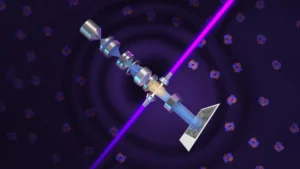
Researchers at Indiana University have played a pivotal role in a groundbreaking advance in fundamental physics, contributing to a collaborative effort between two of the world’s leading neutrino experiments. This international partnership, involving the NOvA experiment in the United States and T2K in Japan, has yielded new insights into the enigmatic properties of neutrinos, tiny, nearly massless particles that could hold the key to one of cosmology’s most profound mysteries: why the universe is filled with matter, allowing for the existence of stars, planets, and life, rather than being an empty void of energy. The significant findings, published in the prestigious journal Nature, mark a substantial step forward in scientists’ quest to understand the cosmic imbalance that favored matter over antimatter after the Big Bang.
The Quest for Cosmic Asymmetry: Unraveling the Matter-Antimatter Mystery
At the heart of this research lies one of the most enduring puzzles in modern physics: the matter-antimatter asymmetry of the universe. According to the prevailing Big Bang theory, the early universe should have produced nearly equal amounts of matter and antimatter. When matter and antimatter particles encounter each other, they mutually annihilate in a burst of energy, leaving nothing but photons. Had there been perfect symmetry in the primordial cosmos, the universe would have been a desolate expanse of radiation, devoid of any particles that could coalesce into galaxies, stars, or indeed, us. Yet, a slight, almost imperceptible excess of matter—estimated to be just one part in a billion—survived the annihilation period, forming the basis of everything we observe today. Identifying the mechanism responsible for this minuscule imbalance is a central goal for particle physicists and cosmologists.
Neutrinos, often called "ghost particles" due to their elusive nature, are believed to be crucial to solving this riddle. These elementary particles are among the most abundant in the cosmos, second only to photons. They possess no electric charge and interact only through the weak nuclear force and gravity, making them incredibly difficult to detect. However, these same properties make them invaluable probes for exploring the deepest laws of physics, potentially revealing new phenomena beyond the Standard Model of particle physics.
The Elusive Neutrino: A Cosmic Messenger
First hypothesized by Wolfgang Pauli in 1930 to explain energy conservation in beta decay, neutrinos were experimentally confirmed by Clyde Cowan and Frederick Reines in 1956. Since then, their study has led to several Nobel Prizes and revolutionized our understanding of particle physics. Neutrinos exist in three distinct "flavors": electron, muon, and tau neutrinos, named after the charged leptons they are associated with. A peculiar quantum mechanical phenomenon known as neutrino oscillation allows these particles to spontaneously switch between flavors as they travel through space. This oscillation implies that neutrinos, contrary to earlier assumptions, must possess a tiny, non-zero mass, a discovery that fundamentally revised the Standard Model.
Scientists hypothesize that if neutrinos and their antimatter counterparts, antineutrinos, oscillate differently—a phenomenon known as Charge-Parity (CP) violation—this difference could account for the universe’s matter dominance. CP symmetry posits that the laws of physics should remain the same if a particle is swapped with its antiparticle (Charge conjugation, C) and its spatial coordinates are inverted (Parity, P). While CP violation has been observed in other particle systems (like kaons and B mesons), the magnitude of these observed violations is insufficient to explain the vast cosmic matter asymmetry. A significant difference in neutrino and antineutrino behavior could provide the missing piece of this cosmological puzzle.
A Decade of Discovery: The NOvA and T2K Experiments
The breakthrough stems from an unprecedented joint analysis of data from two state-of-the-art long-baseline neutrino experiments: NOvA (NuMI Off-axis νe Appearance) in the United States and T2K (Tokai to Kamioka) in Japan. These projects represent the pinnacle of international scientific collaboration and technological innovation in neutrino physics.
NOvA: Traversing the American Midwest
Operational since 2014, NOvA generates a high-intensity beam of muon neutrinos and antineutrinos at Fermi National Accelerator Laboratory (Fermilab) near Chicago. This beam, produced by the NuMI (Neutrinos from the Main Injector) facility, is directed 810 kilometers (503 miles) northwest through the Earth’s crust to a massive 14,000-ton detector located in Ash River, Minnesota. The NOvA far detector, composed of 344,064 individual cells filled with liquid scintillator, is designed to observe how muon neutrinos transform into electron neutrinos over this long baseline. The off-axis configuration of the detector relative to the beam line enhances its sensitivity to these flavor oscillations.
T2K: From Accelerator to Mountain Depths in Japan
Concurrently, Japan’s T2K experiment, which began collecting data in 2010, fires a similar beam of neutrinos and antineutrinos from the J-PARC (Japan Proton Accelerator Research Complex) facility in Tokai. This beam travels 295 kilometers (183 miles) westward to the Super-Kamiokande detector, a colossal underground water Cherenkov detector situated 1,000 meters beneath Mount Ikenoyama. Super-Kamiokande, containing 50,000 tons of ultra-pure water and lined with 11,146 photomultiplier tubes, has been instrumental in numerous neutrino discoveries, including solar and atmospheric neutrino oscillations. T2K aims to precisely measure the parameters governing neutrino oscillations over its shorter, but highly intense, baseline.
Both experiments employ sophisticated particle accelerators to produce their neutrino beams, which are then precisely characterized by near detectors close to the source. Detecting neutrinos is extraordinarily challenging; out of countless particles generated, only a minuscule fraction interact within the massive detectors, leaving measurable signals. Advanced detector technologies, coupled with powerful software algorithms and machine learning techniques, are then used to reconstruct these rare interactions and meticulously study how neutrinos change as they traverse vast distances.
Indiana University’s Enduring Contribution to Neutrino Physics
Indiana University has maintained a prominent and continuous role in neutrino physics research for decades, significantly contributing to the scientific and technical underpinnings of these monumental experiments. IU scientists have been deeply involved in various facets of the NOvA and T2K projects, from the intricate design and construction of detector systems to the complex interpretation of vast datasets and the vital mentorship of the next generation of researchers.
Mark Messier, a Distinguished Professor and Chair of the Physics department within the College of Arts and Sciences at IU Bloomington, has been a central figure in the NOvA collaboration, holding leadership roles since 2006. His expertise and guidance have been critical to the experiment’s success. Other notable IU researchers involved include physicists Jon Urheim and James Musser (Emeritus), Astronomy Professor Stuart Mufson (Emeritus), and Jonathan Karty from the Chemistry department. Their interdisciplinary contributions highlight the broad scientific impact of neutrino research.
IU’s involvement extends beyond theoretical and analytical work to hands-on technological development. The university’s researchers have been instrumental in developing high-speed electronics for data acquisition, refining complex algorithms for event reconstruction, and implementing advanced statistical methods to extract subtle signals from experimental noise. This sustained commitment has cemented IU’s reputation as a leading institution in high-energy particle physics.
The Power of Synergy: Joint Analysis Unveils New Precision
The new Nature study represents a significant methodological leap by merging the datasets from NOvA and T2K. This unprecedented joint analysis capitalizes on the complementary strengths of the two observatories, providing a more robust and precise measurement of neutrino oscillation parameters than either experiment could achieve independently. As a press release from Nature highlighted, "Combining the analyses takes advantage of the complementary sensitivities of the two experiments and demonstrates the value of collaboration."
NOvA’s longer baseline allows for observations of neutrino oscillations over extended periods, providing crucial information on the overall probability of flavor change. In contrast, T2K’s shorter, yet more intense, beam produces a greater number of detected events, offering high statistical precision in its measurements. By integrating their results, researchers effectively leveraged NOvA’s sensitivity to the CP-violating phase and T2K’s ability to constrain other oscillation parameters, allowing for a more refined comparison of neutrino and antineutrino behavior.
The combined findings specifically focus on the parameter known as the delta-CP phase, which quantifies the difference in oscillation between neutrinos and antineutrinos. The results suggest a preference for a value of the delta-CP phase that indicates a significant difference in how neutrinos and antineutrinos oscillate. This hint of a possible violation of CP symmetry in the lepton sector is a crucial development. In simpler terms, the data suggests that neutrinos may not behave exactly like their antimatter counterparts, a subtle but profound distinction that could be the key to explaining the cosmic matter excess. While not a definitive discovery of CP violation, the joint analysis significantly narrows down the possible values for the delta-CP phase, strengthening the evidence for a specific range that would support matter-antimatter asymmetry.
Professor Messier articulated the significance of this progress: "We’ve made progress on this really big, seemingly intractable question: why is there something instead of nothing?" He added, "And, we’ve set the stage for future research programs that aim to use neutrinos to tackle other questions."
Broader Impact: Technology, Talent, and Global Cooperation
The benefits of large-scale particle physics experiments extend far beyond fundamental scientific discovery. The pursuit of elusive particles like neutrinos drives profound technological innovation. Technologies developed to detect neutrinos—including ultra-sensitive sensors, high-speed electronics for massive data acquisition, and advanced data analysis systems leveraging machine learning and artificial intelligence—often find practical applications in various industries. For instance, sophisticated imaging techniques used in particle detectors can inspire new medical imaging technologies, and advanced computing solutions developed for processing petabytes of experimental data can be adapted for big data challenges in finance, healthcare, and environmental monitoring.
"There has been transformative technological innovation across all sectors of society that’s come out of high-energy physics," noted Professor Messier. He also emphasized the invaluable human capital developed through these projects: "Further, next-generation scientists immerse themselves in data science, in machine learning, artificial intelligence, and in electronics, and then go into industries with the deep skills they’ve gained while trying to answer these really difficult questions." Students participating in these collaborations gain unparalleled experience in cutting-edge research, complex problem-solving, and international teamwork, making them highly sought-after professionals in diverse fields.
The NOvA and T2K collaborations exemplify the immense scientific power of international cooperation. These projects involve hundreds of scientists, engineers, and technicians from more than a dozen countries spanning the United States, Europe, and Japan. The shared analysis underscores the efficacy of pooling resources, expertise, and diverse perspectives to tackle challenges that no single nation or institution could address alone. The U.S. Department of Energy provides significant funding for these joint research efforts, alongside support from other international agencies like Japan’s Ministry of Education, Culture, Sports, Science and Technology (MEXT).
Indiana University continues to foster this spirit of collaboration by actively involving students in the research. Current IU Ph.D. students contributing to the joint study include Reed Bowles, Alex Chang, Hanyi Chen, Erin Ewart, Hannah LeMoine, and Maria Manrique-Plata. Since NOvA began operations in 2014, Professor Messier and his colleagues have also mentored numerous IU graduate and undergraduate students, providing them with invaluable hands-on experience at the forefront of scientific discovery.
Looking Ahead: The Future of Neutrino Physics
This successful partnership between NOvA and T2K offers a compelling preview of how future large-scale particle physics projects may operate. The results from this joint analysis open the door to even more precise studies, setting the stage for the next generation of experiments. Future endeavors like the Deep Underground Neutrino Experiment (DUNE) in the United States, which aims to send neutrinos 1,300 kilometers through the Earth, and the Hyper-Kamiokande experiment in Japan, a successor to Super-Kamiokande, will build upon these findings. These monumental projects will utilize even larger detectors and more intense neutrino beams to achieve unprecedented levels of precision, potentially providing a definitive answer to the question of leptonic CP violation and its role in the universe’s matter-antimatter asymmetry.
For Indiana University and its global collaborators, the journey to understand the universe’s fundamental properties is ongoing. The ability to break down such an enormous question into manageable, step-by-step inquiries is a testament to the scientific method and the dedication of researchers worldwide. As Professor Messier eloquently concluded, "As a physicist I find it fascinating that a huge question, like why there’s matter in the universe instead of antimatter, can be broken down into smaller, step-by-step questions. Instead of being dumbstruck by the enormity of it, we can actually make progress toward an answer about why we’re here in the universe." This collaborative triumph underscores humanity’s relentless pursuit of knowledge and its capacity to unravel the deepest secrets of existence.