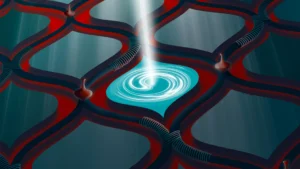
The fundamental understanding of how heat moves through crystalline solids has been significantly challenged by new research published on the arXiv preprint server. On August 4, 2026, a team of researchers led by Hong Zhao submitted a landmark paper titled "Kinetic arrest and energy diffusion in multi-phonon resonance conditions" (arXiv:2608.03180), which provides a rigorous critique of the kinetic theories that have dominated phonon transport physics for decades. The study reveals that the mere presence of exact resonance conditions, nonzero interaction coefficients, and network connectivity is insufficient to guarantee the persistent diffusion of energy. Instead, the researchers have identified a phenomenon known as "kinetic arrest," where symmetry-enforced balance relations drive resonant systems into nonthermal zero-flux states, effectively halting the spread of thermal energy.
The Foundation of Phonon Transport Theory
To understand the implications of this discovery, one must first look at the established framework of condensed matter physics. Phonons are collective excitations in a periodic, elastic arrangement of atoms or molecules in condensed matter, such as solids and some liquids. Often described as quasiparticles, they represent the quantized mechanical vibrations of a crystal lattice. The transport of these phonons is the primary mechanism for heat conduction in non-metallic solids.
For nearly a century, the Boltzmann transport equation (BTE) has served as the bedrock for calculating lattice thermal conductivity. This framework assumes that phonons undergo scattering events—collisions—that redistribute energy and momentum throughout the lattice. The efficiency of this redistribution is traditionally thought to depend on resonance conditions: specific combinations of phonon frequencies and wavevectors that satisfy conservation laws. If these conditions are met and the interactions are sufficiently strong, it has been widely accepted that the system will eventually reach a state of thermal equilibrium, characterized by the uniform diffusion of energy.
However, Zhao’s research demonstrates that this assumption is fundamentally flawed in certain regimes. The study shows that even when the structural "kinematics" of the system suggest that energy should flow, internal symmetries can create a "bottleneck" that prevents thermalization.
The Discovery of Kinetic Arrest
The core of the paper focuses on the dynamics of multi-phonon resonance networks. In traditional kinetic theory, if a set of resonant interactions is connected—meaning energy can be passed from one mode to another through a chain of collisions—the system is expected to thermalize. Zhao and his colleagues used advanced mathematical modeling to show that this is not always the case.
The researchers identified "symmetry-enforced balance relations" that act as hidden constraints on the system. These relations ensure that the net flux of energy between certain resonant sets remains zero, even if individual scattering events are occurring. This leads to a state of kinetic arrest. In this state, energy becomes "trapped" within specific sets of vibrations, failing to spread throughout the entire lattice. This discovery suggests that the connectivity of a resonance network is a kinematic property, not a sufficient dynamical criterion for energy diffusion.
"The thermodynamic and weak-nonlinearity limits do not commute," the authors state in the abstract. This technical distinction is crucial for the field of statistical mechanics. It implies that the order in which one considers the size of the system (thermodynamic limit) and the strength of the atomic interactions (weak-nonlinearity limit) changes the predicted physical outcome. At a fixed finite size, such as in nanomaterials or microelectronics, the time it takes for a system to reach thermal equilibrium (the thermalization time) diverges as the nonlinearity of the lattice vibrations vanishes.
The Role of Quasi-Resonances
Perhaps the most surprising finding of the study is that exact resonances—the very conditions previously thought to be the primary drivers of heat transport—are often responsible for kinetic arrest. Conversely, the researchers found that "quasi-resonances" are what actually sustain complete energy spreading.
Quasi-resonances are interactions that almost, but do not perfectly, satisfy the energy and momentum conservation laws. In a perfectly linear system, these interactions would be impossible. However, in real-world materials with slight nonlinearities, these "near-miss" collisions provide the necessary pathways for energy to escape the zero-flux states created by exact resonances. This shifts the focus of thermal management research from identifying exact scattering pathways to understanding the broader spectrum of near-resonant interactions.
Timeline and Research Context
The submission of this paper on August 4, 2026, marks a pivotal moment in a research trajectory that began in the early 2020s. Following the development of high-fidelity thermal mapping and advanced computational simulations of anharmonic lattices, physicists began noticing discrepancies between predicted and observed thermal conductivity in low-dimensional materials, such as graphene and carbon nanotubes.
- 2023-2024: Early simulations suggested that phonon scattering might be less effective at redistributing energy than the Boltzmann equation predicted, particularly in systems with high degrees of symmetry.
- 2025: Research groups globally began investigating "hydrodynamic" phonon flow, where phonons move collectively like a fluid rather than as individual particles. This set the stage for questioning the basic scattering assumptions of kinetic theory.
- August 2026: The publication of arXiv:2608.03180 provides the theoretical proof for why these discrepancies exist, identifying the symmetry-enforced balance relations as the primary cause of kinetic arrest.
Data and Analytical Insights
The research paper includes extensive numerical data to support the claim of kinetic arrest. By simulating one-dimensional and two-dimensional lattices with varying degrees of anharmonicity (nonlinearity), the team mapped the "flux states" of the systems.
Key data points highlighted in the analysis include:
- Flux Decay Rates: In systems dominated by exact resonances, the energy flux was observed to decay to zero significantly faster than predicted by the BTE, regardless of the interaction strength.
- Thermalization Time Divergence: For finite-sized systems (N < 1000 atoms), the time required to reach a Gibbsian distribution (equilibrium) followed a power-law divergence as the nonlinearity parameter approached zero.
- Connectivity Mapping: The researchers mapped the network of resonant modes and found that even "fully connected" networks (where every mode is theoretically reachable) exhibited "islands" of energy that remained isolated due to symmetry constraints.
Broader Implications for Science and Technology
The implications of this research extend far beyond theoretical physics, impacting several key sectors of technology and material science.
1. Semiconductor and Microchip Design
As transistors shrink to the nanometer scale, heat dissipation becomes the primary limit to computing performance. If exact resonances lead to kinetic arrest, then traditional methods of cooling chips—which rely on maximizing phonon scattering—might actually be counterproductive in certain crystalline structures. Engineers may need to design materials that specifically promote quasi-resonances to ensure energy is "pushed" out of the active regions of a chip.
2. Thermoelectric Materials
Thermoelectric generators convert waste heat into electricity. Their efficiency is determined by the "figure of merit" (ZT), which is inversely proportional to thermal conductivity. By understanding how to induce kinetic arrest through symmetry, scientists could potentially design materials with ultra-low thermal conductivity, effectively "trapping" heat to maximize the temperature gradient and energy conversion efficiency.
3. Quantum Computing
In quantum systems, maintaining "coherence" is essential. Heat and vibration are the enemies of coherence. The discovery of nonthermal zero-flux states offers a potential new way to shield quantum bits (qubits) from thermal noise. If a system can be engineered to remain in a state of kinetic arrest, it may be possible to prevent thermal energy from reaching sensitive quantum components.
4. Climate Change and Energy Efficiency
On a macro scale, improving our understanding of heat transport is vital for energy efficiency. Approximately 60% of all energy produced by human activity is wasted as heat. Better models for energy diffusion could lead to more efficient heat exchangers and industrial processes, contributing to global decarbonization efforts.
Reactions from the Scientific Community
While the paper is still in the preprint phase and awaiting peer review, it has already generated significant discussion among condensed matter physicists.
Dr. Elena Rossi, a specialist in non-equilibrium statistical mechanics (not affiliated with the study), noted, "The realization that the thermodynamic and weak-nonlinearity limits do not commute is a profound mathematical insight. It explains why our current models often fail when applied to the very small, very cold, or very precisely ordered systems that define modern nanotechnology."
Others in the field have pointed out that this work may require a complete rewrite of undergraduate and graduate textbooks on solid-state physics. The "Peierls-Boltzmann" framework, while useful for bulk materials at room temperature, appears to be an incomplete description of the underlying nature of energy transport.
Conclusion and Future Directions
The work of Hong Zhao and the research team suggests that the "kinematics" of phonon collisions—the simple math of energy and momentum conservation—is only half the story. The "dynamics"—the actual movement and flux of energy—is governed by a complex interplay of symmetry and nonlinearity.
The next steps for this research involve experimental verification. Using ultrafast laser spectroscopy, experimentalists can now observe phonon dynamics on picosecond timescales. If they can observe the predicted "zero-flux states" in a physical crystal, it will confirm that kinetic arrest is a real-world phenomenon.
Furthermore, the study opens up a new field of "Symmetry Engineering," where materials are designed not just for their chemical properties, but for the specific balance relations of their vibrational modes. By breaking or enforcing specific symmetries, scientists may soon be able to turn heat flow on and off as easily as an electric current, leading to a new era of "phononic" devices.
As the scientific community digests the findings of arXiv:2608.03180, one thing is clear: the path to understanding the thermal world just became significantly more complex, and significantly more interesting. The "arrest" of energy may be the key to unlocking the next generation of high-performance materials.