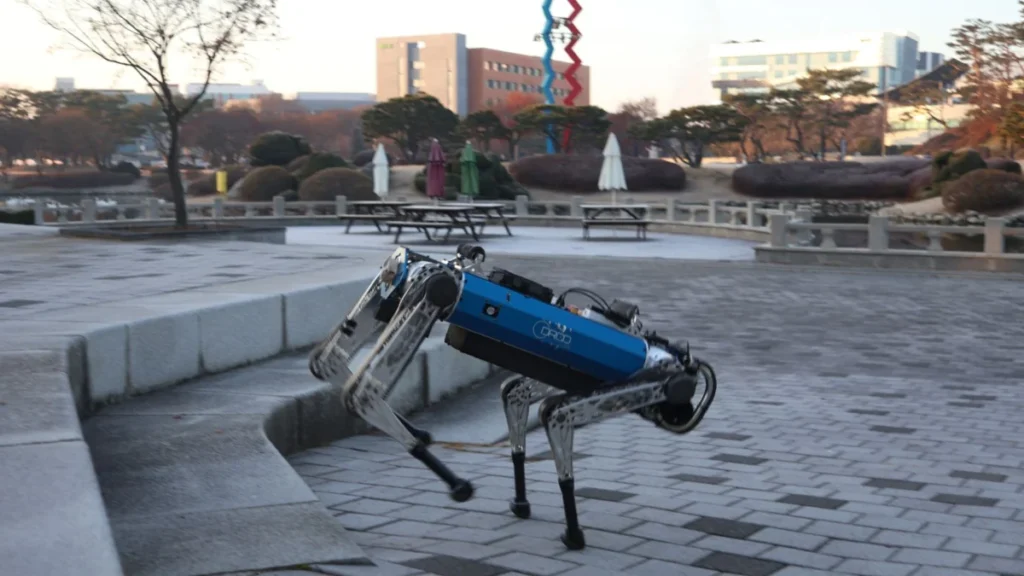
Researchers from a consortium of leading South Korean institutions, including the Korea Advanced Institute of Science and Technology (KAIST), Korea University, the Agency for Defense Development, and DIDEN Robotics, have achieved a significant breakthrough in legged robotics. They have developed an artificial intelligence (AI) framework, dubbed Action Pretrained Transformer-based Reinforcement Learning (APT-RL), that empowers four-legged robots to autonomously and seamlessly switch between various motor skills while traversing highly complex and unpredictable terrain. This innovative system allows a robot to adapt its gait in real-time, navigating challenging environments such as dense forests, ascending and descending stairs, and leaping over obstacles, all by utilizing only its onboard sensors and computing capabilities.
This advanced approach represents a pivotal step forward in the field, combining a vast library of pretrained locomotion skills with sophisticated adaptive decision-making algorithms. The result is a substantial improvement in the agility, robustness, and versatility of quadruped robots operating in dynamic and unstructured environments. The development holds profound implications for future autonomous missions, particularly in high-stakes applications such as search-and-rescue operations in disaster zones, exploration of hazardous or inaccessible areas, and various defense applications where human intervention is either too dangerous or impractical. The research team underscored the versatility of their creation in their published paper in Science Robotics, stating, "A single onboard policy enables robust traversal of diverse obstacles, including stairs, hurdles, stepping stones, gaps, and fallen branches, demonstrating the versatility and effectiveness of our approach."
Overcoming the Quadruped Conundrum: The Need for Adaptive Movement
For decades, the aspiration of creating truly agile and autonomous legged robots capable of navigating the real world has been a central challenge in robotics. Unlike wheeled or tracked vehicles, which excel on relatively flat or prepared surfaces, legged robots are designed to mimic biological locomotion, offering the promise of traversing highly irregular and unstructured terrain. However, this inherent advantage has been historically hampered by the complexity of controlling multiple limbs in a coordinated, stable, and energy-efficient manner, especially when faced with unexpected obstacles or changes in ground conditions.
Traditional approaches often relied on either a single, generalized gait that struggled with diverse obstacles or required separate, pre-programmed controllers for specific tasks (e.g., one for walking, another for climbing). Such systems often necessitated manual switching between modes or external sensing infrastructure, limiting their autonomy and practical deployment in dynamic, unknown environments. The inability of robots to intelligently and instantly adapt their movement strategy to the immediate environment has been a significant bottleneck, preventing their widespread adoption in scenarios demanding high levels of versatility and self-reliance. The APT-RL framework directly addresses this fundamental limitation by introducing an AI-driven solution that enables robots to perceive, decide, and execute the most appropriate movement skill in real-time, without human intervention or reliance on off-board systems. This shift from pre-programmed, rigid movements to adaptive, intelligent locomotion marks a crucial evolution in the development of truly autonomous robotic agents.
The APT-RL Framework: A Tri-Stage Path to Autonomy
The APT-RL framework distinguishes itself through a meticulously structured three-stage training process designed to imbue robots with an unprecedented level of movement intelligence and adaptability. This methodical approach ensures that the robot not only learns a wide array of physical movements but also develops the cognitive capacity to apply these skills appropriately.
The first stage focuses on Pretraining Basic Locomotion Skills. This foundational phase involves teaching the robot a comprehensive library of fundamental movements. The researchers leveraged trajectory optimization techniques to generate an enormous dataset of movement patterns. Specifically, the system learned from over 180,000 optimized motion trajectories, collectively representing 15.5 hours of simulated movement. What is particularly remarkable is that this extensive dataset was generated in a mere eight minutes, highlighting the efficiency of the simulation-based training methodology. These motion patterns, ranging from basic walking and trotting to more complex maneuvers like bounding and stepping, serve as the essential "reusable building blocks" for all subsequent, more advanced behaviors the robot will exhibit. This extensive pretraining ensures that the robot possesses a rich vocabulary of physical actions to draw upon.
The second stage introduces Reinforcement Learning for Skill Adaptation. With the fundamental movement skills established, the robot then enters a reinforcement learning environment. In this phase, the AI is tasked with learning when and how to switch between these pretrained skills effectively while maintaining balance and stability across a wide variety of simulated obstacles and terrains. Through trial and error, guided by a reward system, the robot develops an intuitive understanding of which gait or movement strategy is most suitable for a given situation. For instance, it learns that a stable trot is ideal for uneven ground, while a powerful bounding motion might be necessary to clear a large gap. This stage is critical for enabling the robot’s adaptive decision-making capabilities, allowing it to seamlessly transition between different movement strategies in real-time.
The final stage, Real-World Deployment Adaptation, bridges the gap between simulated learning and practical application. A key challenge in robotics is transferring skills learned in simulation to the often-unpredictable real world. The APT-RL framework addresses this by adapting the learned policies for real-world deployment using only onboard perception data. This is achieved through the integration of a depth camera and a 2D LiDAR sensor directly onto the robot. Crucially, this eliminates the need for external motion-capture systems or other off-board sensing infrastructure, which are often impractical or impossible in field environments. The depth camera provides detailed, high-resolution information about immediate obstacles and terrain features, while the LiDAR sensor offers a broader, longer-range view, allowing the robot to detect terrain several meters ahead. This dual-sensor approach provides the robot with a robust and comprehensive understanding of its surroundings, enabling it to plan its movements effectively at high speeds and make informed decisions autonomously in previously unseen real-world conditions.
HOUND’s Triumphs: Mastering Diverse and Unpredictable Terrain
The efficacy of the APT-RL framework was rigorously tested on KAIST’s advanced quadruped robot, HOUND, across a wide array of both indoor and demanding outdoor environments. The trials showcased HOUND’s remarkable ability to autonomously navigate complex landscapes, demonstrating a level of agility and adaptability previously unattainable for legged robots relying solely on onboard intelligence.
HOUND successfully traversed diverse terrains encountered in everyday and challenging scenarios. This included navigating the structured yet varied environments of university campuses, the unpredictable paths of forest trails, expansive grassy fields, and rugged rocky terrain. More impressively, the robot demonstrated proficiency in negotiating specific obstacles designed to test its adaptive capabilities, such as ascending and descending staircases, stepping across uneven stepping stones, leaping over fallen logs and gaps, and maneuvering around branches obstructing its path.
During these rigorous tests, HOUND automatically selected different gaits based on the perceived terrain and its commanded speed. For instance, when confronted with uneven ground or the intricate steps of a staircase, the robot adopted a stable and controlled trot, prioritizing balance and precision. Conversely, when encountering obstacles like logs or needing to descend large steps, it seamlessly transitioned to a faster, more dynamic bounding gait, leveraging momentum and power to clear the impediment efficiently.
The robot’s performance metrics were particularly noteworthy, highlighting its unprecedented speed and agility in complex environments. During obstacle traversal, HOUND reached an instantaneous speed of 4.25 meters per second (approximately 9.5 miles per hour). Even more remarkably, while performing a controlled jump down a three-step staircase, the robot briefly achieved a speed of 6 meters per second (approximately 13.4 miles per hour) before a stable landing. The researchers emphasized that these recorded speeds are among the fastest reported for a perception-driven quadruped robot operating autonomously in challenging, real-world conditions, underscoring the significant leap in performance enabled by APT-RL.
Further validation came from comparative studies where the APT-RL approach was benchmarked against existing reinforcement learning and hierarchical control methods. In these comparisons, APT-RL consistently demonstrated superior performance across several critical metrics. It achieved better success rates in navigating complex obstacle courses, exhibited smoother gait transitions, leading to more fluid and energy-efficient locomotion, and demonstrated faster learning capabilities. A crucial finding was the robot’s ability to adapt to previously unseen terrain without requiring any retraining, a testament to the robustness and generalizability of the pretrained movement skills and the adaptive decision-making framework. This adaptability is vital for real-world deployment where every environment is unique.
The research also highlighted the synergistic effectiveness of HOUND’s onboard sensor suite. The combination of a depth camera and a 2D LiDAR sensor proved optimal for comprehensive environmental perception. The depth camera provided highly detailed, localized information about immediate obstacles and ground variations, crucial for precise foot placement and short-range navigation. Complementing this, the LiDAR allowed the robot to detect terrain features several meters ahead, providing invaluable foresight. This extended perception horizon gave the robot sufficient time to plan its movements, adjust its gait, and prepare for upcoming obstacles, even when operating at high speeds, thereby significantly enhancing its autonomy and safety in dynamic environments.
Broadening Horizons: Implications and Future Trajectories
The development of the APT-RL framework and its successful implementation on the HOUND robot signifies a transformative moment for autonomous robotics, opening doors to a multitude of applications that were previously constrained by the limitations of robot locomotion. The implications extend across critical sectors, promising to redefine capabilities in environments where human presence is either impossible, impractical, or exceedingly dangerous.
One of the most immediate and profound implications is for search-and-rescue missions. In the aftermath of natural disasters such as earthquakes, tsunamis, or industrial accidents, first responders often face unstable rubble, collapsed structures, and hazardous materials. Traditional wheeled or tracked robots struggle in such chaotic environments. An agile quadruped robot, capable of climbing over debris, navigating narrow passages, and traversing uneven ground autonomously, could significantly enhance rescue efforts. It could quickly locate survivors, assess structural damage, and deliver vital supplies or communication devices into areas too risky for humans, thereby saving lives and mitigating further risks to rescue personnel.
Beyond immediate crises, the framework holds immense potential for exploration. This includes planetary exploration, where rovers must navigate alien landscapes with unpredictable terrains; underwater exploration, where autonomous robots could map vast ocean floors or inspect subsea infrastructure; and terrestrial exploration in hazardous environments like active volcanoes, deep caves, or chemically contaminated zones. The ability to dynamically adapt to varying ground conditions without external control makes these robots ideal candidates for pioneering roles in unknown territories.
Given the involvement of the Agency for Defense Development, the technology also has significant defense and security applications. Agile quadruped robots could be deployed for reconnaissance, surveillance, and logistics in complex operational theaters, providing troops with crucial situational awareness in environments ranging from urban warfare zones to dense forests. Their ability to operate autonomously and quietly would offer strategic advantages, reducing the risk to human soldiers.
Furthermore, the technology could revolutionize industrial and logistics applications. Imagine construction sites, often characterized by uneven ground, obstacles, and changing layouts; autonomous quadruped robots could perform inspections, transport tools, or assist in material handling. In last-mile delivery, especially in rural areas or regions with poor infrastructure, these robots could navigate challenging landscapes to deliver goods, bypassing the limitations of traditional delivery vehicles.
The APT-RL framework also represents a significant advancement in embodied AI and machine learning. It demonstrates how sophisticated AI can be seamlessly integrated with complex robotic hardware to achieve real-time decision-making and robust physical interaction with the environment. This research paves the way for future AI systems that can learn more generalized and adaptable behaviors, moving beyond task-specific programming to truly intelligent autonomy.
Looking ahead, the researchers envision expanding the capabilities of the APT-RL system. Future work will focus on incorporating additional gaits, such as galloping for even higher speeds over open terrain and crawling for navigating extremely confined spaces. Enhancing the robot’s agility further, including more agile turning and sideways movement, will be crucial for operating in cluttered environments. Perhaps most ambitiously, the team plans to adapt the same learning framework to other types of legged machines, including humanoid robots, promising to unlock similar levels of adaptive locomotion for a broader spectrum of robotic platforms. This continuous evolution suggests a future where autonomous robots are not just tools but intelligent, adaptable companions capable of tackling humanity’s most challenging physical frontiers.






