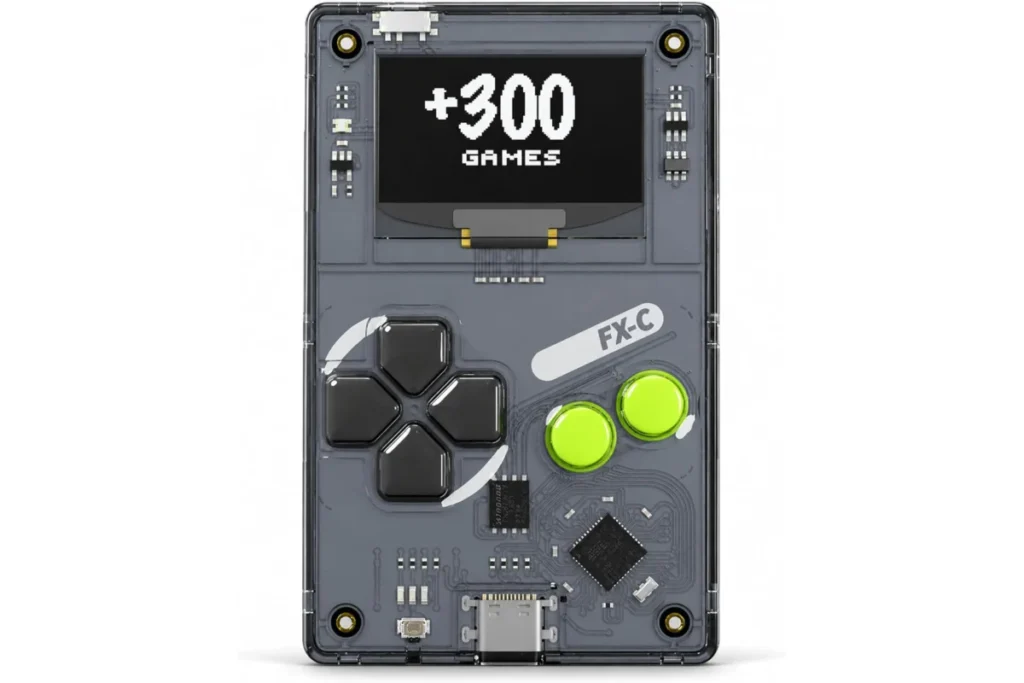
The Arduboy FX-C represents the latest evolution in the lineage of credit-card-sized gaming consoles, maintaining its position as a staple in the maker community while embracing modern hardware standards. Manufactured in partnership with Seeed Studio, this iteration of the Arduboy platform continues to utilize the 8-bit ATMega32u4 microcontroller, a deliberate choice that prioritizes compatibility and the preservation of a decade’s worth of community-driven software development. At a retail price of approximately $79, the FX-C positions itself not merely as a novelty toy, but as a robust educational tool and a portable showcase for the "low-spec" indie gaming movement.
Technical Architecture and Hardware Specifications
The core of the Arduboy FX-C is the ATMega32u4, an 8-bit AVR microcontroller that will be familiar to any hobbyist who has worked with the Arduino Leonardo or Micro. While the industry has largely shifted toward more powerful 32-bit architectures like the ESP32 or the Raspberry Pi RP2040, the retention of the ATMega32u4 ensures that the device remains accessible to beginners. The constraints of 8-bit processing—limited memory and clock speed—act as a creative catalyst, forcing developers to optimize their code and rely on clever programming tricks to achieve impressive visual and auditory results.
One of the most significant upgrades in the FX-C model is the transition to USB-C. This move aligns the device with contemporary charging and data standards, replacing the aging micro-USB port found on previous iterations. The USB-C port serves a dual purpose: it is the primary interface for charging the internal lithium-polymer battery and the gateway for uploading custom code via the Arduino IDE. Furthermore, the port supports head-to-head multiplayer functionality, allowing two devices to be linked for competitive play, a feature that harkens back to the "link cable" era of 1990s handhelds.
The display remains a high-contrast, monochromatic OLED screen. Despite its small dimensions, the screen offers exceptional clarity and brightness, making it legible even in direct outdoor sunlight. To complement the visual experience, the board includes a built-in piezo speaker and an RGB LED. The LED provides a splash of color to an otherwise monochromatic experience, often used by developers to indicate player health, status effects, or environmental ambiance. However, some users have noted that the LED’s intensity can be overwhelming in dark environments, though this is a minor grievance given the open-source nature of the platform, which allows users to dim the light through software modifications.
The FX Advantage: Memory and Game Library
The "FX" designation in the model name refers to the inclusion of an external SPI flash memory chip. In the original Arduboy models, the internal flash memory of the ATMega32u4 was only large enough to hold a single game at a time. Users who wanted to switch games were required to tether the device to a computer and re-upload a new sketch. The FX-C eliminates this friction by pre-loading a library of over 300 community-made games onto the external flash chip.
This library is not a collection of repetitive clones. Instead, it represents a diverse ecosystem of independent titles. The experience has been compared to UFO 50, the acclaimed collection of fictional retro games, but manifested in physical hardware. The library spans various genres, from traditional "Snake" and "Arkanoid" clones to complex faux-3D dungeon crawlers and rhythm games. This massive repository is a testament to the longevity of the Arduboy community, which has remained active since the device’s inception in 2014.
A Chronology of the Arduboy Platform
The journey of the Arduboy began over a decade ago, and its timeline reflects the broader growth of the hardware startup and maker movements:
- 2014: Creator Kevin Bates introduces the first Arduboy prototype, a thin, card-like device that garnered viral attention for its minimalist design.
- 2015: A highly successful Kickstarter campaign raises over $430,000, far exceeding its initial $25,000 goal. This success proved there was a significant market for open-source, programmable handhelds.
- 2016-2019: The original Arduboy enters mass production. The community begins to swell, leading to the creation of the Arduboy Community Forum, which becomes a hub for sharing code, tutorials, and game assets.
- 2020: The Arduboy FX is introduced. By adding the flash memory chip, the developers addressed the platform’s biggest limitation—the "one-game-at-a-time" restriction.
- 2023-2024: The partnership with Seeed Studio is solidified to handle large-scale manufacturing and global distribution. The FX-C is developed to modernize the hardware with USB-C and refined build quality.
Educational Impact and the Maker Philosophy
Beyond its utility as a gaming device, the Arduboy FX-C is fundamentally an educational platform. It serves as a bridge between playing games and making them. Because the hardware is entirely open-source, users have access to the schematics and the underlying C++ code for every game in the library.

For educators and students, the Arduboy offers a tangible way to learn computer science principles. The constraints of the system teach efficient memory management and the basics of logic and physics in a 2D space. The community has produced extensive documentation and "game jam" events that encourage new programmers to submit their work. This "learn-by-doing" philosophy is what separates the Arduboy from closed-loop retro consoles or emulators. When a user buys an Arduboy, they are not just buying a toy; they are buying a development kit that fits in their wallet.
Market Positioning and Community Reception
The release of the FX-C comes at a time when the "handheld enthusiast" market is bifurcated. On one end are high-power devices like the Steam Deck or ASUS ROG Ally, capable of playing modern AAA titles. On the other end are boutique retro devices like the Analogue Pocket or the Playdate. The Arduboy FX-C carves out a unique niche by being the most portable and the most "hackable" of the group.
Industry analysts suggest that the partnership with Seeed Studio is a strategic move to ensure supply chain stability. Seeed Studio, based in Shenzhen, is a veteran in the maker hardware space, known for producing high-quality PCBAs (Printed Circuit Board Assemblies) and modules. This partnership allows Kevin Bates and the core Arduboy team to focus on software and community engagement while leveraging Seeed’s manufacturing prowess to keep the $79 price point sustainable.
Initial reactions from the community have been largely positive, with particular praise directed at the build quality and the convenience of the pre-loaded FX library. While some "power users" have expressed a desire for a more powerful processor to allow for grayscale graphics or higher-fidelity sound, the consensus remains that the 8-bit charm is central to the Arduboy’s identity. The lack of a physical volume wheel remains a point of contention for some, though the software-based mute functions implemented by most developers mitigate this issue in practical use.
Broader Implications for Open-Source Hardware
The continued success of the Arduboy platform serves as a case study for the viability of open-source hardware. In an era where "planned obsolescence" and "right to repair" are hot-button issues, the Arduboy stands as a counter-example. It is a device designed to be opened, understood, and modified.
The FX-C’s reliance on the ATMega32u4 also highlights a growing trend in "permacomputing"—the idea of using older, well-understood, and highly efficient technology rather than constantly chasing the latest specifications. By sticking to a standard that has existed for years, Arduboy ensures that games written in 2015 still run perfectly on hardware released in 2024.
Conclusion
The Arduboy FX-C is a refined version of a classic concept. By integrating the expansive game library of the FX model with the modern convenience of USB-C and the manufacturing reliability of Seeed Studio, it remains the gold standard for miniature programmable consoles. It successfully balances its roles as a nostalgic gaming device, a serious educational tool, and a badge of honor for the maker community. Whether used to pass the time during a commute or as a primary tool for learning C++ programming, the Arduboy FX-C proves that sometimes, the smallest packages contain the most significant potential.
Limited Founders Edition models are currently available through the official Arduboy website, while the standard edition can be found through Seeed Studio’s distribution channels and major retailers like Amazon. As the library continues to grow beyond 300 titles, the Arduboy ecosystem shows no signs of slowing down, proving that in the world of gaming, more bits aren’t always better.