Imagine a world where the seemingly mundane act of combining two cups of warm water could inexplicably result in a single cup of boiling water. While this scenario defies the laws of everyday physics, it offers a compelling analogy for a phenomenon now being harnessed at the quantum level. At this fundamental scale, the energy of multiple low-energy particles of light can be coalesced to forge a single particle possessing significantly higher energy. This principle, known as photo upconversion, is at the heart of a groundbreaking development by researchers at Kyushu University, who have engineered a novel solid-state molecular material capable of converting visible sunlight directly into ultraviolet (UV) light under ambient outdoor conditions.
The study, published on June 23rd in the prestigious journal Nature Communications, details the creation of this innovative material, which boasts an impressive photo upconversion efficiency of 1.9%. This achievement marks a significant leap forward in the quest for practical and efficient methods of generating UV light from abundant solar energy, a development with far-reaching implications across various technological and scientific fields.
The Crucial Role of Ultraviolet Light in Modern Technology
While the public often associates ultraviolet light with the less desirable effects of sunburn and potential skin damage, its utility extends far beyond these concerns. UV radiation is an indispensable tool in a surprisingly diverse array of modern technologies. Its germicidal properties make it a cornerstone of air purification systems, effectively neutralizing airborne pathogens. In the rapidly evolving field of 3D printing, UV light plays a critical role in curing and hardening resins, allowing for the precise formation of complex structures. The dental industry relies on UV light to rapidly harden fillings and bonding agents, ensuring durable and aesthetically pleasing dental work. Even in the realm of personal care, UV lamps are commonly used for the swift and effective hardening of gels in nail treatments.
Despite its widespread applications, ultraviolet light constitutes a relatively small fraction of the solar spectrum that reaches Earth’s surface, accounting for approximately 6% of incoming sunlight. Furthermore, not all of this UV radiation is practical or suitable for direct technological utilization. This scarcity and the need for specialized equipment to generate UV light have historically presented challenges and limitations for its widespread adoption in various applications.
"What we are doing here is effectively ‘adding together’ the energy from two visible light photons to create one ultraviolet photon," explains Yoichi Sasaki, Associate Professor at Kyushu University’s Faculty of Engineering and the study’s corresponding author. "It’s a fascinating process known as photo upconversion, and our success lies in achieving this efficiently within a solid material."
The Science Behind Turning Visible Light into UV Light: Triplet-Triplet Annihilation
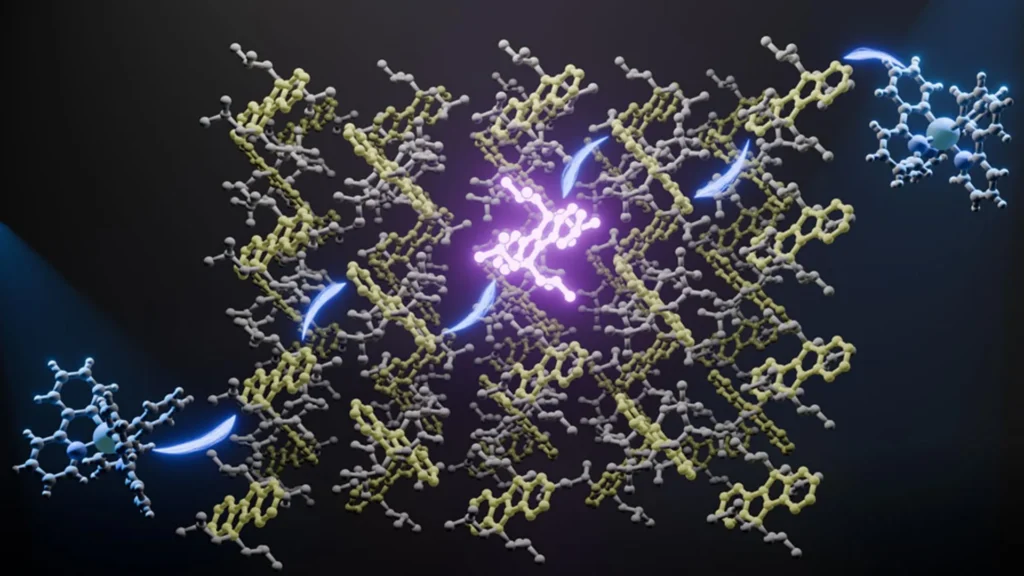
The underlying mechanism enabling this transformation is a phenomenon called triplet-triplet annihilation (TTA). This process begins when a molecule, designated as a "donor," absorbs visible light. This absorption energizes the donor molecule, propelling it into a high-energy state known as a triplet state. The energy from this excited donor molecule is then efficiently transferred to a nearby "acceptor" molecule, also bringing it into a triplet state.
The crucial step in TTA occurs when two of these triplet-excited acceptor molecules encounter each other. Upon collision, their energies combine, leading to the emission of a single photon with a significantly higher energy content – in this case, an ultraviolet photon.
Historically, scientists have recognized that TTA operates with considerable effectiveness in liquid solutions. The free movement of molecules in liquids facilitates frequent and easy interactions between donor and acceptor species, promoting efficient energy transfer and subsequent annihilation. However, liquid-based systems are often plagued by drawbacks. They frequently necessitate the use of toxic organic solvents, posing environmental and safety concerns. Moreover, the inherent volatility of liquids means they can evaporate over time, leading to system degradation and limiting their long-term practicality and scalability. These limitations have spurred a sustained and intensive search within the scientific community for a robust and reliable solid-state alternative.
"In solid materials, the molecules are typically packed much more closely together. This proximity leads to significant overlap of their electron clouds – the regions of high electron density that hover above and below each molecular plane," elaborates Professor Sasaki. "When this strong overlap occurs, the excited triplet states can easily lose their energy through non-radiative pathways, essentially ‘fizzling out’ before they have a chance to encounter another triplet state. The key challenge has been to engineer a solid-state system where molecules are close enough for efficient energy transfer to occur, but simultaneously separated enough to prevent this detrimental ‘quenching’ of excited states, also known as excitons."
A Novel Solid-State Solution: The Dihydroindenoindenedene Breakthrough
The breakthrough achieved by the Kyushu University team hinges on a sophisticated modification of an organic semiconductor known as dihydroindenoindenedene, or DHI. This molecule served as the foundational component for their novel material.
The researchers ingeniously engineered the DHI molecules by attaching carefully selected alkyl chains to their sp³ hybridized carbon atoms. These carbon atoms possess four bonds that point in fixed, three-dimensional directions, allowing for precise control over the spatial arrangement of the molecules. This strategic molecular design resulted in the creation of carefully controlled inter-molecular spacing. The DHI molecules were positioned in such a way that they remained sufficiently close to facilitate efficient energy transfer between them, a prerequisite for TTA. Crucially, however, this spacing was also large enough to prevent the excessive electronic interactions that typically lead to the quenching of excited states in other solid-state systems.
The resulting material exhibited a remarkable suite of desirable properties. It demonstrated strong luminescence, indicating efficient emission of light after excitation. Furthermore, its excited states were characterized by long lifetimes, providing ample opportunity for energy transfer processes to occur. Most significantly, the material facilitated highly effective energy transfer between molecules, a critical factor for the success of the TTA mechanism. In isolation, the modified DHI material achieved a solid-state fluorescence quantum yield exceeding 60%, a testament to its intrinsic efficiency in handling excited states.
When this optimized DHI material was integrated into a system with a suitable donor molecule, it successfully achieved the target upconversion efficiency of 1.9% for converting visible light into UV light.
"This 1.9% efficiency means that for every hundred visible-light photons absorbed by the material, we are generating approximately two ultraviolet photons," Professor Sasaki clarifies. "While this figure might sound modest at first glance, it is critically important to recognize that this process is driven entirely by natural sunlight under normal outdoor conditions. Many previously developed solid-state materials struggle to achieve comparable efficiencies, often requiring much higher light intensities to yield even a fraction of this result."
Unlocking Potential Applications for Solar-Powered UV Light Generation
The scientific and technological implications of this breakthrough are substantial. The Kyushu University team has already taken steps to protect their innovation by filing a patent application for the newly developed material.
Beyond its impressive performance, the material offers several practical advantages that enhance its appeal for commercial and industrial applications. It can be synthesized through relatively straightforward and scalable processes, utilizing inexpensive and readily available starting materials. These factors contribute to a potentially lower cost of production, making it more economically viable for widespread adoption.
The researchers envision a diverse range of future applications for their solar-powered UV light generation technology. Potential uses include enhancing solar-powered photocatalysis, a process that uses light to drive chemical reactions for applications like pollution control and chemical synthesis. The material could also be integrated into indoor air purification systems, providing a sustainable and energy-efficient method for sterilizing air. Furthermore, its capability to generate UV light could be beneficial for low-intensity 3D printing technologies, potentially enabling new printing techniques or improving existing ones.
A 14-Year Scientific Journey Culminating in Success
For the dedicated researchers involved in this project, the achievement represents the culmination of more than a decade of persistent effort and scientific inquiry. This discovery is not merely a technical advancement but a testament to the power of long-term research and the unwavering pursuit of fundamental scientific understanding.
The genesis of this research can be traced back to 2012, when Nobuo Kimizuka, now a Professor Emeritus at Kyushu University’s Research Center for Negative Emissions Technologies, embarked on an exploration of photon upconversion through triplet energy migration within self-assembled molecular systems. His overarching goal was to establish a novel paradigm in molecular systems chemistry, where the inherent ability of molecules to self-assemble could be harnessed to perform specific, useful functions.
Over the subsequent years, Professor Kimizuka’s research group made steady and incremental progress, demonstrating promising results with solution-based and gel-based systems. However, achieving efficient and stable upconversion in a solid-state format remained an elusive yet critical objective. The inherent challenges of molecular arrangement and energy transfer in solids presented a significant hurdle.
A major breakthrough, which would ultimately pave the way for the current success, finally materialized in May 2024. This significant advance occurred less than a year before Professor Kimizuka’s planned retirement, adding a poignant and deeply satisfying dimension to the discovery.
The months that followed became a period of intense, focused effort to bring the project to its final publication. A dedicated team of graduate students, including Naoyuki Harada, Hayato Shoyama, and Nutnicha Boonmong, worked tirelessly alongside Professor Sasaki and then-Assistant Professor Kiichi Mizukami, also of Kyushu University’s Faculty of Engineering. Together, they consolidated years of accumulated research, experimental data, and theoretical insights into a cohesive and compelling final publication.
"We were able to hand the draft manuscript to Professor Kimizuka just 11 days before he officially left the lab," Professor Sasaki recalls with evident emotion. "For us, it felt like presenting him with a heartfelt retirement gift, a tangible symbol of his enduring legacy and the impact of his vision."
Professor Kimizuka himself reflected on the significance of this achievement, stating, "This discovery is the culmination of over 14 years of our dedicated research and represents a major milestone in the fields of photon upconversion and molecular self-assembly research. It validates the fundamental principles we have been exploring and opens up exciting new avenues for future innovation."
This sustained commitment to a complex scientific challenge, spanning over a decade, highlights the intricate nature of scientific discovery. It underscores the importance of foundational research, patient experimentation, and the collaborative spirit that drives progress in academic and technological frontiers. The successful development of this solid-state photo upconversion material by Kyushu University not only offers a promising solution for generating UV light but also serves as an inspiring example of scientific perseverance and innovation. The potential applications, ranging from environmental technologies to advanced manufacturing, suggest that this breakthrough could have a tangible and positive impact on society in the years to come.