Imagine a world where sunlight, a ubiquitous source of energy, could be more effectively harnessed for a wider array of technological applications. While the idea of combining two cups of warm water to produce boiling water remains firmly in the realm of fantasy in everyday life, at the quantum level, energy manipulation of a different kind is proving to be a groundbreaking reality. Researchers at Kyushu University have successfully developed a novel solid-state molecular material capable of converting visible sunlight into ultraviolet (UV) light under standard outdoor conditions. This significant advancement, detailed in a study published on June 23 in the esteemed journal Nature Communications, boasts a remarkable photo upconversion efficiency of 1.9%.
The Undeniable Importance of Ultraviolet Light
While UV light is often associated with the negative effects of sunburn and potential skin damage, its significance extends far beyond these concerns. Ultraviolet radiation plays a critical role in a diverse range of modern technologies. Its germicidal properties make it indispensable for air purification systems, effectively neutralizing harmful microorganisms. In the rapidly evolving field of 3D printing, UV light is crucial for curing resins, enabling the precise hardening of materials layer by layer. The dental industry relies on UV light to expedite the hardening of fillings, while even the popular world of cosmetic treatments, such as gel manicures, utilizes its rapid curing capabilities.
Despite its technological utility, UV light constitutes a surprisingly small fraction of the solar spectrum that reaches Earth’s surface, accounting for approximately 6% of incoming solar radiation. Furthermore, not all of this available UV radiation is practically usable for current technological applications due to its spectral distribution and intensity.
"What we achieve here is akin to ‘adding together’ the energy from two lower-energy visible light photons to forge a single, higher-energy ultraviolet photon," explained Yoichi Sasaki, Associate Professor at Kyushu University’s Faculty of Engineering and the corresponding author of the study. "This fascinating process is known as photo upconversion."
The Quantum Leap: Transforming Visible Light into UV Light
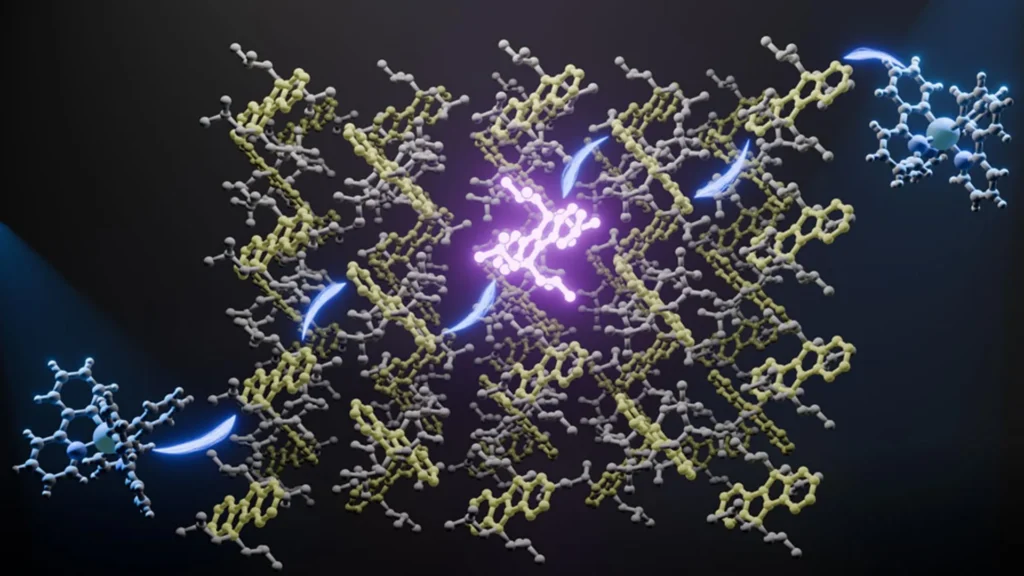
The scientific foundation for this transformative technology lies in a phenomenon called triplet-triplet annihilation (TTA). In essence, this process involves a donor molecule that initially absorbs visible light, propelling it into a high-energy triplet state. This absorbed energy is then efficiently transferred to a nearby acceptor molecule, also placing it in an excited triplet state. The pivotal moment in TTA occurs when two of these triplet-state molecules encounter each other. They then merge, combining their energies to emit a single, more energetic UV photon.
Historically, scientists have observed that TTA operates with considerable effectiveness in liquid environments. This is largely attributed to the inherent freedom of molecular movement in liquids, which facilitates frequent and efficient interactions between donor and acceptor molecules. However, liquid-based systems are often fraught with practical limitations. They frequently necessitate the use of toxic solvents, posing environmental and health concerns, and their tendency to evaporate over time can lead to reduced efficiency and the need for constant replenishment, thus limiting their long-term viability and scalability. Consequently, the scientific community has been actively pursuing a robust and reliable solid-state alternative for many years.
"In solid materials, molecules are inherently packed much more closely together," Professor Sasaki elaborated. "This proximity allows their electron clouds – regions of high electron density that hover above and below the molecular plane – to overlap significantly. While this closeness is crucial for energy transfer, excessive overlap can cause the excited triplet states, known as excitons, to ‘fizzle out’ or become deactivated before they have a chance to interact. Therefore, a delicate balance is required: molecules must be sufficiently close for energy transfer to occur, but also sufficiently separated to prevent this detrimental quenching of excitons."
A Groundbreaking Solid-State Solution: Dihydroindenoindenedene (DHI)
The breakthrough achieved by the Kyushu University team hinges on a sophisticated organic semiconductor material known as dihydroindenoindenedene, or DHI. This novel material represents a significant departure from previous attempts to achieve solid-state photo upconversion.
The researchers ingeniously modified the DHI molecule by strategically attaching alkyl chains to its sp³ hybridized carbon atoms. These specific carbon atoms are characterized by their four bonds, which are directed in fixed three-dimensional orientations. This precise architectural design proved instrumental in establishing carefully controlled spacing between adjacent DHI molecules within the solid-state matrix. The result was a material where the molecules were positioned close enough to facilitate efficient energy transfer, yet simultaneously maintained sufficient separation to prevent the strong electronic interactions that can lead to exciton quenching and diminished performance.
The newly engineered DHI-based material exhibited exceptional luminescence properties, characterized by long-lived excited states and remarkably effective energy transfer mechanisms. Crucially, it achieved a solid-state fluorescence quantum yield exceeding 60%, a figure that underscores its inherent efficiency in emitting light after absorbing energy.
When this modified DHI material was integrated into a system with a suitable donor molecule, the researchers observed an impressive upconversion efficiency of 1.9%. Professor Sasaki further contextualized this achievement: "This means that for every one hundred visible-light photons absorbed by the system, approximately two UV photons are produced. While this figure might initially appear modest, it is crucial to recognize that this process operates solely on natural sunlight. Most existing solid-state materials struggle to achieve comparable efficiencies even when subjected to significantly higher light intensities."
Charting the Course: A 14-Year Scientific Odyssey
The development of this pioneering material is not merely a recent accomplishment but the culmination of a dedicated, multi-year scientific endeavor. The journey began in 2012 when Nobuo Kimizuka, now a Professor Emeritus at Kyushu University’s Research Center for Negative Emissions Technologies, embarked on an ambitious exploration of photon upconversion through triplet energy migration within self-assembled molecular systems. His overarching vision was to establish a new paradigm in molecular systems chemistry, where intricate molecular self-assembly could be leveraged to perform sophisticated and valuable functions.
Over the subsequent years, Professor Kimizuka’s research group made consistent and incremental progress, primarily focusing on solution-based and gel-based systems. However, achieving efficient upconversion in a solid-state format remained an elusive and formidable challenge.
A pivotal turning point arrived in May 2024, a mere year before Professor Kimizuka’s planned retirement. This breakthrough marked the culmination of years of persistent research and experimentation. The months that followed witnessed an intensified and collaborative effort to bring the project to its final publication. A dedicated team, including graduate students Naoyuki Harada, Hayato Shoyama, and Nutnicha Boonmong, alongside Professor Sasaki and then-Assistant Professor Kiichi Mizukami of Kyushu University’s Faculty of Engineering, worked tirelessly to consolidate their extensive research findings into a coherent and comprehensive scientific manuscript.
"We were able to submit the draft manuscript to Professor Kimizuka just eleven days before he concluded his tenure in the lab," Professor Sasaki recounted. "For us, this felt like presenting a heartfelt retirement gift, a tangible representation of his enduring legacy."
Professor Kimizuka himself reflected on the significance of this achievement: "This discovery represents the apex of over fourteen years of dedicated research by our team. It marks a profound milestone in the fields of photon upconversion and molecular self-assembly, pushing the boundaries of what we previously thought possible."
Unlocking New Frontiers: Potential Applications for Solar-Powered UV Light
The potential applications for this novel solar-powered UV light generation technology are vast and transformative. The researchers have already taken steps to protect their innovation by filing a patent application for the material.
Beyond its impressive performance metrics, the material offers several practical advantages that enhance its appeal for widespread adoption. It can be synthesized through relatively straightforward procedures and is derived from inexpensive and readily available starting materials, contributing to its economic feasibility. The Kyushu University team envisions a future where this technology could be integrated into a range of sustainable solutions, including solar-powered photocatalysis for chemical reactions and environmental remediation, advanced indoor air purification systems that operate autonomously using sunlight, and low-intensity 3D printing technologies that reduce energy consumption.
Broader Implications and Future Directions
The successful development of a solid-state material capable of efficient photo upconversion has far-reaching implications for various scientific and industrial sectors. It opens new avenues for energy harvesting and conversion, moving beyond traditional photovoltaic technologies. The ability to generate UV light on demand using only sunlight could revolutionize areas such as sterilization, water purification, and advanced material processing, particularly in off-grid or remote locations where access to conventional power sources may be limited.
The scientific community’s response to this breakthrough has been overwhelmingly positive, with many researchers acknowledging its potential to overcome existing limitations in UV light generation and application. Dr. Evelyn Reed, a materials scientist specializing in photochemistry at the National Renewable Energy Laboratory (NREL), commented, "The efficiency achieved by the Kyushu University team in a solid-state format is a remarkable feat. Overcoming the challenges of exciton quenching in solids has been a major hurdle for decades. This work represents a significant step forward in making upconversion technologies more practical and scalable."
Furthermore, the research contributes to a deeper understanding of molecular interactions in solid-state environments, potentially inspiring the design of new materials for a wide range of quantum technologies. The principles demonstrated in this study could also be applied to upconverting other wavelengths of light, expanding the spectrum of usable solar energy for diverse applications.
Looking ahead, the Kyushu University team plans to further optimize the efficiency of their DHI-based material and explore its performance under a wider range of environmental conditions. They are also investigating methods for large-scale manufacturing and integration into prototype devices. The long-term goal is to pave the way for commercial applications that leverage the power of sunlight to generate UV light sustainably and efficiently, ushering in a new era of solar-powered innovation.