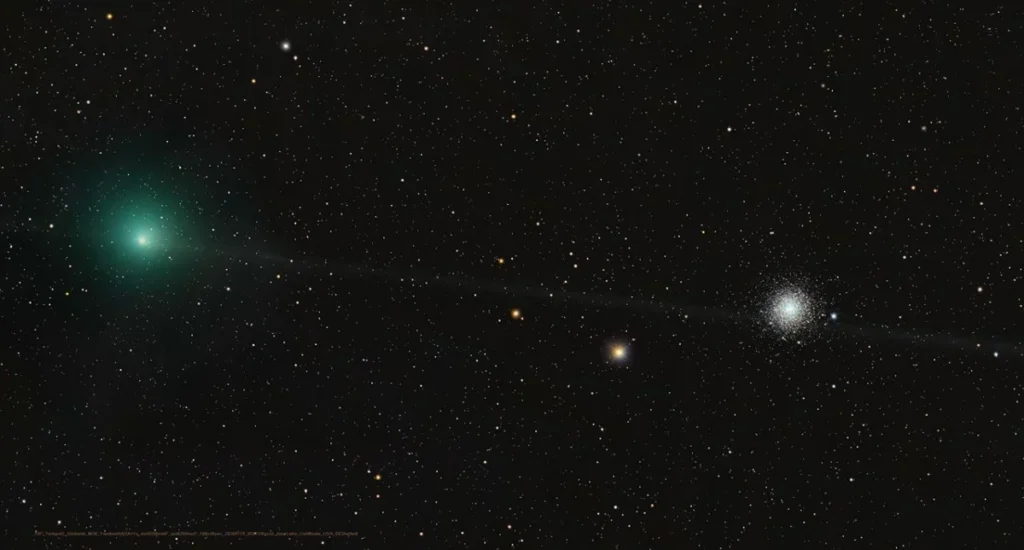
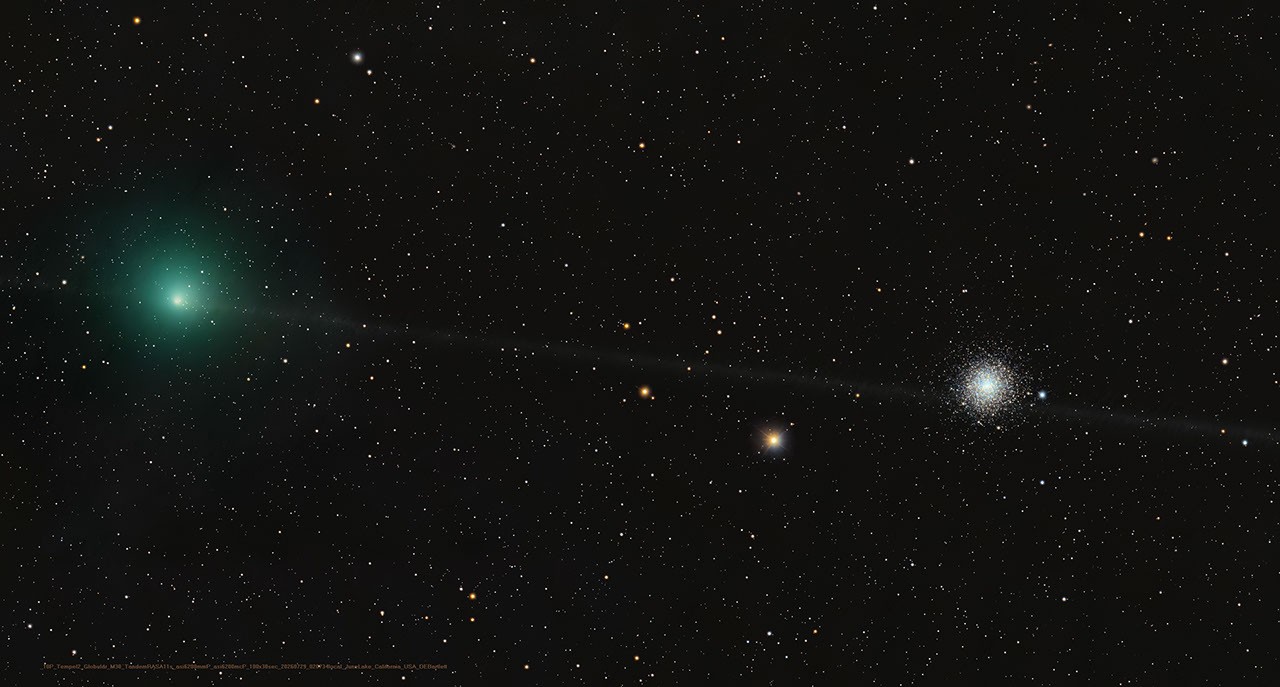
A remarkable celestial juxtaposition, captured in a recent telescopic image, presents the diffuse, greenish coma of periodic comet 10P/Tempel 2 alongside the dense, ancient globular star cluster Messier 30 (M30). This striking visual, featured as the Astronomy Picture of the Day (APOD) on August 10, 2026, offers a unique opportunity to explore the distinct nature of these astronomical phenomena, highlighting the historical quest to differentiate between transient comets and seemingly static deep-sky objects. The image serves as a testament to the advancements in astronomical observation, allowing us to perceive details that would have been indistinguishable to early skygazers.
A Tale of Two Celestial Objects: Comet Meets Cluster
The photograph prominently displays the comet 10P/Tempel 2 on the left, characterized by its ethereal, greenish coma. This coma, a hazy envelope of gas and dust surrounding the comet’s nucleus, is illuminated by sunlight and often exhibits distinct coloration due to the presence of specific molecules, such as diatomic carbon (C2), which fluoresces green. In contrast, the object on the right, Messier 30, appears as a tightly packed, luminous sphere of stars. This globular cluster is a venerable collection of hundreds of thousands of stars, bound together by gravity, and representing a snapshot of the galaxy in its earlier stages of formation.
The visual riddle posed by the image – "Which of these is not a comet?" – directly addresses the historical challenge faced by astronomers like Charles Messier. In the 18th century, Messier, a renowned comet hunter, meticulously cataloged objects that appeared fuzzy and diffuse in his telescopes. His primary objective was to identify and track comets, which traverse the solar system on predictable orbits. However, his observations often revealed numerous other non-cometary objects, such as nebulae and star clusters, that shared a similar fuzzy appearance in his relatively low-resolution instruments. To avoid confusion and wasting time on these stationary objects, Messier compiled his famous "Catalogue of Nebulae and Star Clusters." Messier 30, cataloged as the 30th entry in this influential list, was one such object that was definitively identified as not being a comet.
Historical Context: The Quest for Comets and the Birth of Cataloging
Charles Messier’s endeavors in the mid-18th century were driven by a fervent passion for discovering new comets. At the time, comets were often viewed with a mixture of awe and trepidation, perceived as celestial omens or harbingers of change. The ability to predict their appearance and trajectory was a significant scientific achievement. Messier, equipped with increasingly sophisticated telescopes for his era, embarked on a systematic survey of the night sky. His meticulous record-keeping, however, revealed a persistent problem: many of the fuzzy objects he observed did not exhibit the characteristic movement of comets against the backdrop of fixed stars.
His frustration with these "false alarms" led him to create his catalog. The Messier catalog, now a cornerstone of astronomical nomenclature, initially comprised 110 objects and was intended as a guide to help astronomers distinguish between comets and these other, non-moving celestial bodies. Objects like M30, a globular cluster, were included precisely because they were static and thus not the comets Messier was actively seeking. This historical context underscores the fundamental difference between comets, which are dynamic members of our solar system, and globular clusters, which are ancient and gravitationally bound stellar islands within our galaxy.
The Modern View: Unveiling Distant Worlds and Their Interstellar Connections
The modern telescopic image captured on July 29, 2026, showcases the capabilities of contemporary astronomical instruments. It not only clearly distinguishes the comet from the globular cluster but also reveals subtle details that would have been invisible to Messier. The faint, narrow, orbital dust trail of comet 10P/Tempel 2 is discernible, hinting at the comet’s passage and the material it has shed. This dust trail is composed of microscopic particles released from the comet’s nucleus as it approaches the Sun and heats up. These particles are left behind along the comet’s orbital path, forming a stream that can persist for thousands of years.
The image also provides a profound sense of cosmic scale and distance. Comet 10P/Tempel 2, though appearing to sweep close to M30 in the sky, was relatively nearby at approximately 3.5 light-minutes away from Earth at the time of observation. A light-minute is the distance light travels in one minute, roughly 18 million kilometers or 11 million miles. This proximity makes it a fleeting visitor within our solar system.
In stark contrast, Messier 30 resides at a staggering distance of approximately 28,000 light-years from Earth. This means the light we are observing from M30 today began its journey towards us 28,000 years ago. This immense distance places the globular cluster firmly within the halo of the Milky Way galaxy, a region populated by some of the galaxy’s oldest stars. The difference in distance highlights the vastness of space and the diverse nature of celestial objects.
Supporting Data and Astronomical Significance
Comet 10P/Tempel 2: A Periodic Traveler
- Orbital Period: Approximately 5.25 years. This relatively short period means 10P/Tempel 2 is a frequent visitor to the inner solar system, allowing for repeated observations.
- Nucleus Size: Estimated to be around 4.8 kilometers (3 miles) in diameter.
- Coma Characteristics: The greenish hue is primarily attributed to the emission from diatomic carbon (C2) molecules, which fluoresce when excited by ultraviolet radiation from the Sun. The coma can extend for hundreds of thousands of kilometers.
- Dust Trail: The visible dust trail is a direct consequence of the comet’s sublimation process and the solar wind’s influence on the ejected particles.
Globular Cluster Messier 30 (M30)
- Type: Globular cluster, a dense, spherical collection of stars.
- Age: Estimated to be around 12 to 13 billion years old. This places it among the oldest objects in the Milky Way galaxy.
- Star Count: Contains an estimated 100,000 to 1,000,000 stars.
- Diameter: Approximately 100 light-years across.
- Distance: About 28,000 light-years from Earth.
- Discovery: Cataloged by Charles Messier in 1764.
The concurrent appearance of a comet and a globular cluster in the same field of view is a matter of celestial alignment, dictated by the orbital paths of both objects relative to Earth. While such conjunctions are not exceedingly rare, they provide invaluable opportunities for comparative study and public engagement with astronomy.
Implications and Broader Impact
The visual comparison between comet 10P/Tempel 2 and Messier 30 serves as a powerful educational tool, reinforcing fundamental astronomical concepts. It underscores the distinction between solar system bodies and extragalactic or galactic objects. Comets, with their volatile composition and dynamic behavior, offer insights into the early conditions of the solar system and the potential for life’s building blocks. Globular clusters, on the other hand, act as time capsules, providing astronomers with a glimpse into the universe’s distant past and the processes of stellar evolution in dense environments.
The fact that this image was selected as APOD signifies its merit in both scientific interest and aesthetic appeal. NASA’s Astronomy Picture of the Day program has a long-standing tradition of showcasing the beauty and wonder of the cosmos, making complex astronomical phenomena accessible to a global audience. Such images can inspire curiosity, encourage scientific literacy, and foster a deeper appreciation for our place in the universe.
The successful capture of this dual celestial event by modern astronomical techniques also speaks to the ongoing advancements in telescope technology, image processing, and observational planning. Amateur astronomers, equipped with increasingly sophisticated instruments and collaborating through online platforms, are playing a vital role in astronomical discovery and documentation. The attribution of the image to a specific observation date and contributor (implied by the URL structure) suggests a collaborative effort within the astronomical community.
Future Observations and Unanswered Questions
The study of comets like 10P/Tempel 2 continues to yield valuable data on the composition and evolution of icy bodies in our solar system. Future missions, both robotic and potentially crewed, may target comets to conduct in-situ analysis, seeking to understand their origins and their role in delivering water and organic molecules to planets.
Similarly, globular clusters like M30 remain subjects of intense research. Astronomers are studying the dense stellar populations within these clusters to understand star formation, stellar dynamics, and the evolution of galaxies. The presence of dark matter within globular clusters is also an active area of investigation.
The image of 10P/Tempel 2 and M30, therefore, is more than just a beautiful photograph; it is a window into the past, a testament to scientific progress, and an inspiration for future exploration. It reminds us that the universe is a dynamic and awe-inspiring place, filled with objects of vastly different scales, ages, and origins, all sharing the same celestial canvas.
Tomorrow’s Glimpse: Contemplating the Sun
The accompanying announcement of "Tomorrow’s picture: Contemplating the Sun" hints at a focus on our own star, the Sun. This suggests a continued exploration of diverse astronomical subjects, from distant comets and galaxies to the immediate celestial neighbor that sustains life on Earth. The Sun, a star in its own right, presents a unique set of challenges and opportunities for astronomical study, from its energetic solar flares to its profound influence on the heliosphere. This transition from the deep universe to our local star underscores the comprehensive scope of astronomical inquiry.