In the fleeting moments following the Big Bang, the universe was not composed of the atoms, stars, or galaxies we observe today, but rather an ultra-hot, dense "soup" known as quark-gluon plasma (QGP). For decades, physicists have sought to recreate and understand this exotic state of matter by smashing atomic nuclei together at nearly the speed of light in massive particle accelerators. While much of the scientific focus has historically centered on the plasma’s temperature, its magnetic fields, and its swirling "vorticity," a groundbreaking new study led by researchers at Fudan University has turned its attention to a long-overlooked fundamental: acceleration. By mapping the intense acceleration fields within these subatomic fireballs, the team has identified a potential new "axis" in the phase diagram of matter, suggesting that acceleration itself may dictate how quarks and gluons transition into the baryonic matter that makes up our world.
The Quest to Replicate the Little Bang
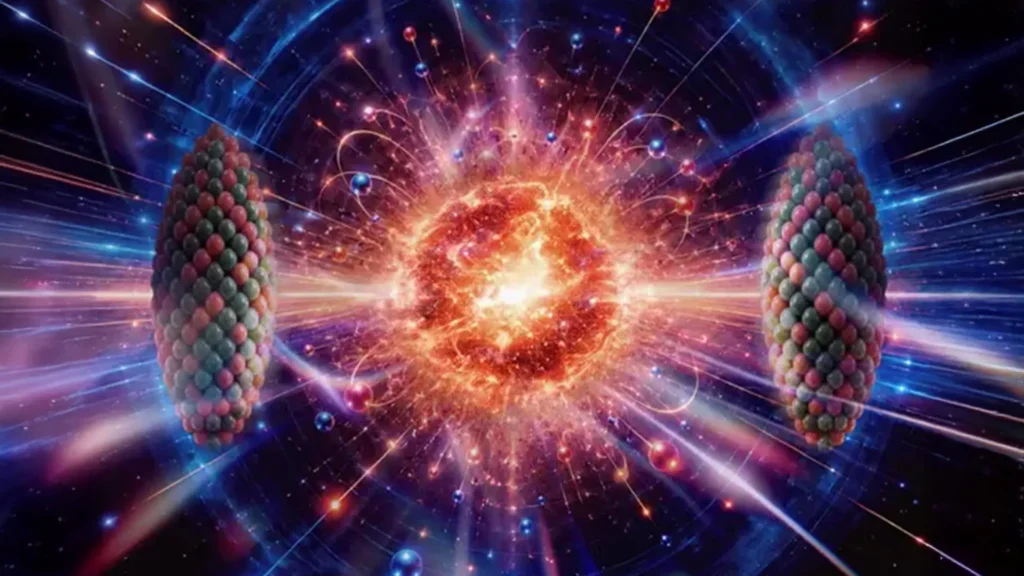
The study of quark-gluon plasma is essentially the study of the universe’s infancy. Under ordinary conditions, quarks and gluons are "confined" inside protons and neutrons by the strong nuclear force. However, when heavy ions—such as gold or lead nuclei—collide at ultra-relativistic speeds, the resulting energy density is so high that these bonds melt away. This creates a tiny, short-lived droplet of QGP, often referred to as a "Little Bang."
For the past twenty years, experiments at the Relativistic Heavy Ion Collider (RHIC) in New York and the Large Hadron Collider (LHC) in Switzerland have confirmed that QGP behaves like a "nearly perfect fluid," characterized by extremely low viscosity. While researchers have extensively mapped the "vorticity"—the localized swirling or "spin" of this fluid—and the colossal electromagnetic fields generated during collisions, the role of acceleration has remained largely in the shadows. In the realm of classical hydrodynamics, acceleration is a peer to vorticity; just as electric and magnetic fields are two sides of the same electromagnetic coin, acceleration and rotation are the twin pillars of fluid motion. The Fudan University team, led by Professors Yu-Gang Ma and Xu-Guang Huang, argued that without understanding acceleration, our picture of the early universe remains fundamentally incomplete.
Methodology: Bridging Particle Transport and Fluid Dynamics
To capture the elusive dynamics of acceleration, the research team utilized a sophisticated computational framework. The challenge in simulating QGP lies in its dual nature: it begins as a collection of individual high-energy particles but rapidly evolves into a continuous fluid.
The researchers combined two of the most robust models in the field: A Multi-Phase Transport (AMPT) and Ultra-relativistic Quantum Molecular Dynamics (UrQMD). These models track the trajectories and interactions of thousands of individual particles produced in a collision. However, to analyze these particles through the lens of fluid mechanics, the team applied a "Gaussian smearing" method. This technique effectively "smooths out" the discrete data points of individual particles into continuous fields of energy, momentum, and velocity.
By treating the particle debris as an evolving fluid, the team was able to calculate the "proper acceleration"—the acceleration experienced by a localized point within the plasma—across a vast range of collision energies, from 3.5 GeV (typical of lower-energy experiments) to 2.76 TeV (representative of the high-energy frontier at the LHC).
The Discovery of the Acceleration Hotspot
The simulations revealed a striking and consistent pattern: the most intense acceleration does not occur at the center of the collision, where the density is highest, but rather at the very edges of the expanding fireball. According to the team’s data, peak proper acceleration can reach several hundred MeV (mega-electronvolts). To put this in perspective, in the units typically used by particle physicists, this represents a force so massive that it rivals the internal forces holding a nucleus together.
The researchers identified the outer boundary of the plasma as an "acceleration hotspot." This phenomenon is driven by the physics described in the relativistic Euler equation. At the edge of the fireball, the internal pressure of the plasma drops precipitously as it meets the vacuum of space. Simultaneously, the enthalpy density—a measure of the fluid’s internal energy and pressure—remains low at the periphery. These two factors reinforce one another, creating a massive pressure gradient that "kicks" the matter outward with extreme intensity.
"The strongest transverse acceleration consistently points outward and appears near the outer boundary of the fireball," the researchers noted. This finding is significant because it explains how the plasma transforms from a static point of impact into a rapidly expanding system.
Energy Dependencies and Nuclear Stopping
One of the study’s most nuanced findings involves how acceleration patterns change as collision energy increases. The team observed a distinct "chronology" of motion depending on the speed of the colliding nuclei.
At lower collision energies (around 3.5 GeV to 7.7 GeV), the researchers observed a phenomenon known as "nuclear stopping." Because the nuclei are moving relatively slowly, they essentially "slam" into each other and decelerate significantly upon impact. This produces a deceleration phase of up to 500 MeV.
In contrast, at ultra-relativistic energies (TeV scales), the nuclei are moving so fast that they largely pass through each other. Instead of stopping, they leave behind a trail of high-energy gluons and quarks that are caught in the "wake" of the receding nuclei. This creates brief but incredibly intense acceleration pulses that pull the newly created plasma outward.
Surprisingly, the team found that the geometry of the collision—whether the nuclei hit head-on or "glance" off each other at an angle—has a minimal effect on the peak acceleration. Because the most powerful forces are concentrated at the boundary, the overall acceleration profile remains remarkably stable regardless of the impact’s centrality.
The Unruh Effect and the New "Acceleration Axis"
The most provocative implication of the Fudan study lies in the intersection of acceleration and thermodynamics. In theoretical physics, the Unruh effect suggests that an observer undergoing extreme acceleration will perceive a vacuum as being filled with a warm bath of particles. In other words, acceleration can mimic the effects of temperature.
Professor Xu-Guang Huang and his colleagues suggest that the accelerations of several hundred MeV observed in their simulations are high enough to trigger effects similar to those found at the QCD (Quantum Chromodynamics) transition temperature. This is the critical temperature at which quarks and gluons freeze into ordinary matter.
"Acceleration is not merely a kinematic detail—it may act as a thermodynamic control parameter of QCD matter," Professor Huang explained. This suggests that the "Phase Diagram of QCD Matter"—the map scientists use to understand the different states of nuclear matter—might need a third dimension. Traditionally, this map is defined by temperature and net baryon density. The Fudan team proposes adding an "acceleration axis."
If acceleration acts as a thermodynamic control, it could directly influence the chiral transition (the process by which particles acquire mass) and quark confinement. This would mean that the very act of the plasma’s rapid expansion changes the fundamental properties of the matter itself.
Solving the Spin Puzzle
The study also offers a potential solution to one of the most persistent mysteries in high-energy physics: the "spin polarization" of particles. For years, experiments at RHIC have shown that certain particles, called hyperons, emerge from collisions with a specific "spin" or orientation. While vorticity (the swirling of the plasma) explains some of this, it does not account for all the observed data.
The Fudan team argues that the intense acceleration gradients they mapped could generate previously unexplored transport effects. These effects, rooted in the non-inertial nature of the accelerating fluid, could influence the alignment of particle spins in ways that complement vorticity. By accounting for acceleration, researchers may finally be able to reconcile theoretical models with the experimental spin behavior observed at the LHC and RHIC.
Future Directions and Experimental Verification
The research community has reacted with cautious optimism to these findings. Dr. Elena G., a senior researcher at a major European physics laboratory (speaking on the implications of the study), noted, "If acceleration truly acts as a thermodynamic axis, it fundamentally changes how we interpret the results of heavy-ion collisions. It moves us away from a simple ‘hot soup’ model toward a much more dynamic, non-inertial system."
The Fudan team is already planning the next phase of their research. Their goal is to integrate more realistic hydrodynamic evolution into their calculations, moving beyond the current transport models to see how acceleration interacts with fluid viscosity over time.
More importantly, they are searching for "measurable signatures"—specific patterns in the debris of a collision that can only be explained by acceleration. This includes looking for specific patterns in hyperon spin polarization and the distribution of produced particles.
"Just as temperature and density define the phase diagram of matter, acceleration may open a new axis of that diagram," stated Professor Huang. "By mapping this hidden dimension of the quark-gluon plasma, we hope to turn non-inertial quantum effects into signatures that experiments can actually measure."
Conclusion: A New Lens on the Early Universe
The work of Ma, Huang, and their team represents a significant shift in the field of high-energy nuclear physics. By elevating acceleration from a secondary consequence of expansion to a primary driver of thermodynamic change, they have provided a new framework for understanding the strongest force in nature.
As particle accelerators around the world continue to push the boundaries of energy and intensity, the insights provided by this study will be crucial. Understanding the "acceleration axis" may not only solve local puzzles like the spin polarization of hyperons but could also provide deeper insights into how the universe transitioned from a chaotic plasma into the structured world of atoms we inhabit today. The "Little Bangs" created in our laboratories are finally revealing the full complexity of their internal motion, proving that in the world of the ultra-fast, how you speed up is just as important as how hot you get.