Researchers at the University of Oxford have unearthed compelling evidence suggesting that Mars, long considered a geologically simpler "stagnant lid" planet, may have once harbored vast, Earth-like magmatic systems deep beneath its surface. This groundbreaking discovery, detailed in the latest issue of Nature Astronomy, challenges long-held assumptions about the necessity of plate tectonics for developing complex planetary interiors and opens new avenues for understanding how rocky planets, including those beyond our solar system, might evolve to support life.
Unveiling Mars’ Complex Interior: A Seismic Revelation
For decades, planetary scientists have classified Mars as a "stagnant lid" planet, a designation stemming from its lack of Earth’s dynamic plate tectonics. On our home planet, the ceaseless movement of tectonic plates plays a pivotal role in geological processes such as volcanism, the recycling of crustal material, and the very formation of continents. This absence of plate tectonics on Mars has led to the prevailing assumption that its crust developed through a comparatively straightforward and less complex geological history.
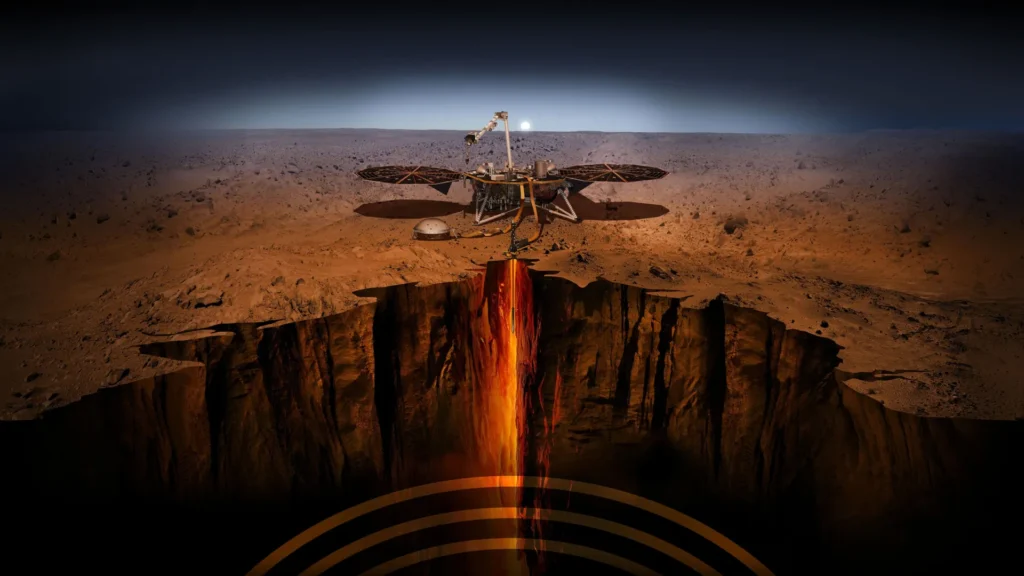
However, the new study, spearheaded by a team from Oxford’s Departments of Earth Sciences and Statistics, provides a powerful counterpoint to this long-standing hypothesis. By meticulously analyzing seismic data gathered by NASA’s highly successful InSight mission, the researchers have identified a previously enigmatic boundary approximately 24 kilometers beneath the Martian surface. This boundary, while noted in earlier research, had eluded definitive explanation.
The InSight mission, which landed on Mars in November 2018, deployed the first seismometer on another planet, providing an unprecedented window into the Red Planet’s internal structure. The mission’s primary objective was to study Mars’ deep interior – its crust, mantle, and core – to understand the processes and evolution of rocky planets. The seismic waves, generated by both meteorite impacts and marsquakes (the Martian equivalent of earthquakes), offered the crucial data for this latest revelation.
Deciphering the Seismic Signal: From Mystery Boundary to Magmatic Evidence
The Oxford team’s innovative approach involved a sophisticated integration of thermodynamic modeling and advanced statistical methods. They compared the observed seismic properties at and below the 24-kilometer boundary with hundreds of simulated rock compositions. This rigorous analysis allowed them to pinpoint the materials that best matched the geophysical characteristics detected at different depths.
The results of this detailed investigation were striking. The seismic data indicated that the rocks situated beneath the 24-kilometer mark are best explained by "ultramafic" material. This type of rock is characterized by its high concentration of iron and magnesium, and a correspondingly low silica content. Conversely, the seismic properties of the rocks above this boundary were found to be more consistent with "mafic" rocks, which contain a higher proportion of silica.
This stark contrast in composition strongly suggests a significant geological event or process that created a distinct layering within the Martian crust. The researchers propose that this buried layer is the product of a vast magmatic system that once existed deep within Mars. In this scenario, molten rock, or magma, would have accumulated in large reservoirs beneath the surface. Over time, through a process of fractional crystallization, this magma would have gradually separated into different components. Denser, early-forming crystals, rich in iron and magnesium, would have settled towards the bottom of the accumulating magma chamber, forming the ultramafic layer. Simultaneously, lighter, more chemically evolved melts, with a higher silica content, would have ascended and solidified to form the overlying mafic crust.
Transcrustal Magmatism: A Process Once Thought Uniquely Terrestrial
This process of magma evolution and differentiation, where molten rock undergoes significant chemical changes and layering within the crust, is known as "transcrustal magmatism." On Earth, such processes are well-documented beneath volcanic arcs and are intimately linked to the formation and growth of continental crust. The discovery that Mars may have experienced similar, large-scale transcrustal magmatism is particularly significant because it implies that complex geological evolution can occur even in the absence of Earth-style plate tectonics.
Dr. Tobermory Mackay-Champion, the lead author of the study, who was at the University of Oxford’s Department of Earth Sciences at the time of the research and is now with the University of Bristol, expressed the profound implications of these findings. "We’ve traditionally assumed that volcanism on Mars was relatively simple compared to that on Earth," Dr. Mackay-Champion stated. "But this discovery suggests Mars could sustain large, long-lived systems where molten rock evolved and reprocessed itself throughout the entire crust. It raises exciting possibilities for how common such systems might be on rocky planets beyond our solar system."
The scale of this inferred magmatic system could be immense. The study’s analysis suggests that this buried layer might extend across hundreds, or even thousands, of kilometers, potentially dominating large portions of Mars’ northern hemisphere. This suggests that ancient Mars was not solely characterized by isolated, simple volcanoes. Instead, the planet may have once hosted a vast, interconnected network of magmatic systems that profoundly shaped its crust.
Implications for Habitability: Rethinking the Requirements for Life
The implications of this research extend far beyond our understanding of Martian geology; they have significant ramifications for the broader field of astrobiology and the search for habitable worlds. Geological recycling, the continuous process of crustal renewal and material exchange, is considered a crucial factor in the development and maintenance of environments conducive to life. On Earth, plate tectonics drives this recycling, playing a vital role in regulating the planet’s climate and sustaining the long-term cycling of essential elements like water and carbon.
For many years, the presence of plate tectonics has been viewed as a potential prerequisite for habitability. The assumption has been that without this dynamic geological engine, a planet would struggle to develop the complex atmospheric and oceanic systems, as well as the stable climate, necessary for life to emerge and thrive.
However, the findings from Mars offer a compelling alternative. They demonstrate that substantial geological recycling and complex crustal evolution can occur through internal processes, even on planets lacking Earth-like plate tectonics. This suggests that the conditions necessary for habitability might be more widespread across the universe than previously thought.
Professor Jon Wade, a co-author from the University of Oxford’s Department of Earth Sciences, highlighted this crucial point. "One of the big questions in planetary science is whether Earth is unique," Professor Wade remarked. "If Mars could develop this kind of complex crust without plate tectonics, then maybe the conditions needed for habitability can emerge on more planets than we realized, including those previously dismissed based on size or their apparent lack of tectonic activity."
This broadened perspective could significantly impact the way scientists search for exoplanets and assess their potential for harboring life. Planets that were previously overlooked due to their lack of observed tectonic activity might now be considered prime candidates for further investigation.
The Legacy of InSight: A Deeper Understanding of Mars
The InSight mission, though now concluded, has provided an invaluable dataset that will continue to inform planetary science for years to come. Its success in placing a seismometer on Mars and meticulously recording seismic activity has allowed researchers to peer into the planet’s interior with unprecedented detail. This particular study, a collaborative effort involving researchers from the University of Oxford’s Department of Earth Sciences and Department of Statistics, and the University of Bristol, stands as a testament to the mission’s profound scientific return.
The data collected by InSight has not only illuminated the internal structure of Mars but has also challenged fundamental paradigms in planetary evolution. The discovery of these ancient, Earth-like magmatic systems on a planet so different from our own underscores the diverse pathways rocky planets can take in their development. It suggests that the universe may be replete with worlds that, while not identical to Earth, possess the necessary ingredients and geological complexity to foster life.
Looking Ahead: Future Missions and the Search for Life
The implications of this research will undoubtedly shape the design and objectives of future Mars exploration missions. Understanding the extent and history of magmatic activity on Mars could provide crucial context for ongoing investigations into the planet’s past habitability and the potential for extant life. Future missions might focus on searching for direct evidence of these ancient magmatic systems, perhaps through the analysis of specific mineral deposits or isotopic signatures.
The ongoing quest to understand whether life exists beyond Earth is intricately linked to our comprehension of planetary evolution. By revealing that complex geological processes can unfold independently of plate tectonics, the Oxford study has expanded the cosmic neighborhood where such life might be found. The Red Planet, once viewed as a relatively simple geological entity, is proving to be a far more dynamic and complex world than previously imagined, offering tantalizing clues in the universal search for life.