Mass Finishing Inc. (MFI), a leading provider of industrial parts polishing and deburring machines, has introduced its innovative HZ-6 centrifugal barrel tumbler, a compact and highly efficient finishing solution designed to meet the burgeoning demand for streamlined post-processing of additively manufactured (AM) components. This new system addresses a critical bottleneck in the 3D printing workflow, offering a rapid and effective method for achieving superior surface finishes on complex, micro-precision parts.
The HZ-6 boasts a 6-liter capacity and an impressively small footprint of just 3×2 feet, making it an ideal addition to workshops where space is at a premium. Its mobility, facilitated by a set of integrated wheels, allows for easy repositioning to wherever it’s needed on the shop floor, or even removal when not in use. This flexibility underscores MFI’s commitment to providing practical and adaptable solutions for modern manufacturing environments. The system is engineered to deliver high-polished finishes on multiple additively manufactured components simultaneously, significantly reducing post-processing time.
Addressing the Surface Roughness Challenge in Additive Manufacturing
The efficacy of 3D printed metal parts is often hampered by surface roughness, a direct consequence of the layer-by-layer deposition inherent in processes like laser powder bed fusion (LPBF). While LPBF enables the creation of intricate and large-scale metal components, the resulting layered surface texture can impede optimal performance in demanding industries such as aerospace, energy, and healthcare. For medical applications, in particular, a smooth and uniform surface finish is paramount. For instance, 3D printed medical devices like stents and implants require a consistent finish to promote healthy bone in-growth, directly impacting patient outcomes. Overcoming this surface roughness is therefore a critical step in unlocking the full potential of additive manufacturing for high-stakes applications.
The HZ-6: A Closer Look at Design and Capability
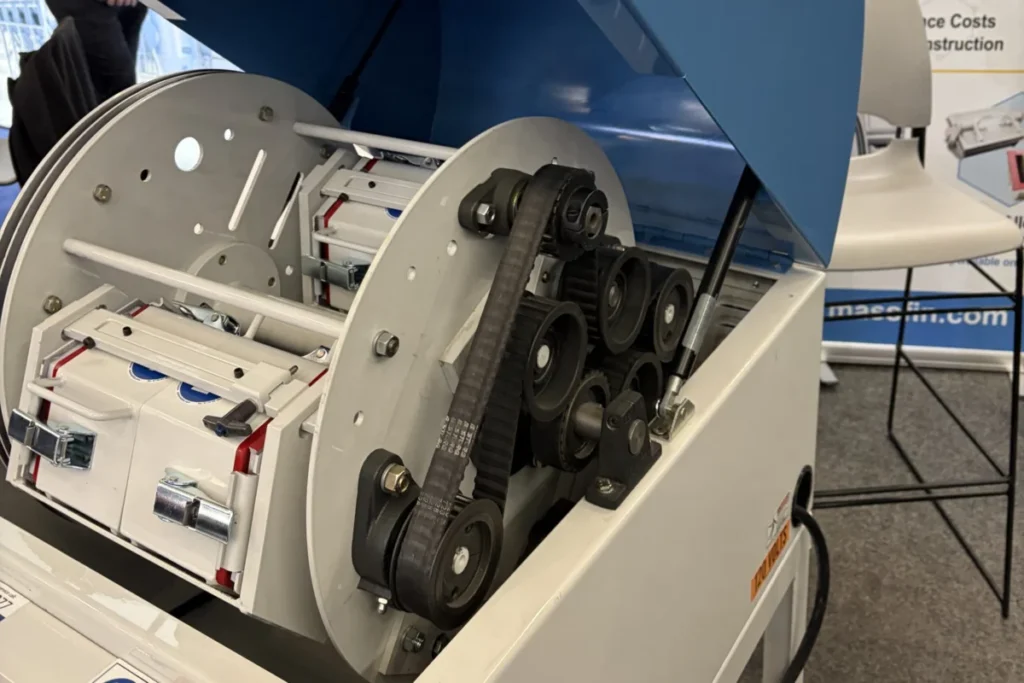
MFI’s HZ-6 is a sophisticated two-barrel system featuring two distinct cradle positions, offering exceptional versatility. One cradle accommodates a standard, full-size latched-end barrel measuring 8.375 inches in length. This larger barrel is capable of processing parts up to 8 inches long and with an outside diameter of 4.5 inches. Complementing this is a second cradle designed to hold two half-size latched-end barrels, each measuring 3.625 inches in length. These smaller barrels are specifically engineered for finishing small, micro-precision parts, and they require only minimal media for iterative testing and development processes. This dual-barrel configuration allows for simultaneous finishing of different part sizes or types, maximizing throughput.
A key advantage of the HZ-6, as highlighted by MFI, is its significantly reduced noise level compared to many vibratory tumbling systems. The machine utilizes centrifugal force, a high-energy method, to efficiently remove excess material, deburr components, polish surfaces, and achieve a refined final finish. This method is particularly well-suited for parts made from common AM materials, including titanium, copper, nitinol, and carbon steel, materials frequently employed in high-performance applications.
The Science Behind Centrifugal Barrel Finishing
Centrifugal barrel finishing, also known as centrifugal barrel tumbling, represents a high-energy, rapid post-processing technique that stands in contrast to more traditional methods like vibratory finishing. The principle of operation is often described as a "Ferris Wheel" effect, where the rotation of the barrels is directly synchronized with the rotation of the turret, typically at a 1:1 ratio.
The process begins by loading one or all four chambers of the machine with a carefully balanced combination of components, water, finishing compound, and abrasive media. The fill level is generally recommended to be between 50% and 80% of capacity to ensure optimal movement and action of the media and parts. As the machine’s turret rotates, the barrels undergo a planetary motion, creating a substantial sliding force within each barrel. This dynamic action, driven by centrifugal force, generates significant pressure and friction.

This intense mechanical action is highly effective in rapidly removing excess material and burrs from the component surfaces. Furthermore, it polishes the parts, imparting a smooth, uniform finish. The resulting surface finish is isotropic, meaning it is achieved uniformly and evenly in all directions across the part. This characteristic is crucial for applications where consistent surface properties are critical for performance and longevity.
Time Savings and Media Versatility
The high-energy nature of centrifugal barrel finishing translates into substantial time savings. While vibratory finishing might require 10 to 20 hours to achieve a comparable smooth surface on a metal AM component, MFI’s HZ-6 can accomplish the same results in as little as one hour, processing multiple parts concurrently. This dramatic reduction in cycle time can significantly accelerate production workflows and reduce manufacturing lead times.
The HZ-6 system is designed to accommodate a wide array of finishing media. This includes robust ceramic media for aggressive material removal, porcelain media for finer polishing, and plastic media for delicate parts. The variety of media shapes and sizes available allows operators to tailor the finishing process to the specific hardness and material properties of the components being processed, ensuring optimal results without compromising part integrity.
A Spectrum of Surface Finishing Techniques for AM Parts
The journey from a raw 3D printed part to a finished, functional component often involves a series of post-processing steps. Layer lines, residual powder, support structure marks, and internal surface roughness are common challenges that necessitate post-processing. It is important to note that there is no universal "AM finishing" solution; the optimal sequence of techniques depends on a multitude of factors, including the material used, the part’s geometry (particularly intricate internal features), the desired surface roughness, and the ultimate end-use requirements of the component. Below is an overview of common post-processing and finishing techniques employed in additive manufacturing today:
Media Blasting (Bead, Sand, or Soda)
This is frequently the initial step for both metal and polymer AM parts. Utilizing pressurized media, this process effectively removes loose powder, smooths minor surface imperfections, and imparts a uniform matte finish. It is a rapid and cost-effective method for preparing parts for subsequent finishing operations.
Tumbling and Vibratory Finishing
In these processes, parts are placed in a bowl or barrel along with abrasive media and subjected to prolonged agitation, often for many hours or even days. This method is well-suited for batch processing of small to medium-sized parts and is particularly effective for breaking sharp edges.
Chemical and Electrochemical Polishing
This technique involves immersing parts in a specialized chemical solution that selectively dissolves the raised areas (peaks) of the surface while leaving the recessed areas (valleys) largely intact. This method is advantageous for addressing both external and internal surfaces, making it ideal for complex geometries such as lattice structures, conformal cooling channels, and medical implants.
Abrasive Flow Machining (AFM)
AFM utilizes a viscous putty laden with abrasive particles that is pumped back and forth through internal passages under pressure. This method is widely employed for smoothing intricate internal features in components like AM fuel nozzles, manifolds, and hydraulic blocks.

CNC Machining
While often considered a subtractive manufacturing process, CNC machining remains essential for achieving precise tolerances on critical mating surfaces, bearing journals, sealing faces, and other features requiring tight dimensional control. The rise of hybrid manufacturing machines, which integrate additive processes like directed energy deposition (DED) or LPBF with subtractive capabilities like milling within a single setup, is further enhancing efficiency.
Manual Grinding, Sanding, and Polishing
For large structural components, prototypes, and the removal of stubborn support witness marks, manual finishing techniques remain indispensable. Despite advancements in automated processes, hand finishing often represents a significant cost driver in low-volume metal AM workflows.
Laser Polishing
This advanced technique employs a defocused laser to remelt a thin surface layer. Surface tension then naturally smooths out imperfections. Laser polishing offers the advantage of using no consumables and no media that needs to be cleaned from internal features, providing tightly controllable results. It is often an ideal solution for small, high-value parts, particularly in the dental and aerospace sectors.
Coatings and Plating
Various coatings and plating techniques, such as anodizing, physical vapor deposition (PVD), electroless nickel, and powder coating, can be applied to AM parts after mechanical preparation. These treatments can mask minor surface defects, enhance wear or corrosion resistance, or provide a uniform cosmetic appearance, further optimizing part performance and aesthetics.
Vapor Smoothing
In this automated process, 3D printed parts are placed in an airtight vessel containing a solvent. The vessel is then heated, generating vapor that smooths and polishes the part’s surface over several hours. Automated systems are popular for vapor smoothing, though the process can also be conducted in simpler sealed containers.
Broader Implications and Future Outlook
The introduction of MFI’s HZ-6 centrifugal barrel tumbler signifies a crucial advancement in the additive manufacturing ecosystem. By offering a compact, efficient, and rapid post-processing solution, MFI is directly addressing a key barrier to the wider adoption and commercialization of 3D printed parts, especially in industries with stringent surface finish requirements. The ability to achieve high-quality finishes quickly and cost-effectively will likely accelerate the integration of AM into mainstream production lines.
As the demand for additive manufacturing continues its upward trajectory, driven by innovation in materials, design, and applications, the importance of robust and efficient post-processing technologies will only grow. MFI’s HZ-6 appears well-positioned to be a significant player in this evolving landscape, enabling manufacturers to fully realize the potential of their 3D printed components with enhanced speed, quality, and economic viability. The company’s focus on compact solutions suggests an understanding of the practical constraints faced by many manufacturers, particularly small and medium-sized enterprises looking to leverage AM technologies. This development is a testament to the industry’s ongoing efforts to refine and optimize every stage of the additive manufacturing workflow, from design to final part delivery.