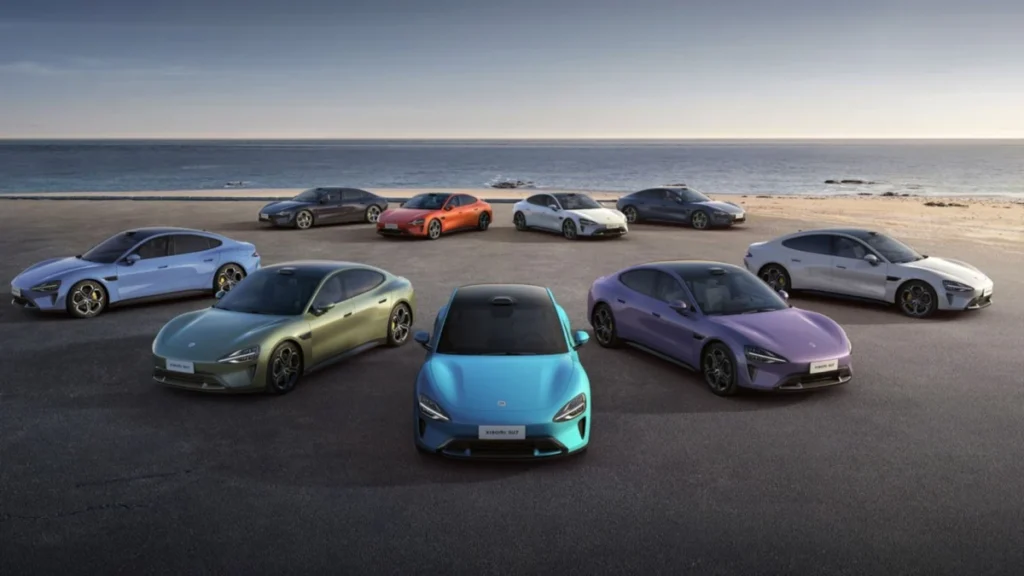
Xiaomi has unveiled its first self-developed high-performance chip for intelligent driving, the Xring D100, marking a profound expansion of the Chinese technology giant’s strategic push to design the critical computing hardware behind its burgeoning electric vehicle business. This announcement not only solidifies Xiaomi’s commitment to becoming a dominant player in the automotive sector but also positions it at the forefront of China’s rapidly accelerating domestic semiconductor development for smart cars. The Xring D100, built on a cutting-edge 3-nanometer process, is meticulously engineered for the demanding computational requirements of automotive artificial intelligence workloads, aiming for commercial deployment by 2027. This move places Xiaomi squarely alongside an increasing number of Chinese automakers, including BYD, Nio, Li Auto, and XPeng, all of whom are investing heavily in proprietary processors to power their increasingly sophisticated driver-assistance and autonomous-driving systems. The unveiling underscores a broader industry trend where the battle for automotive dominance is shifting from mechanical engineering prowess to advanced software and custom silicon.
The Dawn of a New Automotive Brain: Xring D100 Technical Specifications
At the heart of Xiaomi’s ambitious intelligent driving strategy lies the Xring D100, a processor designed to be a "brain" for its future vehicles. According to initial reports, the Xring D100 boasts an impressive architecture featuring a 20-core high-performance CPU (Central Processing Unit) paired with a robust 16-core NPU (Neural Processing Unit). This configuration is tailored to handle the complex parallel processing tasks inherent in AI-driven autonomous systems, from sensor data fusion to real-time decision-making. The chip further supports up to 160 GB of unified memory, a significant capacity that allows for rapid data access and efficient processing, crucial for high-speed, low-latency applications like autonomous driving.
Perhaps one of the most significant capabilities highlighted by Xiaomi is the chip’s ability to support the local deployment of AI models containing up to 200 billion parameters. This feature represents a substantial leap towards edge computing in vehicles, allowing future Xiaomi vehicles to possess considerably more onboard AI capacity. By reducing the need to offload certain computing workloads to external cloud servers, the D100 can enhance privacy, improve response times, and bolster the reliability of intelligent driving systems, especially in areas with limited connectivity. Large, parameter-rich models deployed locally can process vast amounts of information from an array of cameras, lidar, radar, and ultrasonic sensors, directly feeding into Xiaomi’s increasingly ambitious intelligent-driving software stack without the delays associated with cloud communication. This local processing power is vital for advanced functionalities such as predictive path planning, complex object recognition, and adaptive cruise control, enabling a more responsive and safer driving experience.
However, despite these detailed specifications, Xiaomi has not yet disclosed one of the D100’s most critical performance metrics: its computing power in TOPS (trillions of operations per second). This figure is a standard benchmark for AI accelerators and provides a direct comparison point against competitors. Unconfirmed estimates in the industry place the chip’s performance between roughly 700 and 1,000 TOPS, which, if accurate, would position it as a formidable contender in the high-performance automotive chip market. For context, some existing top-tier autonomous driving platforms from industry leaders like Nvidia can offer thousands of TOPS, often by combining multiple chips. The specific TOPS rating will be crucial in understanding the D100’s targeted level of autonomy and its competitive standing.
Strategic Imperative: Xiaomi’s Move Beyond External Suppliers
Xiaomi’s foray into self-developed automotive silicon represents a strategic pivot away from its reliance on external hardware suppliers, most notably Nvidia, for its intelligent-driving systems. The company’s existing electric vehicle models, such as the SU7 and YU7, have leveraged Nvidia’s robust automotive computing platforms. While these platforms are highly capable, the introduction of the Xring D100 signifies Xiaomi’s intent to gain greater control over a much larger part of its technology stack, from the foundational silicon to the overarching software.
The strategic advantages of designing both the hardware and software are multifaceted. Firstly, it provides unparalleled independence from third-party suppliers, mitigating risks associated with supply chain disruptions, geopolitical tensions, and licensing costs. This independence is particularly pertinent in the current global climate, where technological self-sufficiency, especially in critical components like semiconductors, has become a national priority for China. Secondly, and perhaps more importantly, vertical integration allows Xiaomi to theoretically optimize the D100 specifically around the unique data flows, memory requirements, and proprietary AI models used by its own intelligent-driving system. This bespoke optimization can lead to significant performance enhancements, energy efficiency gains, and a more seamless integration between the hardware and software, ultimately delivering a superior user experience and potentially unlocking new functionalities that off-the-shelf solutions might not fully support.
Furthermore, Xiaomi has explicitly stated that controlling the entire stack – the chip, the domain controller, and the underlying software – could lead to substantial reductions in component costs as production volumes scale. This cost-efficiency is a critical factor in the highly competitive EV market, where margins are often tight. Such vertical integration is not merely a corporate strategy but an increasingly vital trend across China’s burgeoning EV industry, as automakers strive to differentiate themselves through advanced technology while simultaneously achieving economies of scale.
The Chronology of Xiaomi’s Automotive Ambition
Xiaomi’s journey into the automotive sector has been marked by rapid acceleration and significant investment. The company, initially known for its smartphones and consumer electronics, officially announced its entry into the electric vehicle market in March 2021, committing an initial investment of 10 billion yuan ($1.5 billion) over the next decade. This was followed by the establishment of Xiaomi EV, Inc., with CEO Lei Jun personally leading the venture, underscoring the company’s serious commitment.
Prior to the Xring D100, Xiaomi had already demonstrated its semiconductor capabilities with its "Surge" series of chips for smartphones, indicating a long-term vision for silicon development. The development of the Xring D100 began in earnest as Xiaomi’s EV ambitions solidified, with significant resources poured into R&D. The formal unveiling of the SU7 electric sedan in late 2023 marked Xiaomi’s highly anticipated entry into the consumer EV market, with the vehicle quickly garnering considerable attention and strong order numbers. The SU7, while advanced, still relies on external suppliers for its intelligent driving compute. The Xring D100’s announcement now represents the next logical step in this chronological progression: moving from an assembler of cutting-edge components to a designer of its own core technological infrastructure, with a clear target for commercialization in 2027, presumably for next-generation Xiaomi EV models. This timeline allows for rigorous testing, refinement, and integration necessary for automotive-grade reliability.
China’s Intense Silicon Race: A Competitive Landscape
Xiaomi’s entry into the automotive chip design arena is not an isolated event but rather a reflection of a broader, fiercely competitive "silicon race" unfolding within China’s EV industry. Leading Chinese automakers are increasingly recognizing that future differentiation will hinge on their ability to control and innovate at the chip level.
BYD, China’s largest EV manufacturer, introduced its 4nm Xuanji A3 intelligent-driving chip earlier this year, demonstrating its commitment to in-house development. Similarly, Nio, Li Auto, and XPeng have all made significant strides in developing proprietary automotive processors. XPeng, a pioneer in intelligent EVs, for example, is already utilizing its in-house Turing chips in its production vehicles. Its GX robotaxi platform reportedly deploys four Turing chips, delivering a claimed 3,000 TOPS of onboard computing power. This comparison highlights the varying strategies and performance targets within the industry; while Xiaomi’s D100 (estimated 700-1,000 TOPS for a single chip) aims for a high-performance foundation, competitors like XPeng are demonstrating scalable solutions with multiple chips to achieve even higher aggregate computing power for more advanced autonomous applications.
Developing custom silicon, however, is an extraordinarily expensive and resource-intensive undertaking. Xiaomi has openly disclosed its staggering investment of more than 21 billion yuan, or roughly $3.1 billion, into its semiconductor program. This colossal sum underscores the financial commitment required, further evidenced by the establishment of a dedicated chip team comprising nearly 3,000 highly specialized engineers and researchers. Such a scale of investment suggests that self-designed chips may remain an exclusive option primarily for automakers with sufficiently large vehicle volumes to amortize the R&D costs and deep financial resources to sustain long-term development cycles. This trend could further consolidate power among the industry’s giants, potentially widening the technological gap with smaller, less capital-intensive players.
The Next Frontier: From Design to Road Deployment
The journey from a chip’s design to its commercial deployment in a vehicle is fraught with challenges. Xiaomi has reported that the Xring D100 has successfully completed validation, a crucial step that confirms the chip meets its design specifications and operates as intended in controlled environments. However, validation is merely the beginning. The company has yet to identify the specific first production vehicle that will incorporate the D100, indicating that further development and integration work is still underway.
Putting a powerful new chip on the road demands far more than just raw processing power. It must prove consistently reliable across an extreme range of automotive operating conditions, including fluctuating temperatures, vibrations, and electromagnetic interference. Deep integration with the vehicle’s complex ecosystem of sensors (cameras, radar, lidar), software architecture, and critical safety systems is paramount. This requires extensive testing, calibration, and certification to meet stringent automotive safety standards (such as ISO 26262). The process of achieving automotive-grade reliability and seamless integration can often take several years, highlighting the ambition behind Xiaomi’s 2027 commercialization target. This timeline suggests an aggressive but plausible roadmap for a company with Xiaomi’s engineering prowess and financial backing.
Broader Impact and Future Implications
The unveiling of the Xring D100 by Xiaomi carries significant implications for the global automotive semiconductor market, the future of intelligent driving, and China’s technological self-reliance ambitions. By developing its own core silicon, Xiaomi is not only challenging established automotive chip giants like Nvidia and Qualcomm but also contributing to China’s broader strategic push for technological independence in critical sectors. This move aligns with national goals to reduce reliance on foreign technology, especially in high-tech areas prone to geopolitical tensions.
For the automotive industry, Xiaomi’s announcement reinforces the paradigm shift towards software-defined vehicles and the growing importance of proprietary hardware. The ability to control the entire vertical stack allows for unprecedented levels of innovation and optimization, potentially leading to more advanced, efficient, and cost-effective intelligent driving solutions. Industry analysts suggest that this move intensifies competition within the EV landscape, compelling other automakers to either accelerate their own in-house chip development or forge deeper, more exclusive partnerships with semiconductor firms.
The ultimate battle for market leadership in the future of mobility may increasingly be decided not just by who builds the most aesthetically pleasing or mechanically sound vehicle, but by who builds the most intelligent and capable computer inside it. Xiaomi’s Xring D100 is a bold declaration of intent, signaling that the company aims to be not just a car manufacturer, but a leading technology provider shaping the very definition of intelligent transportation. As the 2027 commercialization target approaches, the automotive world will be watching closely to see how this ambitious chip translates into real-world performance and market disruption.