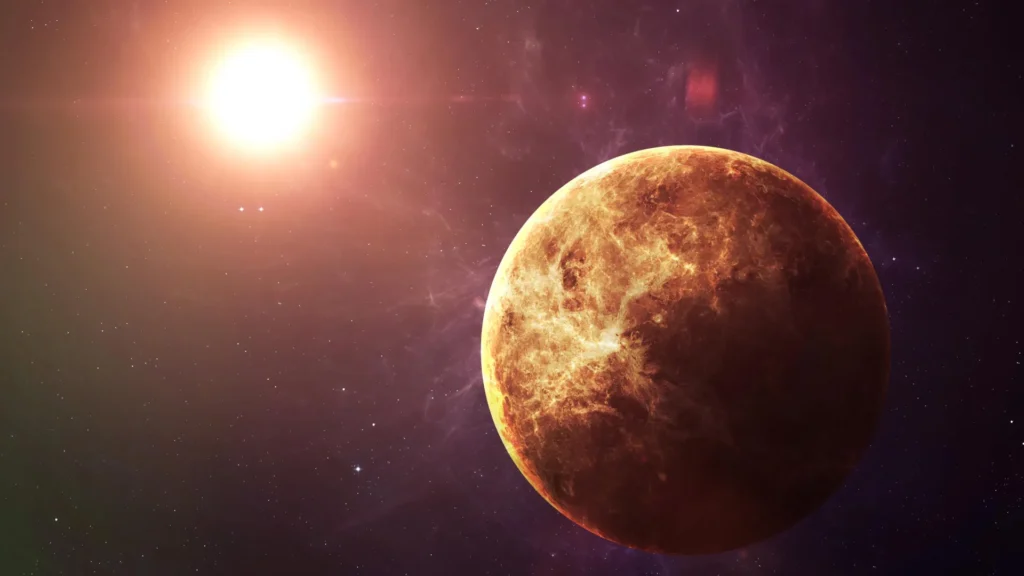
For decades, astronomers and planetary scientists have grappled with a persistent enigma: why does Venus, Earth’s strikingly similar planetary sibling, lack a moon? Despite sharing comparable size, mass, and fundamental geological structure, Venus remains conspicuously devoid of a natural satellite, a feature that has long set it apart from most terrestrial planets in our solar system. Now, groundbreaking research emerging from the University of California, Riverside (UCR) offers a compelling and somewhat unsettling explanation: Venus may have once possessed a moon, only for its own gravitational forces and peculiar rotational characteristics to ultimately draw that celestial companion back into its fiery embrace.
This novel hypothesis challenges long-held assumptions and suggests that the absence of a moon on Venus might not be the result of a catastrophic event or a failure to form in the first place, but rather a consequence of the planet’s inherent dynamics. Previous scientific endeavors to explain Venus’ lunar deficit generally converged on two primary scenarios. The first posited that Venus once harbored a moon, which was subsequently obliterated by a cataclysmic impact event, a cosmic collision of immense power that would have shattered any orbiting body. The second theory suggested that Venus simply never experienced the opportune giant impact, a rare but crucial cosmic event, thought to be the genesis of Earth’s own Moon, that could have seeded it with a satellite.
However, a new study, meticulously detailed in the esteemed journal The Astrophysical Journal, proposes a departure from these dramatic narratives. Lead author Stephen Kane, an astrophysicist at UCR, posits that Venus did not require an external catastrophe to explain its moonless state. Instead, his simulations indicate that the planet’s intrinsic gravity, coupled with its extraordinarily slow rate of rotation, could have naturally orchestrated the demise of any orbiting moon.
The Earth-Moon Dance: A Tale of Recession
To understand Kane’s theory, it’s crucial to first examine the well-documented relationship between Earth and its Moon. Scientists possess a precise understanding of our Moon’s slow but steady departure from Earth, a phenomenon meticulously tracked since the Apollo 11 mission. The installation of retroreflectors on the lunar surface by the Apollo astronauts has enabled scientists to measure the Earth-Moon distance with remarkable accuracy. These measurements reveal that the Moon is currently receding from Earth at an average rate of approximately four centimeters per year.
This outward migration is intrinsically linked to Earth’s relatively rapid rotation. Our planet completes a full rotation on its axis in roughly 24 hours. A significant portion of the rotational energy of Earth is transferred to the Moon through tidal forces. This energy transfer acts like a subtle but persistent push, gradually propelling the Moon farther away from its parent planet over eons. This dynamic process has been ongoing for billions of years, shaping the Earth-Moon system into what we observe today.
Venus: A Different Rotational Rhythm
Venus, in stark contrast to Earth, exhibits a dramatically different rotational characteristic. A single day on Venus, measured from one sunrise to the next, is an astonishingly long 243 Earth days. This sluggish rotation means that Venus spins on its axis far more slowly than any other planet in our solar system, including Earth. This profound difference in rotational speed has significant implications for the gravitational interactions between Venus and any potential moon.
In the case of Venus, the energy transfer mechanism that pushes Earth’s Moon outward is significantly weakened. Because Venus rotates so slowly, a moon orbiting it would not experience the same outward impetus. Instead, the prevailing gravitational forces of Venus, combined with its sluggish spin, could create a destabilizing effect. The research suggests that any moon in orbit around Venus would likely experience a gradual inward spiral, its trajectory slowly but surely bending towards the planet, ultimately culminating in a collision.
Simulating a Cosmic Collision
To rigorously test this hypothesis, astrophysicist Stephen Kane developed sophisticated computer models designed to simulate the intricate gravitational interactions between planets and their moons. These simulations are crucial for understanding the long-term evolution of planetary systems, especially under conditions that differ significantly from our own Earth-Moon experience.
Kane began by validating his model using the familiar Earth-Moon system. By inputting the known parameters of Earth’s rotation, mass, and the Moon’s orbital characteristics, he was able to accurately reproduce the observed recession of the Moon from Earth. This successful replication served as a critical benchmark, confirming that his simulation was behaving realistically and could reliably model celestial mechanics.
With the model’s accuracy established, Kane then turned his attention to Venus. He systematically adjusted the planet’s rotational rate to match Venus’ known 243-day day. He then introduced hypothetical moons into orbit around this simulated Venus, varying their masses across a broad spectrum. These simulated moons ranged in mass from half the mass of Earth’s Moon to a staggering ten times its mass, encompassing a wide range of potential lunar candidates.
The results of these simulations were remarkably consistent and, for Kane, initially surprising. Across the vast majority of the scenarios explored, the outcome was invariably the same: the hypothetical moon, over time, spiraled inward and collided with Venus. Even larger simulated moons met this fate more rapidly, suggesting that a more massive moon would have accelerated the process of orbital decay.
"When I made this discovery, I was shocked," Kane admitted in a statement. "I thought surely the broad range of scenarios I was exploring would lead to a variety of results. But it all went pretty much in the same direction." This uniformity in outcomes across diverse initial conditions lent significant weight to his theory, suggesting a robust and predictable mechanism at play.
The Unseen Past: Evidence Within Venus?
While Kane’s simulations powerfully suggest that a moon could have been reabsorbed by Venus, they do not definitively prove that such a moon ever existed. The formation of moons is a complex process, and whether Venus ever had the opportune conditions for a moon to form remains an open question. However, the study strongly implies that if a moon did exist, its long-term survival was unlikely due to the planet’s unique rotational dynamics.
Uncovering direct physical evidence of an ancient moon impact on Venus presents a formidable challenge. Venus has undergone profound geological transformations throughout its history. Current scientific understanding indicates that approximately 80% of the planet’s surface is remarkably similar in age. This uniformity is widely interpreted as evidence of a massive resurfacing event that occurred roughly a billion years ago. Such a cataclysmic geological upheaval could have effectively erased much of Venus’ older surface record, obscuring any direct traces of an ancient moon collision.
However, clues to Venus’ past might lie hidden deeper within the planet. Scientists theorize that Earth’s Moon formed as a result of a colossal impact early in our planet’s history. Seismic studies conducted on Earth have identified unusual structural anomalies far beneath the planet’s surface, which could potentially harbor remnants linked to this primordial impact event. Future advancements in our ability to conduct comparable seismic measurements of Venus could one day reveal whether our planetary neighbor also absorbed a moon, leaving behind similar subterranean evidence.
A Moon Crash: Reshaping Venus’ Destiny
The potential impact of a moon colliding with Venus could have had far-reaching implications for the planet’s evolution, including its habitability. If such a collision did occur, it would have delivered an immense surge of energy and angular momentum to Venus. This influx of energy could have profoundly altered the planet’s rotation, its geological activity, and its climate.
It is conceivable that if Venus once possessed conditions more favorable to life, such as oceans or a milder atmosphere, a major moon impact could have dramatically altered its subsequent evolutionary trajectory, potentially rendering it inhospitable. This possibility is particularly intriguing given that Venus is Earth’s closest planetary neighbor and, based on some scientific models, may have once been a far more Earth-like world than the scorching hot planet we observe today. The dramatic transformation of a potentially habitable world into its current state could be linked to such a profound cosmic event.
Extrapolating to Exoplanets: Lessons for the Search for Life
The implications of Kane’s research extend beyond our solar system, offering valuable insights into the search for potentially habitable exoplanets. When astronomers survey distant star systems for planets that might harbor life, they often prioritize worlds that resemble Earth. The presence or absence of a moon is a factor that researchers sometimes consider when assessing the long-term environmental stability and habitability of these exoplanets.
Earth’s Moon plays a multifaceted role in our planet’s existence. It influences tidal patterns, contributes to ongoing geological activity through tidal forces, and has demonstrably played a significant role in Earth’s overall evolutionary development. However, the exact extent to which a large moon is a prerequisite for the emergence or persistence of life remains a subject of ongoing scientific debate.
"My feeling is there are benefits to having a moon, but it isn’t required for habitability," Kane stated. "The moon has definitely changed the way Earth has evolved through time, but we don’t fully know how important that role is." His findings suggest that the formation of a moon might be only one piece of the puzzle; a planet must also possess the necessary dynamics to retain its satellite over cosmic timescales.
Planets that rotate too slowly, as Venus does, could be destined to reabsorb their moons, leading to collisions that dramatically reshape the planets themselves. This realization carries significant weight for exoplanetology. "When people think about Earth twins around other stars, one question they ask is, ‘Does it have a moon?’" Kane elaborated. "My study shows a disturbing scenario for many of those cases. If these planets don’t rotate fast enough, the moon will crash to the surface, and that would change the course of history for those planets." This underscores the complex interplay of factors that determine a planet’s habitability and its long-term evolutionary path, moving beyond simple size and atmospheric composition to include the subtle yet crucial influence of its rotational speed and its ability to maintain a stable satellite system. The mystery of Venus’ moonless state may thus offer a cautionary tale for our understanding of life beyond Earth.