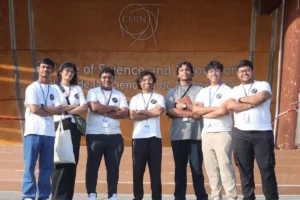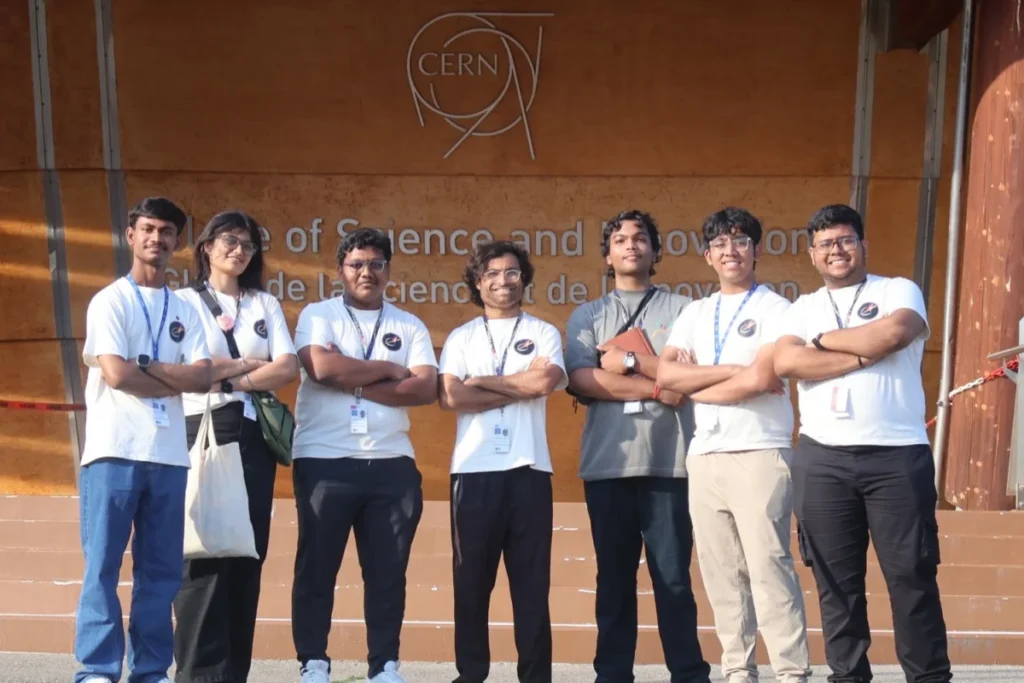
In the competitive landscape of international science, few opportunities carry the prestige and technical rigor of the Beamline for Schools competition hosted by CERN, the European Organization for Nuclear Research. This year, a group of six high school students from India, operating under the moniker Team attoPION, achieved a feat that distinguishes them among thousands of peers globally. Guided by Manu Srivastava, a doctoral student at the Massachusetts Institute of Technology (MIT) Center for Theoretical Physics, the team successfully navigated the complex selection process to become one of only five winning groups out of a record-breaking 712 entries from 89 countries. Their journey from a cold email to the experimental halls of Geneva represents a significant milestone in international STEM mentorship and the democratization of high-level particle physics research.
The collaboration began unexpectedly in the spring when Srivastava, a researcher specializing in quantum gravity under Professor Hong Liu at the Leinweber Institute, received an unsolicited email. Unlike the frequent requests from commercial entities seeking to pair affluent families with Ivy League mentors for a fee, this message came directly from the students themselves. Srivastava, recalling his own early career attempts to reach out to established scientists, recognized a genuine passion for inquiry in the students’ proposal. Despite the heavy demands of his PhD research, the authenticity of the students’ request prompted him to accept the role of mentor, setting in motion a multi-month collaborative effort that would eventually lead to the laboratories of CERN.
The Genesis of Team attoPION and the Competition Landscape
Team attoPION is composed of six secondary school students who met through various science competitions and mutual academic interests. Despite attending four different schools across four separate cities in India, the group maintained a cohesive research unit through digital collaboration. Their participation in the 13th annual Beamline for Schools (BL4S) competition placed them in a field of more than 4,500 students worldwide. The competition is designed to give high schoolers the rare opportunity to function as professional scientists, granting them access to a fully equipped particle accelerator beamline to test their own experimental hypotheses.
The selection process for BL4S is notoriously rigorous. Teams must submit a detailed written proposal and a video explaining their experimental goals, methodology, and the feasibility of their design. For the 2024 cycle, the competition saw its highest level of participation to date, reflecting a growing global interest in high-energy physics. Team attoPION’s success marks a significant achievement for Indian secondary education, highlighting the potential for students to engage with fundamental science at a level typically reserved for graduate-level researchers.
Defining the Experiment: Pion Charge Exchange and Neutrino Research
When Team attoPION first approached Srivastava, they arrived with several ambitious concepts. The mentor’s primary role was to help the students refine these ideas into a singular, scientifically viable experiment that could be executed within the constraints of a 12-day test-beam window. The group eventually settled on investigating the phenomenon of pion charge exchange.
Pions, or pi-mesons, are subatomic particles consisting of a quark and an antiquark. They are the lightest mesons and play a crucial role in mediating the strong nuclear force that binds protons and neutrons together in atomic nuclei. Pions can exist in three charge states: positive, negative, and neutral. The experiment designed by Team attoPION focuses on a specific interaction where a positively charged pion ($π^+$) strikes a neutron within a target material. This interaction results in the production of a neutral pion ($π^0$) and a positively charged proton.
The objective of the experiment is to characterize the frequency and cross-section of this reaction. While this might seem like a niche area of study, it carries profound implications for one of the most significant projects in modern physics: the Deep Underground Neutrino Experiment (DUNE).
Implications for Global Neutrino Physics
The Deep Underground Neutrino Experiment is a flagship international project led by Fermilab in the United States, involving more than 1,000 scientists from 30 countries. DUNE aims to study neutrino oscillations to answer fundamental questions about the nature of matter and the evolution of the universe. To do this, DUNE sends a beam of neutrinos through the Earth’s crust to massive detectors located deep underground.
Dave Newbold, a co-spokesperson for the DUNE collaboration and a prominent physicist, emphasized the importance of the students’ work. He noted that understanding how pions interact with matter is vital for quantifying uncertainties in neutrino measurements. When neutrinos interact with the argon atoms in DUNE’s detectors, they produce secondary particles, including pions. If these pions undergo charge exchange, it can alter the signal captured by the detectors, potentially leading to inaccurate estimates of the neutrino’s "flavor" or energy levels.
By providing high-precision data on pion charge exchange, Team attoPION’s work could assist DUNE researchers in refining their calibration models. Newbold pointed out that the students’ proposal was not merely a pedagogical exercise but a piece of "real experimental particle physics." He suggested that the results could lead to publishable data, a rare achievement for a team of high school students.
The Technical Challenges of Experimental Design
Preparing for a two-week stint at CERN required more than just theoretical knowledge; it demanded a deep dive into the logistics of experimental hardware. Under the guidance of Srivastava and Berare Göktürk, a support scientist for Beamline for Schools, the students had to grapple with the realities of data acquisition and detector sensitivity.
The charge-exchange process is an exceptionally rare event. Detecting it requires a sophisticated array of sensors capable of distinguishing between the various particles produced in a high-energy collision. The team had to design a system that could identify the neutral pion—which decays almost instantaneously into two gamma-ray photons—while filtering out the "noise" of other particle interactions.
Working with Göktürk, the students participated in preparation sessions where they were forced to confront the limitations of their equipment and the brevity of their beam time. At CERN, experimental time is a precious resource. With only 12 days to set up, calibrate, and run their experiment, the margin for error was razor-thin. Göktürk emphasized that the goal was not just to produce a result, but to teach the students the "journey of a scientist," which involves troubleshooting technical failures, managing uncertainty, and collaborating under pressure.
Bridging the Gap Between Theory and Experiment
For Manu Srivastava, the mentorship provided a unique opportunity to step outside the bounds of his own specialization. As a theoretical physicist at MIT focusing on quantum gravity, his daily work involves complex mathematical modeling rather than the hands-on assembly of particle detectors. However, he noted that the culture at MIT’s Center for Theoretical Physics encourages researchers to engage with the broader physics community through seminars and cross-disciplinary dialogue.
This interdisciplinary approach allowed Srivastava to guide the students through the theoretical motivations of their experiment while helping them connect their work to the experimental needs of the high-energy physics community. For Srivastava, the experience was also deeply personal. Having grown up in India, he viewed the mentorship as a way to give back to his home country and inspire a new generation of scientists to look beyond the more common paths of engineering and medicine toward fundamental research.
"I didn’t even know what CERN was in high school," Srivastava remarked, reflecting on the rapid advancement of scientific literacy and access in India. He credited the students’ success entirely to their own initiative and talent, noting that their ability to motivate their measurement and demonstrate its feasibility was at a level far exceeding typical high school standards.
The CERN Experience and Beyond
Upon arriving in Geneva, the members of Team attoPION were immersed in the daily life of the world’s largest particle physics laboratory. They worked directly with beamline scientists, operated data-acquisition systems, and attended lectures by leading researchers. This hands-on experience is the core mission of the Beamline for Schools program: to bridge the gap between textbook physics and the messy, iterative reality of experimental discovery.
The data collected by the team during their 12-day run is currently undergoing analysis. In particle physics, the "run" is only the beginning; the subsequent months are dedicated to "offline" analysis, where researchers sift through gigabytes of data to find the rare signals they were searching for. If their analysis holds up, the students may contribute valuable data to the global understanding of pion-nucleon interactions.
Broader Impact on STEM Education and International Collaboration
The success of Team attoPION serves as a powerful case study for the impact of remote mentorship and the globalization of science. It demonstrates that with the right guidance and access to resources, high school students can contribute to high-level research that has implications for multi-billion-dollar international projects like DUNE.
Furthermore, the collaboration highlights the role of prestigious institutions like MIT in fostering global talent. By supporting students from diverse backgrounds and geographical locations, researchers like Srivastava help ensure that the future of physics is inclusive and representative of a global talent pool.
As the 13th edition of Beamline for Schools concludes, the story of Team attoPION stands as a testament to the power of curiosity. What began as a hopeful email from four cities in India ended in the hallowed halls of CERN, proving that the distance between a high school classroom and the cutting edge of human knowledge is shorter than it has ever been. For these six students, the experience in Geneva is likely only the first chapter in what promises to be a significant contribution to the world of science.