A groundbreaking development from researchers at the Massachusetts Institute of Technology (MIT) introduces a novel class of mechanical metamaterials, dubbed "bifur-circuits," capable of sensing their own configuration and communicating these changes to electronic displays. This innovation marks a significant leap towards embedding intrinsic intelligence directly into hardware, promising a future where objects can dynamically transform, adapt, and interact with their environment in unprecedented ways. The system has been demonstrated through various interactive objects, including a multi-functional chair that effortlessly converts into a table with integrated storage and can even flatten for compact stowing, all while its changing form is recognized and conveyed electronically.
The Dawn of Intelligent Metamaterials: Bridging Form and Function
The core of this research lies in advancing the capabilities of mechanical metamaterials – sophisticated, three-dimensional structures composed of repeating units whose unique geometries allow them to form complex shapes under mechanical stress. Unlike traditional materials that deform predictably, metamaterials can be engineered to exhibit extraordinary properties, such as becoming wider when stretched (auxetic behavior) or bending and twisting in highly precise, pre-programmed ways. The MIT team’s "bifur-circuits" build upon this foundation, introducing a new level of reconfigurability and integrated intelligence.
Marwa AlAlawi, a mechanical engineering graduate student and lead author of the paper detailing these devices, emphasizes the transformative potential: "Metamaterials can make complex mechanical assemblies easy to manufacture just by using repeating units. Our work expands on this design space. If we think of mechanical metamaterials as building blocks, then our work is one way to take advantage of their geometry to embed intrinsic intelligence into hardware, which could open many possibilities." This sentiment underscores a paradigm shift from passive structural components to active, self-aware systems.
The research, soon to be presented at the prestigious ACM Symposium on User Interface Software and Technology, represents a collaborative effort across multiple institutions. AlAlawi is joined by co-senior authors Ticha Sethapakdi, an electrical engineering and computer science (EECS) graduate student at MIT, and Stefanie Mueller, an associate professor in MIT’s departments of EECS and Mechanical Engineering, who also leads the Human-Computer Interaction Group at the Computer Science and Artificial Intelligence Lab (CSAIL). Further contributions came from researchers at MIT, the University of Tokyo, and the University of Michigan, highlighting the interdisciplinary nature of this cutting-edge work.
Evolution of Reconfigurable Structures: From Fixed States to Exponential Possibilities
The journey towards bifur-circuits began with earlier explorations into auxetic metamaterials. In prior work, MIT researchers successfully utilized these unique materials to construct reconfigurable antennas. These antennas were notable for their ability to form three distinct shapes when stretched, allowing them to dynamically adjust their frequency range for communication and sensing applications without relying on bulky, conventional mechanical parts. This early success demonstrated the promise of metamaterials for adaptive hardware.
However, the team soon identified a limitation: the auxetic metamaterials could only achieve a fixed, albeit useful, number of configurations. To unlock a broader spectrum of adaptability, the researchers sought to expand the number of potential antenna configurations beyond these three states. This pursuit led directly to the conceptualization and development of "bifur-circuits."
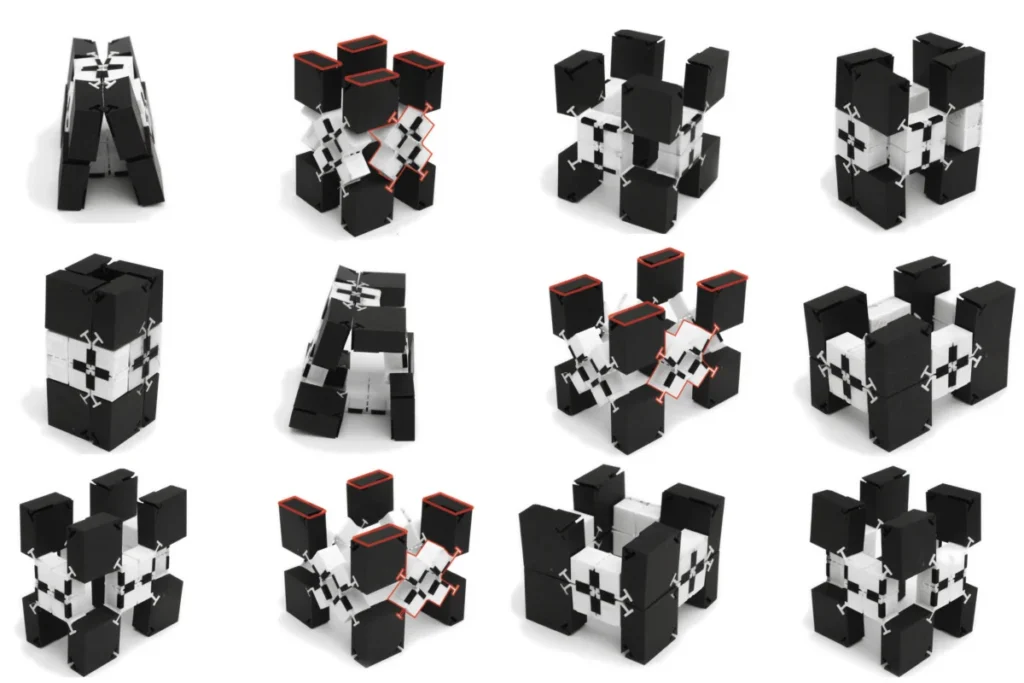
The innovation of bifur-circuits lies in their ability to form a significantly greater number of shapes, not just through stretching, but primarily by how their modular units are connected and rotated. This enhanced versatility is crucial for applications requiring complex, multi-state transformations. Critically, these units are also designed to be electrically modular. Conductive material is ingeniously integrated into the bifur-circuits, ensuring that electrical connections are seamlessly maintained throughout the structure, regardless of how the object is rotated, pressed, or twisted into new forms. This continuous electrical connectivity is what enables the embedded intelligence, allowing the structure to "sense" its own shape.
The Mechanism of Intelligence: Harnessing Mechanical Bifurcation
At the heart of bifur-circuits’ expanded reconfigurability is a property known as mechanical bifurcation. This phenomenon describes a sudden, dramatic change in a mechanism’s behavior once a force exerted upon it crosses a critical threshold – a tipping point. A common analogy is gently bending a plastic ruler; it will resist the force up to a certain point, after which it suddenly buckles into a new stable configuration.
In the context of bifur-circuits, this bifurcation occurs when connected blocks are rotated in specific ways around a pivot point. This property allows interconnected blocks to achieve a greater number of stable configurations than a single block could on its own. The true power emerges when multiple bifur-circuits are integrated: adding more units to a structure exponentially increases the number of potential configurations. As AlAlawi explains, "Bifurcation allows us to significantly expand on this reconfigurability space. Just adding one extra unit gives us so many more combinations out of the same structure."
This exponential increase in configurational states is directly tied to the embedded intelligence. As components are connected and rotated, they activate a unique electrical circuit between adjacent units. This inherent interactivity is the mechanism by which the structure gains the ability to "communicate" with itself, allowing it to precisely sense and identify its current physical configuration. This self-awareness is what differentiates bifur-circuits from previous reconfigurable systems, moving beyond mere shape-shifting to intelligent, context-aware adaptation.
Overcoming Engineering Challenges: Conductivity and Durability
The development of bifur-circuits was not without its engineering hurdles. A significant challenge revolved around incorporating a conductive material that possessed the necessary flexibility to bend and twist with the metamaterial units while simultaneously maintaining high electrical efficiency for reliable signal flow. "The conductive material was a constraint we had to work around in the design process, and it dictated how the sensing between blocks would happen," AlAlawi noted, highlighting the intricate balance required between mechanical and electrical properties. The team meticulously refined their design to ensure robust and consistent electrical connectivity across all possible configurations.
Durability was another critical consideration. For these reconfigurable structures to be practical for real-world applications, they needed to withstand repeated transformations without degradation. The researchers rigorously tested the bifur-circuits by compressing them over 10,000 times. The results were highly encouraging, demonstrating no discernible degradation in electrical connectivity, a testament to the robust design and material selection. This resilience is vital for applications ranging from consumer electronics to industrial robotics, where repeated use is standard.
To facilitate broader adoption and experimentation with bifur-circuits, the researchers also developed a user-friendly construction and simulation tool. This software simplifies the design process, allowing engineers and designers to explore various configurations and predict their behavior. Crucially, the tool generates precise instructions for multimaterial 3D printers, enabling the fabrication of these complex, reconfigurable objects in a single pass. This streamlined manufacturing process significantly lowers the barrier to entry for developing and prototyping bifur-circuit-based systems.
Demonstrated Versatility and Future Applications
The practical applications of bifur-circuits were vividly demonstrated through several prototypes. The interactive furniture example is particularly compelling: a single structure functions as a chair, which can then be reconfigured into a tea table with integrated storage, and further flattened for space-saving stowage. Throughout these transformations, the embedded bifur-circuits sense the geometry change and relay corresponding messages to an electronic display, providing real-time feedback on the object’s current state. This level of dynamic interaction opens new avenues for smart home furnishings and adaptable living spaces.
Another innovative demonstration involved a shape-shifting controller that could launch different video games based on its current configuration. Imagine a controller that physically transforms from a joystick to a steering wheel or a gamepad, instantly adapting its functionality to the game being played. This showcases the potential for highly intuitive and immersive user interfaces that are physically responsive to user intent.
Beyond these immediate demonstrations, the potential applications for bifur-circuits are vast and diverse. As previously noted, the technology can significantly enhance antenna design, allowing communication and sensing systems to dynamically adjust their frequencies to changing environmental conditions without requiring bulky, power-consuming mechanical motors or actuators. This could revolutionize mobile communications, satellite technology, and environmental sensing networks.
Looking further ahead, bifur-circuits could be instrumental in developing interactive rehabilitation tools that adapt their form and resistance to a patient’s progress, offering personalized therapeutic experiences. In the field of robotics, they could lead to shape-changing grippers for modular soft robots, enabling them to handle a wider variety of objects with greater dexterity and adaptability. In humanitarian and disaster relief contexts, reconfigurable shelters that can autonomously adjust their structure to respond to changing weather patterns or emergency needs could provide vital flexibility.
Broader Impact and Implications: A New Era of Intelligent Hardware
The development of bifur-circuits represents more than just an incremental improvement in materials science; it signals a fundamental shift in how we conceive and design hardware. By embedding intrinsic intelligence directly into the material structure, the MIT team is paving the way for a new generation of self-aware, adaptive, and highly functional objects.
This innovation has profound implications for various sectors. In manufacturing, the ability to create complex mechanical assemblies from repeating, intelligent units could drastically simplify production processes, reduce material waste, and lower manufacturing costs. This aligns with the principles of Industry 4.0, emphasizing smart factories and interconnected systems. The global market for smart materials and adaptive structures is already robust, projected to reach tens of billions of dollars in the coming years, driven by demand for greater efficiency, customization, and responsiveness in products. Bifur-circuits are poised to become a key enabling technology within this growing landscape.
The concept of "hardware intelligence" also integrates seamlessly with the burgeoning Internet of Things (IoT). Imagine a smart home where furniture reconfigures itself based on time of day or user presence, or architectural elements that adapt to sunlight and temperature. Bifur-circuits could provide the physical, adaptive layer for these intelligent environments, allowing objects to not only connect and communicate data but also physically respond and transform.
Furthermore, the principles demonstrated by bifur-circuits could foster greater sustainability. Products made from these adaptive metamaterials could have extended lifespans, as they can reconfigure to serve multiple purposes or adapt to evolving needs, reducing the need for new purchases and minimizing waste. The inherent programmability and reusability of modular units also support circular economy principles.
The research was supported, in part, by critical funding from Japan’s Science and Technology Agency and the Bahrain Crown Prince International Scholarship Program, highlighting the international recognition and investment in this transformative field. These partnerships underscore the global importance of developing next-generation materials with embedded intelligence.
Looking to the future, the researchers are keen to explore an even broader array of applications for bifur-circuits. They also aim to enhance the interactivity of these structures further and investigate additional metamaterial shapes and functionalities. Marwa AlAlawi articulates this ambitious vision: "Bifur-circuits are one step toward developing mechanical building blocks with integrated intelligence. It would be interesting to build on this work and come up with building blocks that allow us to create a structure with any form or shape we want, and which are structurally stable and can be actuated." This vision points towards a future where intelligent, reconfigurable materials are not just components but fundamental building blocks of an adaptive world, capable of dynamically shaping themselves and their functions to meet the ever-changing demands of human interaction and environmental conditions.