Cambridge, MA – Engineers at the Massachusetts Institute of Technology (MIT) have achieved a significant breakthrough in soft robotics and wearable technology with the development of a novel flexible, shape-sensing sheet capable of digitally reconstructing its own dynamic form as it bends and twists. This innovative material, detailed in the journal Advanced Intelligent Systems, promises to usher in a new era of interactive garments, advanced physical therapy tools, and intuitive human-robot interfaces, distinguishing itself from current rigid-sensor-based systems through its inherent softness, stretchability, and resilience.
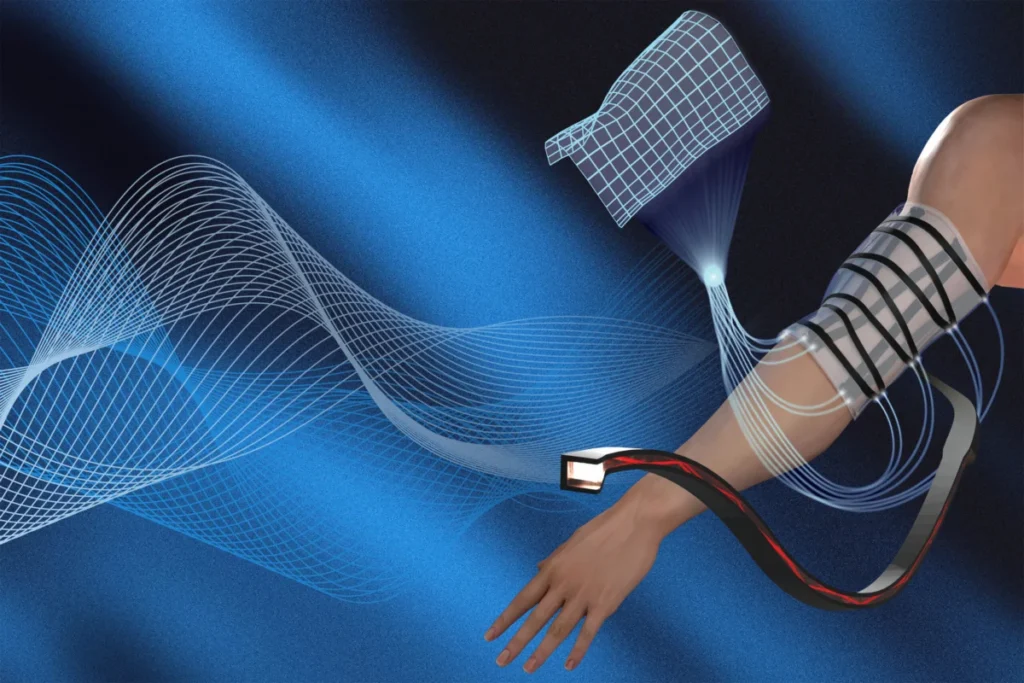
The core of MIT’s invention lies in its unique integration of multiple soft optical fibers, meticulously arranged in a zig-zag pattern throughout a pliant, stretchable silicone sheet. Unlike conventional motion-capture technologies that rely on strategically placed, rigid sensors to track movement and mimic it in a virtual environment, this new design harnesses the fundamental principle of light transmission through optical fibers. As the sheet undergoes deformation—bending, twisting, or stretching—the embedded optical fibers bend in unison, causing a subtle but measurable change in the pattern of light propagating through them. An advanced algorithm, developed concurrently by the research team, interprets these minute alterations in real-time, translating the bending light patterns into an accurate, dynamic digital representation of the sheet’s current 3D shape. A notable feature of this system is its robust damage resistance; the algorithm can still reconstruct the sheet’s overall form with high fidelity even if a few fibers are damaged or disconnected, a critical advantage for real-world applications.
Qifan Yu, a mechanical engineering graduate student at MIT and a lead researcher on the project, emphasized the safety aspect and potential for seamless integration with human physiology and soft environments. "Our setup is targeting fully soft and stretchable sensing surfaces so it’s potentially safer for interacting with a human or a soft environment," Yu stated, highlighting a key differentiator from existing technologies. The team envisions a future where this design could be fashioned into comfortable, pliable garments, allowing users to intuitively control video game characters or tele-operated robots with natural body movements. Beyond entertainment and remote operation, the technology holds immense promise for clinical applications, particularly in physical therapy, where it could precisely track and record a patient’s mobility and range of motion during rehabilitation sessions, offering quantitative data previously difficult to obtain.
The Evolution of Motion Capture and the Need for Softer Solutions
The field of motion capture (mocap) has a rich history, dating back to the early 20th century with techniques like rotoscoping in animation. Modern digital mocap, which gained prominence in the 1980s and 90s, traditionally relies on optical systems using cameras to track markers attached to a performer, or inertial systems using accelerometers and gyroscopes. While these methods have revolutionized animation, film, and sports analysis, they often involve cumbersome suits with rigid sensors, limiting comfort, natural movement, and direct interaction with the environment. The pursuit of "soft robotics" and "smart textiles" in recent decades has been driven by the desire to overcome these limitations, creating systems that are inherently flexible, conformable, and safe for human contact. This MIT innovation represents a significant leap in that direction, bridging the gap between sophisticated sensing and material softness.
The global market for smart textiles and wearable technology is experiencing exponential growth, projected to reach tens of billions of dollars within the next decade. This growth is fueled by advancements in material science, miniaturization of electronics, and increasing demand for health monitoring, immersive entertainment, and intuitive interfaces. However, a persistent challenge has been the integration of rigid electronic components into soft, pliable fabrics without compromising comfort, durability, or the fabric’s natural drape. MIT’s approach with soft optical fibers offers a compelling solution to this challenge, sidestepping the issues associated with traditional rigid sensors and opening up new avenues for truly integrated smart garments.
The Science Behind the Sensor: Harnessing Light’s Journey
The team’s shape-sensing design represents an ingenious modification of the standard optical fiber, also known as a waveguide. Fundamentally, an optical fiber is engineered to guide light efficiently through a core of transparent material (like glass or, in this case, clear rubber) encased in an opaque cladding. The cladding’s role is crucial: by trapping light within the core through total internal reflection, it ensures near-perfect light transmission over long distances, a principle vital for fiber optic telecommunications.
Scientists have long explored the use of waveguides as simple shape sensors. The underlying principle is that when an optical fiber bends, it affects how much light successfully travels through its entire length. A greater degree of bending typically results in more light scattering out of the core and less light reaching the other end. This relationship allows the amount of exiting light to serve as a proxy for the degree of fiber curvature. This method has been successfully applied to sense linear shapes, such as the curvature of a robotic arm. However, as Yu noted, previous applications largely focused on one-dimensional sensing. "People have used waveguides to sense the shape of a line, which they have applied to a robot arm to see how it curves," Yu explained. "But they haven’t been applied to surface shape sensing, to reconstruct the 3D shape of a surface. That’s what we’re trying to do here."
To achieve true surface shape sensing, the MIT team introduced several crucial "fiber tweaks." Instead of hard glass, they fabricated their fibers from a clear, flexible rubber for the core, with the cladding made from the same rubbery material, dyed black. The most critical modification, however, involved intentionally roughening one side of the fiber’s core while keeping the opposite side smooth. Their hypothesis was that if one side of the fiber were rougher, then the scattering of light would be directional. When the fiber bent towards its rough side, light passing through would scatter more intensely, affecting the total amount of light emerging from the other end differently than if the fiber were bent at the same angle but towards its smooth side. This innovative design effectively transforms the optical fiber into a bidirectional shape sensor, capable of distinguishing the direction of bending, not just its magnitude.
From Simulation to Fabrication: Crafting the Sensing Sheet
The development process for this sophisticated sensing sheet involved a meticulous combination of computational modeling and physical fabrication. The researchers began by creating multiple bidirectional optical fibers with their unique half-roughened design. The next challenge was to embed these fibers into a soft silicone sheet in a configuration that would allow for accurate reconstruction of the sheet’s complex 3D shape as it bent and twisted.
To determine the optimal fiber arrangement, the team carried out extensive simulations. They modeled silicone sheets embedded with various optical fiber patterns, ranging from straightforward checkerboard grids to more intricate, criss-crossed, and zig-zagging designs. Through these simulations, they subjected the virtual sheets to different bending and twisting deformations, meticulously measuring the simulated light output from each fiber configuration. These light measurements were then converted into estimates of individual fiber bending, which were subsequently combined to construct an overall 3D shape of the simulated sheet. By comparing these reconstructed shapes against the original simulated deformations, the researchers identified a specific spacing of zig-zagging fibers as the most effective pattern for accurately recreating the sheet’s original form. This iterative simulation process was crucial for optimizing the design before committing to physical fabrication, saving time and resources.
Following the successful simulations, the team proceeded to fabricate a physical shape-sensing sheet incorporating the optimized zig-zag pattern of optical fibers within the silicone. Each fiber was equipped with a miniature LED at one end to inject light and a light sensor at the other end to detect the transmitted light. These sensors were connected to an external circuit board, tasked with collecting and amplifying the minute light measurements. Crucially, the researchers also developed a bespoke algorithm designed to automatically and rapidly convert these complex fiber measurements into a real-time, 3D reconstruction of the sheet’s overall shape.
Rigorous Testing and Superior Accuracy
The efficacy of the new sensing sheet was rigorously tested in a series of experiments. The algorithm demonstrated its capability to smoothly generate a virtual, real-time reconstruction of the sheet as researchers physically manipulated it into various forms. For instance, when the sheet was folded diagonally, and then again in the opposite direction, its virtual counterpart seamlessly mimicked these changing shapes with minimal latency, almost in real-time. This dynamic reconstruction ability is paramount for applications requiring immediate feedback, such as controlling virtual avatars or robotic prosthetics.
To quantify the accuracy of their invention, the researchers placed the physical sheet over different 3D-printed molds. This allowed for a precise comparison between the digitally reconstructed sheet and the known, static shape of the physical sheet conforming to each mold. In these critical tests, the soft sensing sheet consistently outperformed existing designs based on rigid sensors.
"We use a metric that describes the distance between the actual surface and the reconstructed surface, and from that, we found our error was less than 0.4 centimeters," Yu proudly stated. "Existing designs, which are based on rigid sensors, have errors of around 1 to 2 centimeters. So that’s respectable, and at least on par with existing technologies." This significantly reduced error margin—up to five times more accurate than current rigid-sensor alternatives—underscores the superior precision and reliability of the MIT design, making it suitable for applications demanding high fidelity.
Broader Impact and Future Directions
The implications of this flexible, shape-sensing sheet extend across multiple sectors, promising transformative changes in how humans interact with technology and how medical professionals monitor patient progress.
In physical therapy and rehabilitation, the technology could revolutionize patient assessment and treatment. Current methods often rely on subjective observations, goniometers for joint angle measurements, or expensive, bulky optical motion capture systems. A wearable, soft sensing sheet could wrap comfortably around a patient’s limb, providing continuous, objective, and precise data on joint angles, range of motion, and movement quality throughout an exercise session. This granular data would empower physical therapists to meticulously track progress, customize rehabilitation plans, and provide tangible evidence of improvement. "We hope to build tools that augment what a physical therapist can do and help them track and quantify their patients’ progress over time," said Kaitlyn Becker, assistant professor of mechanical engineering at MIT and a co-author of the study. "These sensing sheets could help a physical therapist to recall and compare more precisely how an evaluation went today versus two months and hundreds of appointments ago." This capability to provide longitudinal, quantitative data could significantly improve patient outcomes and streamline clinical workflows.
For human-computer interaction (HCI) and virtual/augmented reality (VR/AR), the soft sensing sheet could enable entirely new forms of immersive experiences. Imagine a VR glove or suit that perfectly translates every nuanced hand gesture or body movement into a virtual environment without the clunky feeling of current haptic or tracking devices. This could lead to more intuitive gaming, more realistic virtual training simulations, and more natural interaction with digital content.
In soft robotics and teleoperation, the technology offers unprecedented control. Robots designed to work in close proximity to humans or in delicate environments often require highly dexterous and compliant control mechanisms. A flexible sensing skin could provide robots with a sense of "touch" and proprioception, allowing them to adapt to complex, unstructured environments and perform intricate tasks with greater precision and safety. Similarly, for tele-operated robots used in hazardous environments or for remote surgery, the ability to translate human hand and arm movements with high fidelity and comfort could significantly enhance operator control and effectiveness.
Looking ahead, the team is focused on further optimizing the sensing sheet. A primary goal is to thin down the optical fibers. Currently, the fibers are 1 millimeter thick, but advanced fabrication processes could reduce them to mere tens of micrometers—thinner than a strand of human hair. This miniaturization would allow for the embedding of many more fibers into a garment, significantly increasing the spatial resolution and detail of shape sensing. Such an enhancement would be critical for capturing highly nuanced changes in form, for instance, to gauge the subtle performance metrics of a patient in physical therapy or the intricate movements required for complex robotic manipulation.
This research, supported in part by MathWorks, underscores MIT’s ongoing commitment to pushing the boundaries of material science and engineering. By addressing fundamental challenges in flexible electronics and human-machine interfaces, these engineers are not just developing new sensors; they are laying the groundwork for a future where technology seamlessly integrates with the human body, offering unprecedented capabilities for health, interaction, and exploration. The development of this flexible, shape-sensing sheet marks a pivotal step toward a world where our garments are not just worn, but truly "smart," responsive, and an extension of ourselves.