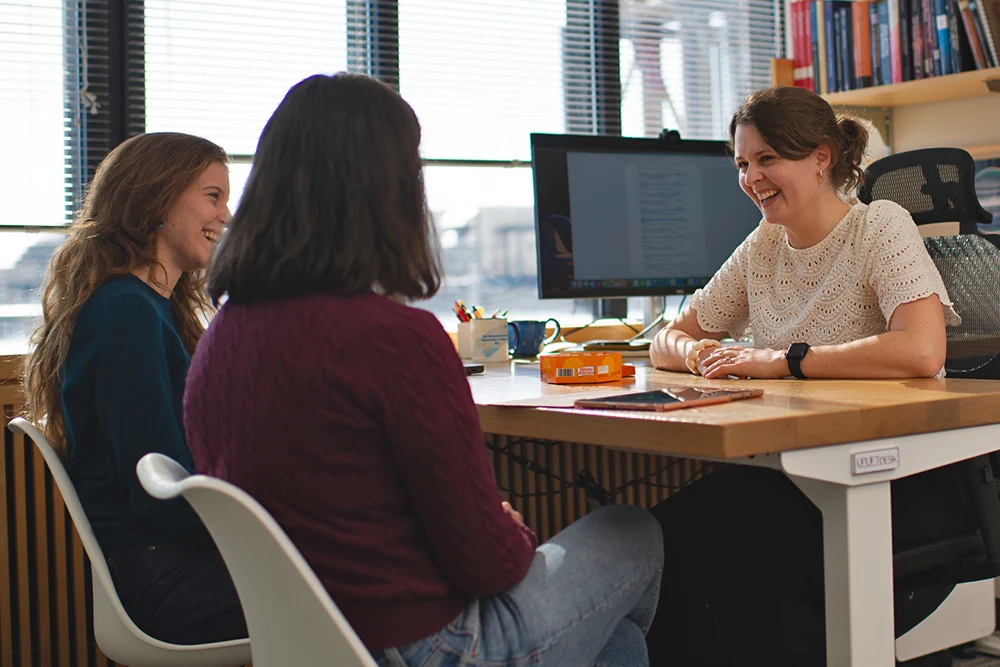
In the demanding environment of elite astrophysical research, where the pressure to publish and secure funding often overshadows the human element of academia, Professor Anna-Christina Eilers has established a sanctuary of mentorship at the Massachusetts Institute of Technology (MIT). An Assistant Professor in the Department of Physics and a member of the Kavli Institute for Astrophysics and Space Research, Eilers has been recognized by the MIT Committed to Caring (C2C) initiative. This student-driven program honors faculty members who go beyond their roles as researchers to provide exceptional support, guidance, and empathy to their graduate students. Eilers’ approach—defined by a blend of high scientific standards and a profound commitment to her students’ well-being—serves as a model for modern academic leadership in the Science, Technology, Engineering, and Mathematics (STEM) fields.
The Intersection of Mentorship and Scientific Discovery
The core of Professor Eilers’ professional life is the study of the "cosmic dawn." This epoch, occurring hundreds of millions of years after the Big Bang, represents the period when the first stars and galaxies began to form, ending the cosmic "dark ages." Her work specifically focuses on the growth of supermassive black holes and the nature of quasars—extremely luminous objects powered by gas spiraling into these black holes at nearly the speed of light.
For many graduate students, working at the literal edge of the observable universe can be an isolating and overwhelming endeavor. The complexity of analyzing data from instruments like the James Webb Space Telescope (JWST) and the Magellan Telescopes requires not only technical proficiency but also emotional resilience. Students in Eilers’ research group report that her mentorship provides the necessary framework to navigate these challenges. By fostering an environment where small, meaningful gestures are prioritized, she ensures that the daunting scale of the cosmos does not diminish the individual experience of the researcher.
The Committed to Caring Initiative: A Benchmark for Excellence
The Committed to Caring (C2C) program at MIT was established to highlight faculty members who demonstrate a consistent commitment to the graduate student experience. Unlike many academic awards that prioritize citation counts or grant acquisitions, C2C is entirely student-nominated. It focuses on several key "caring competencies," including advocacy, diversity, inclusion, and the promotion of work-life balance.
Eilers’ recognition comes at a time when the academic community is increasingly scrutinizing the "lonely scholar" trope. Research from the Council of Graduate Schools and various mental health advocacy groups has shown that high levels of stress and a lack of supportive mentorship are leading factors in graduate student attrition. By being honored through this initiative, Eilers is acknowledged for creating a counter-narrative—one where academic rigor and personal support are not mutually exclusive but are instead deeply intertwined.
A Methodology of Consistency and Feedback
One of the most frequently cited attributes of Eilers’ mentorship is her reliability. In the nomination letters submitted to the C2C committee, students emphasized that her support is not a sporadic occurrence but a constant feature of their daily lives. In the high-stakes world of astrophysics, where a single data error can stall a project for months, having an advisor who provides timely, meticulous feedback is invaluable.
Students describe a mentor who treats every draft of a paper with the same level of intellectual seriousness as a final submission. This "hands-on" approach does not stifle independence; rather, it provides a safety net that allows students to take greater scientific risks. By providing a clear roadmap for professional development and research progress, Eilers mitigates the ambiguity that often leads to "imposter syndrome" among young scientists.
Furthermore, Eilers is noted for her proactive stance on conflict resolution. In large-scale international collaborations—common in modern astronomy—disagreements over data interpretation or authorship can arise. Her students noted that Eilers does not hesitate to step in and advocate for their interests, ensuring that their contributions are recognized and that obstacles do not escalate into career-stalling crises.
Building Community Through Shared Traditions
Scientific research is often viewed as a solitary pursuit, yet Eilers has worked to transform her group into a cohesive community. This is achieved through a series of deliberate traditions that bridge the gap between the professional and the personal. For example, when a student successfully publishes a peer-reviewed paper, the group meeting is transformed into a celebration, complete with the student’s favorite dessert.
Another cornerstone of the group’s culture is the "travel treat" tradition. When a member of the lab returns from a conference or a research trip, they bring back local specialties to share. This practice serves a dual purpose: it humanizes the rigorous travel schedule of an astrophysicist and creates a platform for informal knowledge transfer. As the group shares snacks, they also share insights from the lectures they attended and the researchers they met, effectively turning a single person’s professional development into a collective learning opportunity.
These traditions foster a sense of belonging that is often missing in high-pressure research environments. By celebrating each other’s wins and learning from each other’s experiences, Eilers’ students develop the soft skills necessary to lead their own research groups in the future.
Promoting Sustainability and Work-Life Balance
Perhaps the most unconventional aspect of Eilers’ mentorship is her emphasis on interests outside of the laboratory. It is common in elite institutions for advisors to expect students to dedicate nearly all of their waking hours to research. Eilers, however, actively encourages her advisees to find hobbies that have nothing to do with physics.
"I always recommend to incoming graduate students to find a hobby outside of work that they enjoy, and ideally where they interact with people they don’t work with," Eilers stated. This philosophy is rooted in the belief that a well-rounded individual is a more creative and persistent scientist. By maintaining an identity separate from their research, students are less likely to experience burnout when experiments fail or when data is inconclusive.
This advice reflects Eilers’ own trajectory and the influence of her mentors. Having completed her PhD at the Max Planck Institute for Astronomy in Germany and served as a NASA Hubble Fellow at MIT, she has navigated some of the most competitive environments in the world. She credits her own success to mentors who modeled how to pursue excellence without losing sight of personal integrity and connection.
Broader Implications for the STEM Landscape
The impact of Eilers’ mentorship style extends beyond the walls of her lab. As the scientific community grapples with issues of retention and diversity, the "Eilers model" provides a blueprint for how institutions can support the next generation of researchers. Her approach demonstrates that the "sink or swim" mentality of the past is not only detrimental to student health but also to the quality of the science itself.
In the context of the James Webb Space Telescope era, where the volume of data is unprecedented, the need for collaborative, mentally resilient teams is higher than ever. Eilers’ focus on community and support ensures that her students are not just data processors, but innovators capable of thinking critically about the universe’s most profound mysteries.
Conclusion: The Symbiosis of Care and Excellence
The recognition of Professor Anna-Christina Eilers through the Committed to Caring initiative serves as a reminder that the future of science depends as much on the quality of human relationships as it does on the quality of instrumentation. By showing up in the "everyday moments"—the rough weeks, the draft revisions, and the small celebrations—she has built a research group that is both ambitious and sustainable.
As Eilers continues her investigation into the formation of the first black holes and the light of the cosmic dawn, she does so with a team of students who feel seen, supported, and empowered. Her work proves that in the quest to understand the vast, cold reaches of the universe, there is an essential place for warmth, empathy, and a steady commitment to the person behind the researcher. Through her leadership, MIT continues to demonstrate that academic excellence is most achievable when the well-being of the academic is placed at the center of the mission.