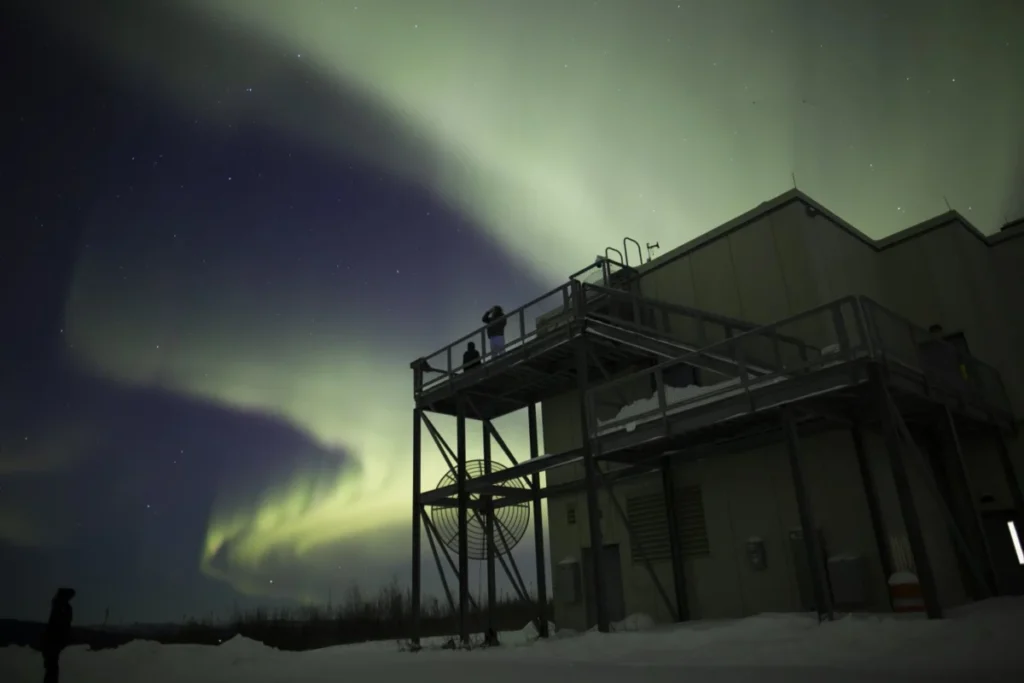
For the graduate students of the Massachusetts Institute of Technology (MIT), the traditional academic schedule often revolves around seminars, laboratory hours, and late-night library sessions. However, for a specialized cohort from the Plasma Science and Fusion Center (PSFC), the typical rhythm of university life was recently traded for a schedule dictated not by the sun, but by the celestial rhythms of the aurora borealis. Operating in the deep freeze of Fairbanks, Alaska, these researchers turned the night sky into a natural laboratory, braving sub-zero temperatures to study the complex behavior of plasma in Earth’s upper atmosphere.
The expedition, known as the Geophysical Plasma Observation Expedition (GPOE), represents a unique intersection of high-level physics research and rugged field exploration. In its third and most ambitious iteration to date, the student-led team sought to capture data that could bridge the gap between theoretical plasma simulations and the chaotic reality of space weather. Working in a landscape where the sun sets before 3:00 p.m. and temperatures frequently plummet to -25 degrees Fahrenheit, the team successfully navigated extreme environmental challenges to document some of the most intense solar activity recorded in the 21st century.
The Arctic as a Natural Plasma Laboratory
The primary objective of the GPOE is the study of plasma—a state of matter consisting of charged particles that makes up over 99% of the visible universe. While plasma is studied at MIT within the controlled environments of fusion reactors and vacuum chambers, the aurora borealis offers a rare opportunity to observe large-scale plasma phenomena in a natural setting. The aurora is created when charged particles from the sun, carried by the solar wind, interact with Earth’s magnetic field and collide with gases in the atmosphere, releasing energy in the form of light.
Fairbanks, Alaska, situated directly beneath the "auroral oval," provides one of the world’s most consistent vantage points for these observations. By deploying a network of sensors across the Alaskan interior, the MIT team aimed to move beyond two-dimensional photography toward a three-dimensional understanding of how these plasma structures evolve. The 2024 campaign was particularly significant as it coincided with the approach of the "solar maximum"—the peak of the sun’s 11-year activity cycle, known as Solar Cycle 25. This timing allowed the students to witness the strongest solar storm in two decades, an event that draped the sky in vibrant, shifting curtains of light and provided a wealth of data for their instruments.
Overcoming Environmental and Technical Constraints
Conducting precision science in the Arctic requires more than just academic expertise; it demands physical endurance and logistical ingenuity. The extreme cold of the Alaskan winter poses a constant threat to both personnel and equipment. Leonardo Corsaro, a PhD student in physics at the PSFC, noted that the drop in temperature had an immediate and drastic effect on their technology. Laptops that showed a full charge would often drain to near zero within ten minutes of exposure to the ambient air. This created a "race against time" during data transfers, requiring the team to work with frantic efficiency before their hardware succumbed to the cold.
The physical demands of the expedition were equally rigorous. To capture simultaneous observations from different angles—a requirement for 3D reconstruction—the team had to deploy camera systems across a 100-mile radius. Much of this equipment had to be placed in remote locations far from maintained roads. Leon Nichols, another PhD student at the PSFC, explained that while the cold can be managed with proper gear, movement through deep snow is exhausting. The team utilized cross-country skis to navigate terrain that would have been impassable on foot, noting that trekking through the thick Alaskan powder can burn up to 900 calories per hour.
Visibility was another constraint. To avoid light pollution and maintain the sensitivity of their cameras, the researchers worked largely in total darkness, relying on red headlamps to navigate. This "night-shift" lifestyle, where the workday begins at sunset and ends long after midnight, is a hallmark of the GPOE experience.
Instrumentation and Scientific Methodology
The 2024 expedition saw a significant expansion in the team’s technical toolkit. Central to their efforts were "all-sky" camera systems—specialized units capable of capturing 360-degree images of the firmament. These were paired with magnetometers, devices designed to measure fluctuations in Earth’s magnetic field. By correlating visual changes in the aurora with magnetic data, the researchers can better understand the electric currents flowing through the ionosphere.
A new addition to this year’s mission was the use of muon detectors. Muons are subatomic particles created when cosmic rays or high-energy solar particles strike the atmosphere. By integrating muon detection into their observational array, the team sought to explore potential correlations between visible auroral activity, magnetic field shifts, and high-energy particle flux. This multi-messenger approach to geophysics allows for a more holistic view of how solar energy penetrates Earth’s magnetic defenses.
The team also focused on a specific and relatively rare phenomenon known as the "pulsating aurora." Unlike the steady, sweeping curtains of light most commonly associated with the aurora borealis, pulsating auroras appear as patches of light that blink on and off rapidly. Understanding the mechanisms behind these pulsations requires high-speed imaging and precise timing, which the GPOE team achieved through their distributed sensor network.
The Evolution of a Student-Led Initiative
Perhaps the most remarkable aspect of the GPOE is its origin and organizational structure. The program began in 2023, sparked by the initiative of graduate student Shon Mackie. Recognizing that hands-on field experience was often missing from the plasma physics curriculum, Mackie proposed a student-led expedition to Alaska to coincide with the rising solar cycle. The proposal was met with immediate and enthusiastic support from then-Director of the PSFC, Dennis Whyte, who famously replied to the pitch with: "Sounds cool, literally! PSFC will fund this."
Since that initial approval, the GPOE has evolved into a sophisticated research cycle that spans several months. The expedition is entirely organized and led by students, who are responsible for every stage of the process: from the initial design and fabrication of instruments to site selection, logistics, and final data analysis. This compressed scientific cycle is rare in academia, where projects often take years to move from concept to publication.
The 2024 cohort featured a diverse group of scholars, including students from the Department of Nuclear Science and Engineering and the MIT Kavli Institute for Astrophysics and Space Research. They were accompanied by Professor Matthew Evans, a physicist affiliated with the LIGO Laboratory, who provided faculty oversight while allowing the students to maintain leadership of the mission.
Global Collaboration and Educational Outreach
The impact of the GPOE extends far beyond the MIT campus. In 2024, the program launched a major outreach collaboration involving the MIT Museum and the MIT Nord Anglia Collaboration. This initiative brought approximately 65 high school students from 20 different countries to MIT to participate in the engineering phase of the project.
These high school students were tasked with designing and building components for the all-sky camera systems used in the field. Under the guidance of the MIT graduate team, the younger students worked within strict technical and environmental constraints, eventually producing 13 cameras that were successfully deployed in Alaska. This collaboration not only provided the GPOE with essential hardware but also served as a powerful educational tool, giving international students a direct stake in a high-level scientific mission.
The designs developed by the MIT team—specifically their low-cost all-sky cameras and magnetometers—are now being shared with the broader scientific community. Other research teams and community science initiatives have begun adopting these designs, facilitating more widespread monitoring of auroral activity and space weather at a fraction of the cost of traditional professional-grade instrumentation.
Implications for Space Weather and Global Infrastructure
While the aurora is a stunning visual spectacle, the science behind it has critical implications for modern civilization. The interaction between solar activity and Earth’s magnetic field creates "space weather," which can have disruptive effects on technology. Strong solar storms, like the one witnessed by the MIT team in 2024, can induce electric currents in power lines, leading to widespread grid failures. They can also interfere with satellite communications, degrade the accuracy of GPS systems, and pose radiation risks to astronauts.
By improving our understanding of plasma behavior in the upper atmosphere, the GPOE contributes to the development of more accurate space weather forecasting models. As society becomes increasingly dependent on satellite technology and interconnected power grids, the ability to predict and mitigate the effects of solar storms becomes a matter of national and global security.
Conclusion: The Human Element of Discovery
For the students involved, the GPOE is more than a data-gathering exercise; it is a transformative experience that reshapes their understanding of their field. Leonardo Corsaro reflected on how the trip provided a "sense of reality" that simulations cannot replicate. In the lab, plasma is often represented by neat, colorful plots on a screen. Standing under the Alaskan sky, watching massive currents of energy shift and flow overhead, serves as a vivid reminder that real-world physics is often messy, intuitive, and awe-inspiring.
John Ball, a PhD student in nuclear science and engineering, noted that the experience provides a necessary perspective on the scale of the universe. Standing in the midnight cold of the Arctic, observing plasma structures that span thousands of kilometers, highlights the "small and delicate" nature of our planet within the broader solar system.
As the Geophysical Plasma Observation Expedition prepares for its future iterations, the team aims to expand its technical capabilities even further. Plans are in motion to install more permanent instrumentation in Alaska and to deepen outreach partnerships. By blending rigorous engineering with adventurous field research, the GPOE continues to demonstrate that some of the most profound scientific insights are found not in the quiet of a library, but in the most extreme and beautiful environments on Earth.