The advancement of modern consumer electronics, from the vibrant organic light-emitting diode (OLED) screens on smartphones to the high-efficiency photovoltaic cells powering the green energy transition, relies heavily on the foundational science of precision optics. These technologies are birthed in laboratories where researchers use lasers and complex arrays of mirrors and lenses to probe the fundamental properties of new materials. However, for decades, a significant bottleneck has persisted: the physical setup of these experiments is an arduous, manual process that can take weeks or even months of meticulous labor. Researchers at the Massachusetts Institute of Technology (MIT) have now unveiled a potential solution to this stagnation, developing a first-of-its-kind reconfigurable robotic optics laboratory capable of autonomously assembling, tuning, and maintaining complex optical experiments.
The system, which will be presented at the upcoming Intelligent Robots and Systems (IROS) conference, represents a paradigm shift in how experimental physics is conducted. By integrating advanced robotics, computer vision, and custom-designed hardware, the MIT team has demonstrated that the "tedious and time-consuming" nature of optical alignment can be offloaded to an autonomous system capable of micron-scale precision. This development promises not only to accelerate the pace of scientific discovery but also to democratize access to high-end experimental facilities through cloud-based remote operation.
The Bottleneck of Manual Precision
In a traditional optics laboratory, the experimental setup often resembles a sprawling, miniature city of glass and metal. Scientists must manually position dozens of components—lasers, beam splitters, mirrors, and lenses—on a vibration-isolated table. Each component must be aligned with extreme accuracy; a deviation of a few microns or a fraction of a degree can render an entire experiment invalid.
"Sometimes this manual setup takes days or months depending on the complexity of the experiment," explains Marin Soljacic, the Cecil and Ida Green Professor of Physics at MIT. "It’s meticulous work that has to be done again and again for each experiment."
While the industry has previously adopted motorized stages and tuners to assist with the fine-tuning of existing setups, the initial assembly and the overall orchestration of the experiment remained a human-centric task. The MIT researchers sought to bridge this gap by creating a system that could transition from an empty tabletop to a fully functional, aligned optical circuit without human intervention.
Architectural Innovation: The Seven-Jointed Scientist
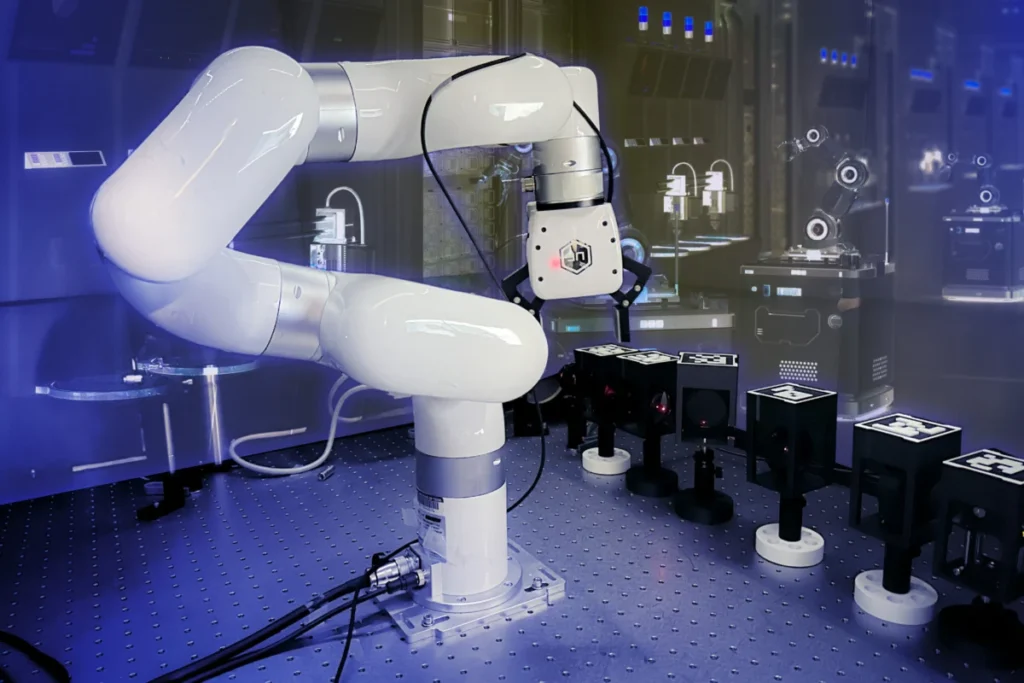
The heart of the new robotic lab is a robotic arm featuring seven moveable joints, providing the degrees of freedom necessary to navigate the crowded environment of an optical table. This arm is mounted to a metallic tabletop and serves as the primary manipulator for a library of optical components.
To facilitate robotic handling, the researchers developed specialized 3D-printed plastic housings for standard optical parts. These housings serve several critical functions:
- Grip and Stability: They provide a uniform interface for the robotic arm to grasp and move delicate glass components safely.
- Identification: Each housing is etched with a unique QR code. When the robot’s overhead cameras scan the table, the system immediately identifies the component (e.g., a 50mm focal length lens versus a high-reflectivity mirror) and retrieves its exact dimensions and optical properties from a database.
- Magnetic Integration: The base of each housing contains magnets that secure the component to the metallic tabletop, ensuring stability while allowing for easy reconfiguration.
To achieve the level of precision required for laser alignment—which far exceeds the native positioning accuracy of most robotic arms—the team engineered a proprietary, Wi-Fi-enabled "fine-adjustment tool." This motorized device clips onto the mounts of the components, allowing the software to wirelessly turn the adjustment knobs with sub-micron sensitivity. This mimics the "feel" and intuition of a human experimentalist but with a level of consistency and repeatability that human hands cannot match.
Software Stack and Computer Vision
The physical hardware is governed by a sophisticated software stack designed to handle the complexities of spatial reasoning and optical logic. Two overhead cameras provide a constant "birds-eye view" of the workspace, feeding data into a computer vision system that monitors the position of every component in real-time.
The software is responsible for path planning, ensuring that as the robotic arm moves a mirror from one side of the table to the other, it does not collide with other sensitive equipment. Furthermore, the researchers developed a virtual user interface that allows scientists to design experiments in a digital environment. By simply dragging and dropping icons representing mirrors or lenses, a researcher can dictate a layout that the physical robot then replicates in the real world.
Experimental Validation: Building a Laser Cavity
To prove the system’s capabilities, the MIT team tasked the robot with one of the more challenging foundational tasks in optics: the construction of a tabletop laser cavity. A laser cavity requires two mirrors to be placed in near-perfect alignment on either side of a gain medium (such as a crystal). Light must bounce back and forth between these mirrors hundreds of times, passing through the crystal to amplify its intensity until a coherent laser beam is produced.
"This is not something a new trainee could do in an afternoon," says Seou Choi, a graduate student in electrical engineering and computer science and co-lead author of the study. "It requires a lot of alignment and component experience."
The robotic system successfully assembled the cavity from scratch, executing 50 precise maneuvers in approximately 30 minutes. Once the laser was operational, the researchers tested the system’s resilience by intentionally disturbing the components. In response, the robot’s autonomous tuning algorithms detected the drop in laser intensity and realigned the mirrors to restore peak performance. This "self-healing" capability is particularly significant for long-term experiments where thermal expansion or floor vibrations can gradually degrade alignment.
Implications for Global Science and Industry
The implications of a fully automated, reconfigurable optics lab extend far beyond the walls of MIT. The researchers are currently developing a cloud-based application that would allow scientists from across the globe to submit experimental protocols to the robotic lab.
"A robot isn’t going to get bored," says Soljacic. "It can work 365 days, 24 hours a day, on very boring things. That will free up so much creativity and time for scientists to then push theories and see what we can do. Science could progress much faster."
In an industrial context, this technology could drastically shorten the R&D cycles for hardware manufacturers. Companies developing next-generation augmented reality (AR) and virtual reality (VR) goggles, for instance, could use robotic labs to rapidly iterate through hundreds of different lens configurations.
The MIT team is already putting the system to practical use in environmental science. They are utilizing the robotic lab to test new materials designed for carbon capture. By shining specific wavelengths of light through these materials and measuring the absorption patterns, they can identify which chemical structures are most effective at sequestering carbon dioxide from the atmosphere. The ability to run these tests autonomously allows for a high-throughput screening process that would be impossible with manual labor.
Future Chronology and Expansion
The current prototype is a proof-of-concept that the researchers plan to scale significantly. The roadmap for the "Robotic Optics Lab" includes several key milestones:
- Near-Term: Expanding the physical library of components to include more specialized sensors, pulse-shapers, and non-linear crystals.
- Mid-Term: Integrating artificial intelligence (AI) that can not only execute a human’s plan but also suggest experimental optimizations. For example, if a scientist wants to achieve a specific beam profile, the AI could calculate the most efficient component layout and direct the robot to build it.
- Long-Term: Establishing a "Lab-as-a-Service" (LaaS) model, where a centralized facility houses dozens of these robotic tables, serving the global scientific community.
The project is a collaborative effort involving researchers from MIT’s Research Laboratory of Electronics (RLE), Nokia Bell Labs, and Arizona State University. The team includes Sachin Vaidya, Seou Choi, Caio Silva, Shrish Choudhury, Shiekh Uddin, and Sajib Shuvo.
Conclusion
The transition of experimental optics from a manual craft to an automated discipline marks a major milestone in the history of laboratory science. By combining the dexterity of modern robotics with the precision of digital control systems, the MIT team has addressed a centuries-old bottleneck. As these autonomous systems become more prevalent, the speed of innovation in fields ranging from quantum computing to climate change mitigation is poised to accelerate, driven by machines that never tire and measurements that never waver.
The research received support from a diverse array of institutions, including the Korea Foundation for Advanced Studies, the U.S. National Science Foundation, the U.S. Army Research Office, and Shell International Exploration and Production Inc., underscoring the broad strategic interest in the automation of high-precision science.