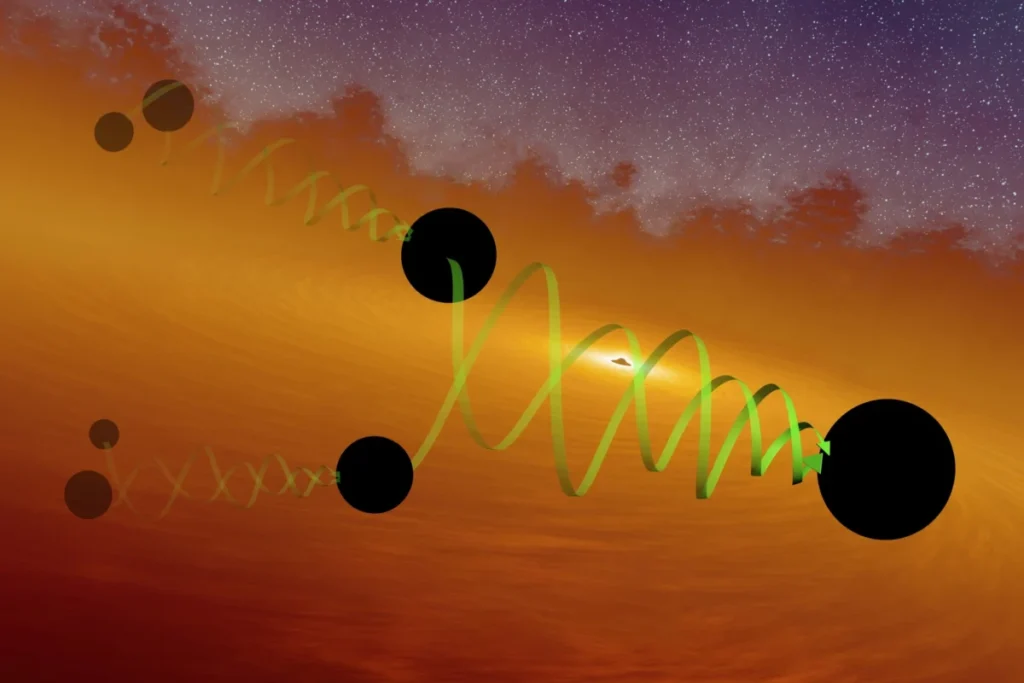
For decades, the astrophysical community has operated under a primary assumption: black holes are the direct descendants of massive stars. This "textbook" origin story describes a cataclysmic finale where a star, having exhausted its nuclear fuel, collapses under its own gravity, triggering a supernova and leaving behind a dense, dark remnant. However, a groundbreaking study from researchers at the Massachusetts Institute of Technology (MIT) suggests that the universe’s black hole population has a far more complex lineage. By analyzing a vast catalog of gravitational-wave data, the team has determined that approximately 14 percent of merging black holes are "second-generation" entities—products of previous black hole collisions rather than direct stellar deaths.
The findings, published recently in Physical Review Letters, represent a paradigm shift in how scientists understand the lifecycle of black holes and the environments in which they reside. This alternative pathway, known as "hierarchical merging," suggests that black holes can act as building blocks for even larger cosmic structures, repeatedly merging in dense stellar nurseries to form massive objects that challenge existing models of stellar evolution.
The Traditional Model vs. Hierarchical Merging
To appreciate the significance of the MIT discovery, one must first understand the two distinct pathways through which a black hole can be formed. The first, and most common, is the stellar-origin pathway. When a star with a mass significantly greater than that of our sun reaches the end of its life, it can no longer support itself against the inward pull of gravity. The resulting explosion, a supernova, sheds the star’s outer layers into space, while the core collapses into a point of infinite density. Because stars lose a significant portion of their mass and angular momentum during this violent process, the resulting black holes are expected to have relatively low spin.
The second pathway, hierarchical merging, operates on a different set of physical rules. In this scenario, two black holes that have already been formed—either through stellar collapse or previous mergers—become gravitationally bound to one another. As they orbit, they radiate energy in the form of gravitational waves, causing them to spiral inward and eventually collide. The resulting "second-generation" black hole is not only more massive than its progenitors but also possesses a high degree of spin, inherited from the orbital angular momentum of the collision.
"We’re finding that, for some of these merging black holes, it’s not their first rodeo," explains Cailin Plunkett, a graduate student in MIT’s Department of Physics and the study’s first author. "Overall in the universe, black holes are merging all the time. The question of how often they are repeatedly merging was pretty uncertain. Now we’re seeing a relatively consistent picture where there’s a decent percentage of black holes that are coming from this repeated pathway."
Decoding the Orbital "Wobble"
The researchers reached their conclusions by examining data from the LIGO (Laser Interferometer Gravitational-Wave Observatory) in the United States, Virgo in Italy, and KAGRA in Japan. These observatories are designed to detect gravitational waves—minuscule ripples in the fabric of spacetime caused by the most violent events in the universe.
The key to identifying a second-generation black hole lies in its "spin" and "precession." When two black holes of stellar origin merge, they typically have low spin, and their orbital plane remains relatively stable. However, a second-generation black hole enters a new merger with significant rotation. If this spin is not perfectly aligned with the orbital plane of the new pair, it causes the entire system to "wobble" or precess, much like a spinning top that is beginning to slow down.
Plunkett and her co-author Salvatore Vitale, an associate professor of physics at MIT, developed a sophisticated analytical model to search for this characteristic precession across a massive dataset. Instead of looking at individual events in isolation, they analyzed the LIGO-Virgo-KAGRA Gravitational Wave Transient Catalog 4.0 (GWTC-4.0), which contains 155 pairs of binary black holes.
By applying their model to the entire catalog, the team was able to identify a statistical pattern of "wobbling" that suggests a significant portion of the population did not come from stars, but from prior mergers. This "lopsided" nature—where one black hole in a pair is significantly more massive and faster-spinning than its partner—is a "smoking gun" for hierarchical merging.
The Mass Gap and the 45-Solar-Mass Threshold
One of the most compelling aspects of the study involves the mass of the black holes being detected. Standard stellar evolution theory predicts a "mass gap" in the black hole population. According to these models, stars of a certain size undergo a "pair-instability supernova," an explosion so powerful that it completely obliterates the star, leaving no remnant behind. This suggests that there should be no black holes formed from stars in the range of roughly 50 to 130 solar masses.
However, gravitational-wave detectors have frequently spotted black holes that fall squarely within this "forbidden" zone. The MIT study provides a logical explanation for this discrepancy. If black holes are merging hierarchically, they can easily bypass the mass limits imposed by stellar death.
The analysis revealed that black holes with masses of approximately 10 and 30 times the mass of the sun appear to be standard, first-generation objects. In contrast, those with masses around 20 solar masses, 40 solar masses, and higher often exhibit the characteristics of second-generation mergers.
"One of the reasons why the 40-and-above regime is interesting is that stellar evolution theory predicts you shouldn’t be able to form black holes in that mass range at all from just a supernova," Plunkett says. "We think supernovae from really massive stars end up being so violent that they leave no black holes at all above roughly 45 solar masses. Yet we have seen black holes that are that massive. And the question is: Where did they come from?"
Chronology of Discovery: From First Detection to GWTC-4.0
The journey to this discovery began in 2015 with the first-ever detection of gravitational waves (GW150914), which proved that binary black holes exist and can merge within the age of the universe. Since then, the sensitivity of the global network of detectors has increased dramatically, allowing for the observation of more distant and subtle signals.
In early 2024, the scientific community was alerted to two specific events: GW241011 and GW241110. Detailed analysis of these signals suggested they were lopsided mergers involving at least one high-spin black hole. These individual cases served as the catalyst for the MIT team to zoom out and look for a broader trend.
The transition from studying individual "outlier" events to performing a population-wide analysis of the GWTC-4.0 catalog allowed the researchers to move from anecdotal evidence to a statistically significant conclusion. The identification of the 14 percent figure provides a concrete metric for how common this process is across the observable universe.
Cosmic Nurseries: Where Hierarchical Mergers Occur
For hierarchical merging to take place, the environment must be incredibly dense. In the vast emptiness of most of a galaxy, black holes are too far apart to ever find one another. Scientists believe these mergers occur in "dense stellar environments," such as globular clusters or the nuclei of galaxies.
In these cosmic "beehives," stars are packed so tightly that their remnants are constantly interacting. "You might have a ton of stars whizzing around each other, and if some are massive and explode, they become black holes," Plunkett explains. "The black holes continue to whizz around and can capture each other and merge. This process can repeat potentially ad infinitum."
These environments act as factories for massive black holes. When two black holes merge, the "kick" from the gravitational waves can sometimes eject the new black hole out of the cluster. However, if the cluster’s gravity is strong enough to retain the new, larger black hole, it remains available to merge again, creating a third, fourth, or even higher-generation object.
Broader Implications for Astrophysics
The implications of this study extend beyond the classification of black holes. Understanding the frequency of hierarchical mergers allows astronomers to better model the evolution of galaxies and the role that black holes play in shaping their surroundings.
Furthermore, this research provides a vital check on stellar evolution models. If 14 percent of mergers are hierarchical, then the remaining 86 percent likely follow the traditional stellar-death path. This helps scientists refine their understanding of how stars live and die, and what factors (such as metallicity or rotation) influence the final mass of a black hole remnant.
The study also sets the stage for the next generation of gravitational-wave observatories. As detectors like the Cosmic Explorer (USA) and the Einstein Telescope (Europe) come online in the coming decades, their increased sensitivity will allow researchers to see even further back in cosmic time. They will likely detect "third-generation" black holes and beyond, potentially tracing the lineage of black holes back to the very first stars in the universe.
Conclusion
The work conducted by Plunkett, Vitale, and their colleagues Thomas Callister and Michael Zevin demonstrates the power of "big data" in modern astronomy. By looking for patterns in the "wobbles" of spacetime, they have revealed a universe where black holes are not just static remnants of dead stars, but active participants in a continuous process of growth and collision.
As the LIGO-Virgo-KAGRA collaboration continues its fourth observing run, the catalog of known black hole mergers will only grow. With each new detection, the picture of a hierarchically active universe becomes clearer, proving that for a significant portion of the cosmos’s most mysterious objects, the first merger is merely the beginning of a much longer journey. This research, supported by the National Science Foundation and the Brinson Foundation, marks a definitive step toward solving the puzzle of the "mass gap" and understanding the true diversity of the dark universe.