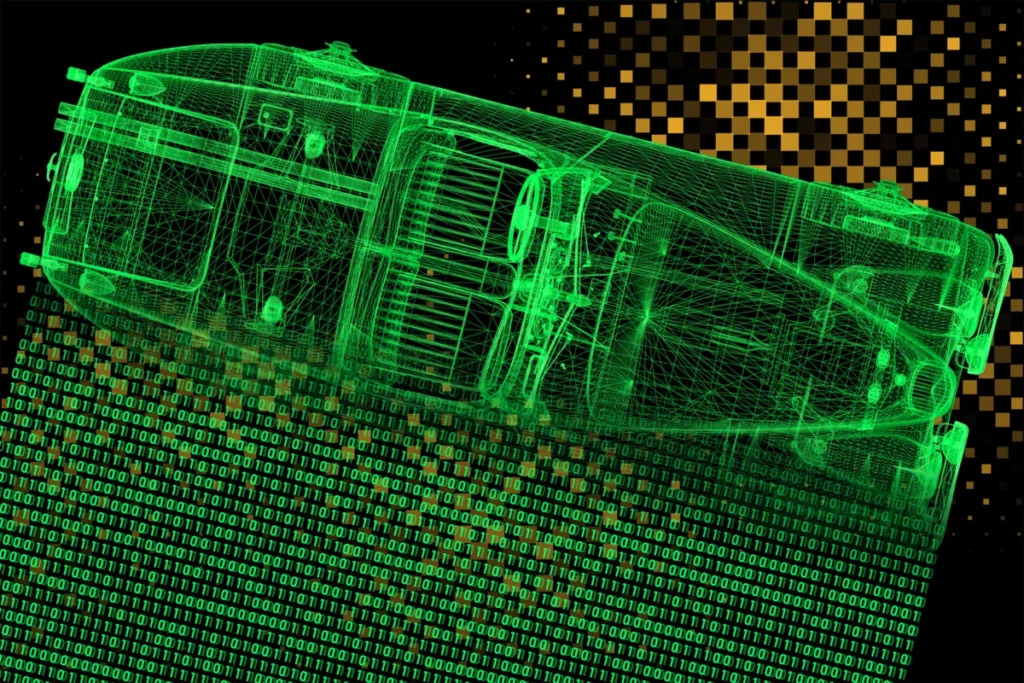
Engineers across critical sectors such as aerospace and automotive manufacturing frequently leverage vision-language models (VLMs) to conceptualize and generate preliminary designs for components ranging from intricate engine parts to entire vehicle bodies. Once these initial designs are conceived, the subsequent crucial step involves simulating their performance under a myriad of realistic conditions, which necessitates the creation of precise 3D models. Historically, this has been accomplished using sophisticated, industry-standard computer-aided design (CAD) software, where skilled engineers manually translate 2D blueprints or VLM outputs into detailed 3D representations. These CAD models are then subjected to rigorous virtual testing, including crash simulations, durability assessments, and aerodynamic analyses, to validate their structural integrity and functional efficacy before physical prototyping commences. However, this conventional workflow often presents a significant bottleneck: the manual conversion process is resource-intensive, time-consuming, and prone to human error, hindering the pace of innovation and increasing development costs.
Addressing this long-standing challenge, a groundbreaking research collaboration between scientists from the Massachusetts Institute of Technology (MIT) and other affiliated institutions has yielded a revolutionary system capable of autonomously teaching vision-language models to transform 2D designs into CAD programs with significantly enhanced accuracy and functionality. This innovative approach not only surpasses the performance of existing methods but also achieves these superior results using only a fraction of the computational resources typically required. The development of this advanced technique promises to profoundly streamline the rapid prototyping process, drastically reduce associated costs, and potentially empower engineers to discover and implement advantageous design choices that might otherwise be overlooked in traditional, human-centric design cycles.
The Critical Role of CAD in Modern Engineering
Computer-aided design (CAD) software forms the bedrock of modern engineering and manufacturing. From the smallest consumer electronics to the largest aircraft, nearly every physical product begins its life as a CAD model. These digital representations are not merely static images; they are intricate datasets containing geometric information, material properties, and assembly instructions that are fundamental for analysis, simulation, manufacturing, and documentation. For decades, engineers have relied on CAD for precision, consistency, and the ability to iterate designs rapidly in a virtual environment. The global CAD software market, valued at tens of billions of dollars annually, underscores its indispensable role in the industrial landscape.
Traditional CAD workflows, while robust, are inherently human-dependent. A designer interprets a 2D sketch or a conceptual idea and painstakingly translates it into a 3D digital model using specialized software tools. This process requires extensive training, experience, and a keen eye for detail. When coupled with the emerging capabilities of AI-driven design, where VLMs can rapidly generate numerous conceptual designs from textual prompts or simple images, the manual CAD conversion step becomes a significant chokepoint. The sheer volume and complexity of AI-generated concepts often overwhelm the capacity for manual 3D modeling, limiting the practical applicability of AI in the early stages of the design process. The MIT researchers’ work directly targets this critical interface, aiming to bridge the gap between AI-driven conceptualization and detailed 3D realization.
Unveiling GIFT: A Self-Correcting AI for CAD Generation
At the heart of this innovation lies a novel data augmentation system named GIFT, an acronym for Geometric Inference Feedback Tuning. Unlike conventional data augmentation techniques, which typically generate new data through random permutations of existing samples (e.g., adjusting colors, sizes, or shapes in images), GIFT adopts a "model-aware" strategy. This means it intelligently creates new training data specifically tailored to improve the performance of a particular VLM for the complex task of CAD generation. The system operates by first developing a deep understanding of the VLM’s strengths and, more importantly, its weaknesses, through a systematic testing process. Armed with this knowledge, GIFT then strategically generates data designed to bolster the model’s capabilities in areas where it struggles the most.
Giorgio Giannone, a lead author of the study and a research affiliate in MIT’s Design Computation and Digital Engineering (DeCoDE) Lab, emphasized the framework’s autonomous learning capabilities. "We want engineers to be able to point our framework at an underperforming CAD model, set a compute budget, and let the system take over — turning the model’s own mistakes into better training data," Giannone stated. This self-improvement mechanism is a paradigm shift, moving away from the laborious and costly process of manually curating vast, diverse datasets by human experts, which has historically been the main bottleneck limiting the capabilities of vision-language models for tasks like CAD generation.
The core methodology of GIFT involves asking the target VLM to generate Python code for solving a given CAD generation problem multiple times in parallel. The system then meticulously checks the correctness of these attempts. Giannone elaborated on the nuances of this process: "For a model, generating CAD query code that is almost correct is not that hard, but generating code that is perfectly correct and can be executed is much more challenging for a standard VLM." GIFT identifies these "near-misses" — code snippets that are almost, but not entirely, functional — and intelligently adjusts them to become perfectly successful solutions. Both these newly refined "near-misses" and any initially successful solutions are then incorporated into a continually expanding dataset. This enriched dataset serves as a potent learning resource, teaching the VLM how to overcome the precise problems and intricate challenges it initially struggled with.
"If we sample the model 10 times and it generates 10 correct answers to the same problem, then there is not much for it to learn. We care about the in-between cases, where the model might only solve the problem 50 percent of the time," Giannone explained, highlighting GIFT’s focus on the model’s learning frontier. By concentrating on these challenging "in-between cases," GIFT generates data augmentations that are both model-aware and task-aware, maximizing the learning efficiency. Furthermore, by integrating multiple correct solutions to the same problem, the new data significantly broadens the model’s generalized knowledge of CAD code generation, making it more robust and adaptable.
Genesis of the Innovation and Research Timeline
The need for more efficient and accurate AI-driven design tools has been a growing concern within the engineering community for several years. Traditional vision-language models, while promising, often faltered when tasked with generating the highly precise and executable code required by CAD software. This limitation spurred researchers at institutions like MIT to investigate fundamental bottlenecks, identifying the scarcity of diverse, high-quality CAD datasets as a primary inhibitor.
The research leading to GIFT likely began with an in-depth analysis of existing VLM limitations in CAD generation, perhaps in the past 2-3 years, as AI’s role in design began to rapidly expand. The conceptualization of a "model-aware" data augmentation system would have followed, moving from theoretical frameworks to practical implementation and iterative refinement. The collaboration between MIT’s DeCoDE Lab and the MIT-IBM Computing Research Lab, a partnership designed to foster breakthroughs in AI, provided the ideal environment for such an ambitious project. Red Hat, a leading provider of open-source solutions and a key player in enterprise AI, also contributed significantly through the expertise of its AI Innovation Team.
The development process would have involved several phases:
- Problem Definition (Early Stage): Identifying the critical need for better AI-CAD integration and pinpointing the data bottleneck.
- Conceptualization of GIFT (Mid Stage): Designing the "model-aware" data augmentation framework, distinguishing it from traditional methods.
- Implementation and Iteration (Development Stage): Coding the GIFT system, developing mechanisms for parallel code generation, correctness checking, and intelligent correction of "near-misses." This phase would have involved extensive experimentation and refinement.
- Testing and Validation (Late Stage): Rigorously evaluating GIFT’s performance against existing techniques, focusing on accuracy, functionality, and computational efficiency.
- Dissemination (Recent Event): The culmination of this research was its recent presentation at the prestigious International Conference on Machine Learning, a significant milestone for any AI-related breakthrough.
This chronological progression highlights a deliberate and systematic approach to addressing a complex problem at the intersection of artificial intelligence and engineering design.
Performance and Efficiency: A Comparative Edge
The effectiveness of the GIFT system was rigorously tested against several competing techniques, and its results were compelling. The system demonstrated superior performance, generating CAD programs that were not only more accurate but also achieved these results with remarkable computational efficiency. Specifically, GIFT required only approximately 20 percent of the computation compared to other methods, making it a highly resource-efficient solution. This efficiency is critical for widespread adoption in industrial settings, where computational costs can quickly escalate, particularly for complex design tasks.
Furthermore, the CAD models produced by VLMs trained with GIFT exhibited a significantly better alignment with the shapes of ground-truth models. This "better alignment" is a direct indicator of higher fidelity and accuracy, meaning the AI-generated 3D models more closely represent the intended design specifications. This level of precision is paramount in engineering, where even minor deviations can lead to structural failures or functional impairments in physical products.
A key aspect of GIFT’s efficiency stems from its use of inference-time scaling. This process allows a pre-trained, static model to generate improved outputs without the exorbitant computational costs typically associated with retraining an entire model from scratch. Users can dynamically determine the amount of computation they wish to allocate for GIFT, thereby tailoring its operation to their specific time and budget constraints. This flexibility makes GIFT an adaptable tool for a wide range of engineering applications, from rapid conceptualization to detailed design refinement.
Broader Implications and Future Outlook
The implications of the GIFT system extend far beyond mere technical achievement, promising a transformative impact on the entire engineering design ecosystem.
Streamlining Rapid Prototyping and Cost Reduction
One of the most immediate benefits is the acceleration of the rapid prototyping process. By automating the conversion of 2D designs to accurate 3D CAD models, engineers can iterate through design cycles much faster. This reduction in time-to-market is a significant competitive advantage in industries where innovation speed is critical. Furthermore, the lower computational costs and reduced reliance on extensive manual labor translate directly into substantial cost savings throughout the product development lifecycle.
Fostering Innovation and Design Exploration
The ability of AI to explore a vast design space far more comprehensively than human designers opens doors to unprecedented innovation. By efficiently generating and validating numerous design variations, GIFT can help engineers identify optimal or novel design choices that might otherwise be overlooked due to cognitive biases or time constraints. This could lead to more performant, durable, and manufacturable products. Faez Ahmed, an associate professor of mechanical engineering at MIT, leader of the DeCoDE Lab, and a co-senior author of the paper, articulated this vision: "Nearly every physical product around us, from airplanes to appliances, begins its life as a CAD model. Industry teams are eager for AI that can help speed-up the creation of these designs, but today’s models often produce simple shapes inadequate for practice. What excites me about this work is that it gives many image-to-CAD-code models a way to improve themselves, learning from their own errors rather than waiting for more human-made data — and that brings trustworthy AI design tools much closer to everyday engineering."
Towards Trustworthy AI in Design
The self-correcting nature of GIFT contributes significantly to building "trustworthy AI design tools." By learning from its own mistakes and refining its outputs autonomously, the system increases its reliability and accuracy over time, fostering greater confidence among engineers in AI-generated designs. This is crucial for integrating AI more deeply into safety-critical applications like aerospace and medical device design.
Expanding the Scope of AI-Driven Engineering
While the initial focus of GIFT has been on geometric accuracy—a foundational element in engineering design—the researchers are already looking ahead. Giannone noted, "With GIFT, we started with geometry because with engineering problems, if the geometry of a 3D shape is not correct, nothing else will be correct, but there are many other aspects to consider." Future iterations of GIFT aim to expand its capabilities to teach models to generate CAD programs that not only produce accurate geometry but also optimize for critical performance metrics and manufacturability. This would involve teaching the AI to consider factors like material stress, thermal properties, assembly constraints, and cost-effective production methods. The team also plans to apply the system to larger models and a more diverse array of CAD generation tasks, further broadening its applicability.
The research, supported in part by the MIT-IBM Computing Research Lab, represents a significant leap forward in the practical application of artificial intelligence in engineering design. By addressing a core limitation in the AI-CAD interface, GIFT paves the way for a future where AI acts not just as a design assistant, but as an integral, self-improving partner in the creation of the next generation of physical products. The collaborative efforts of researchers like Anna Claire Doris, Amin Heyrani Nobari, Kai Xu, Akash Srivastava, and Faez Ahmed are pushing the boundaries of what AI can achieve, bringing closer the era of truly intelligent design automation.






