Since the groundbreaking debut of NASA’s James Webb Space Telescope (JWST) in 2022, astronomers have been captivated by a peculiar phenomenon: the appearance of "little red dots" (LRDs) scattered across the distant, early universe. These incredibly compact and extremely red sources, observed at high redshifts, have presented a significant puzzle, defying easy explanation within our current cosmological models. While one prominent hypothesis posited them as active galactic nuclei (AGN) powered by supermassive black holes, their distinct behavior – common at high redshifts but sharply declining at lower ones – has fueled a crucial question: what becomes of these enigmatic objects as the cosmos matures? A recent study, spearheaded by a team of researchers from the University of Arizona and the Space Telescope Science Institute (STScI), offers a compelling potential evolutionary path, suggesting that LRDs might not represent a unique galactic population but rather a fleeting, observational phase of supermassive black hole activity.
The Puzzle of Little Red Dots and the Search for Their Progeny
The initial observations from JWST provided an unprecedented glimpse into the universe’s infancy, revealing LRDs as tantalizingly bright, compact sources. Their extreme redness indicates they are either intrinsically very red or heavily obscured. The prevailing theory linked them to active galactic nuclei (AGN), the luminous central regions of galaxies fueled by accreting supermassive black holes. However, the observed distribution of LRDs posed a challenge to this interpretation. Their prevalence at high redshifts, corresponding to billions of years after the Big Bang, contrasts sharply with their scarcity at lower redshifts, closer to our present cosmic epoch. This disparity suggests a dynamic evolution, prompting scientists to investigate what happens to these powerful engines as the universe ages and expands.
The research, published on July 29 in The Astrophysical Journal, builds upon earlier insights and proposes a novel framework for understanding LRDs. Led by Pierluigi Rinaldi, formerly of the University of Arizona’s Steward Observatory and now at STScI, the team suggests that the unusual appearance of LRDs might be partly an artifact of observational bias. At vast cosmic distances, the faintness of surrounding galactic structures can render them undetectable to even JWST’s advanced capabilities, leaving only the intensely luminous central source visible and leading to their classification as isolated "dots."
The Saguaro: A Window into the Evolutionary Path of LRDs
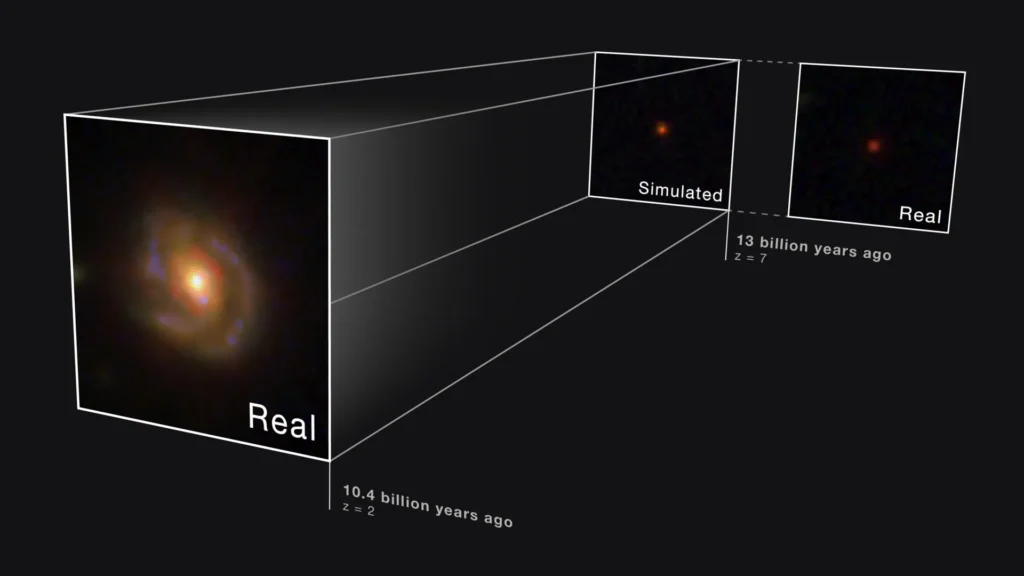
Central to this new theory is the detailed study of a lower-redshift spiral galaxy named WISEA J123635.56+621424.2. Nicknamed "Saguaro" by the researchers due to its prominent spiral arms, which evoke the iconic cactus of the Sonoran Desert, this galaxy offers a unique laboratory for studying LRD evolution. Located at a redshift of 2, the Saguaro is observed as it appeared approximately 3.3 billion years after the Big Bang. At its core lies a compact, red source that bears a striking resemblance to the distant LRDs, even echoing the deep ruby hue of the desert cactus’s fruit.
"Everything created in the early universe must evolve into something around us," stated co-author George Rieke of the University of Arizona. "We have had little idea of what LRDs become, but these results finally show us how to find their progeny." This sentiment underscores the significance of the Saguaro as a potential link between the nascent LRDs and the more evolved galaxies we observe today.
Previous observations from NASA’s retired Spitzer Space Telescope had already hinted at the existence of dust-obscured, compact galaxy populations in the lower-redshift universe, including galaxies like the Saguaro. These early findings laid the groundwork for the more sophisticated analyses now possible with JWST and the Hubble Space Telescope. Fabio Pacucci of the Harvard-Smithsonian Center for Astrophysics, another co-author, emphasized the Saguaro’s importance: "It’s a prototypical little red dot and is one of the few we have found at lower redshift. It can be used to study the pathway of these dots throughout cosmic time."
Webb and Hubble Collaboration: Illuminating the Saguaro in Unprecedented Detail
The Saguaro’s exceptional visibility and the fortunate positioning of JWST’s microshutter arrays over its core allowed for the collection of crucial spectroscopic data. This enabled Rinaldi and his team to conduct a comprehensive examination of the galaxy across a broad spectrum of electromagnetic radiation, combining archival observations from both JWST and Hubble. Hubble provided vital ultraviolet imaging, while JWST delivered detailed infrared imaging and spectroscopic data, offering a holistic view of the Saguaro’s composition and structure.
"Because the Saguaro is at lower redshift, we can see the very beautiful and bright host galaxy in high resolution and detail with Webb and Hubble," explained Zihao Wu of the Harvard-Smithsonian Center for Astrophysics, a co-author. "Webb’s observations can help us understand how the galaxy and its little red dot-like nucleus are connected."
The researchers employed several methods to confirm whether the Saguaro’s central compact red source aligned with the defining characteristics of a typical LRD. Their analysis revealed that the nucleus emits more strongly in ultraviolet and infrared wavelengths than in visible light, a signature consistent with distant LRDs.
A critical step in their investigation involved separating the light emanating from the galaxy itself from that produced by its central nucleus. Furthermore, they probed for X-ray emissions. While most high-redshift LRDs remain undetectable in X-rays, the Saguaro exhibited weak X-ray emission, detected by NASA’s Chandra X-ray Observatory.
"What the X-ray light observations show is that this galaxy has an active galactic nucleus, and a very obscured one at that," noted Carys Gilbert, a Master’s student at the University of Cape Town and co-author. "It’s not only obscured but also X-ray weak. That kind of combination could explain the lack of X-ray emission that we see from all other little red dots. It fits the puzzle of little red dots nicely." This finding suggests that the obscured nature of the AGN within the Saguaro, combined with its inherent X-ray weakness, could explain why many distant LRDs appear to lack detectable X-ray signatures.
Simulating Cosmic History: How the Saguaro Would Appear in the Early Universe
To further validate their hypothesis, the research team conducted a revealing simulation. After establishing the Saguaro’s central nucleus as a match for LRD characteristics, they digitally shifted the galaxy to a higher redshift. This manipulation simulated how the galaxy would appear if observed much earlier in cosmic history, when the universe was significantly younger and smaller.
The outcome of this simulation was profound. As the Saguaro was computationally moved to greater distances, its surrounding spiral structure became progressively fainter, eventually disappearing from view. The bright, LRD-like source at its center, however, remained prominently visible. This simulation strongly supports the theory that at least some of the distant LRDs appear isolated not because they are truly alone, but because the fainter, surrounding galaxies are beyond the detection limits of current telescopes at those extreme distances.
"Our theory is that most of these distant sources are affected by this cosmological effect, creating an observational bias," Rinaldi explained. "We simply are not able to sample the immediate environment of high-redshift little red dots because their surroundings are just too faint to be observed even with Webb. Little red dots are far more complex than just being a dot. They’re just the tip of the iceberg — of a supermassive black hole interacting with its nearby surroundings." This statement highlights that what we perceive as a simple "dot" is likely a complex system obscured by distance and the limitations of our observational tools.
Implications: A Hidden Phase of Supermassive Black Hole Growth
Based on the Saguaro case study, the researchers propose that LRDs might not constitute a distinct, immutable class of galaxies. Instead, they could represent a transient, albeit powerful, phase in the life cycle of supermassive black holes. During this phase, these black holes are exceptionally active, their intense radiation and outflows potentially obscuring the surrounding galactic structure and leading to the "little red dot" appearance.
If this interpretation holds true, the Saguaro could serve as a crucial bridge, connecting the vast population of LRDs observed by JWST at high redshifts to the more diverse and evolved galaxies populating the universe closer to our present time. The study suggests a possible evolutionary continuum where LRDs are an early, obscured manifestation of AGN activity that eventually becomes more visible as the host galaxy evolves and the central black hole’s activity perhaps stabilizes or shifts.
The researchers, however, exercise caution, acknowledging that the Saguaro, while illuminating, cannot definitively represent every LRD. They propose it as a prime example of one possible stage within the complex evolution of these compact red sources. Further observational efforts are deemed essential to solidify this interpretation. The team intends to continue their in-depth study of the Saguaro and actively search for additional Saguaro-like galaxies at lower redshifts. Concurrently, they plan to meticulously analyze JWST’s extensive archive to compile a more comprehensive census of LRDs and to investigate the intricate relationship between their surrounding environments and their evolutionary trajectories.
Charting the Future: Reconstructing the LRD Family Tree
The ongoing efforts to understand LRDs are poised to significantly enhance our comprehension of galaxy formation and evolution in the early universe. By piecing together the characteristics of galaxies like the Saguaro and comparing them with distant LRDs, astronomers aim to reconstruct the "family tree" of these mysterious objects. This ambitious endeavor could ultimately reveal how these early universe sources develop over cosmic timescales, shedding light on the fundamental processes that shaped the galaxies we observe today.
Webb and Hubble: Enduring Pillars of Cosmic Exploration
The James Webb Space Telescope continues its pioneering role as the world’s premier space science observatory, pushing the boundaries of our knowledge by investigating phenomena from our solar system to the most distant reaches of the cosmos. Its mission is to unravel the mysteries of the universe’s origins and structure, and to help us understand our place within it. JWST is an international collaboration led by NASA, in partnership with the European Space Agency (ESA) and the Canadian Space Agency (CSA).
Similarly, the Hubble Space Telescope, after more than three decades of operation, continues to deliver groundbreaking discoveries that redefine our understanding of the universe. Hubble is a testament to international cooperation between NASA and ESA, with its management and operations overseen by NASA’s Goddard Space Flight Center and Lockheed Martin Space. The Space Telescope Science Institute, operated by the Association of Universities for Research in Astronomy, is responsible for Hubble’s science operations. Together, these iconic observatories provide complementary perspectives, enabling unprecedented insights into the universe’s past, present, and future.