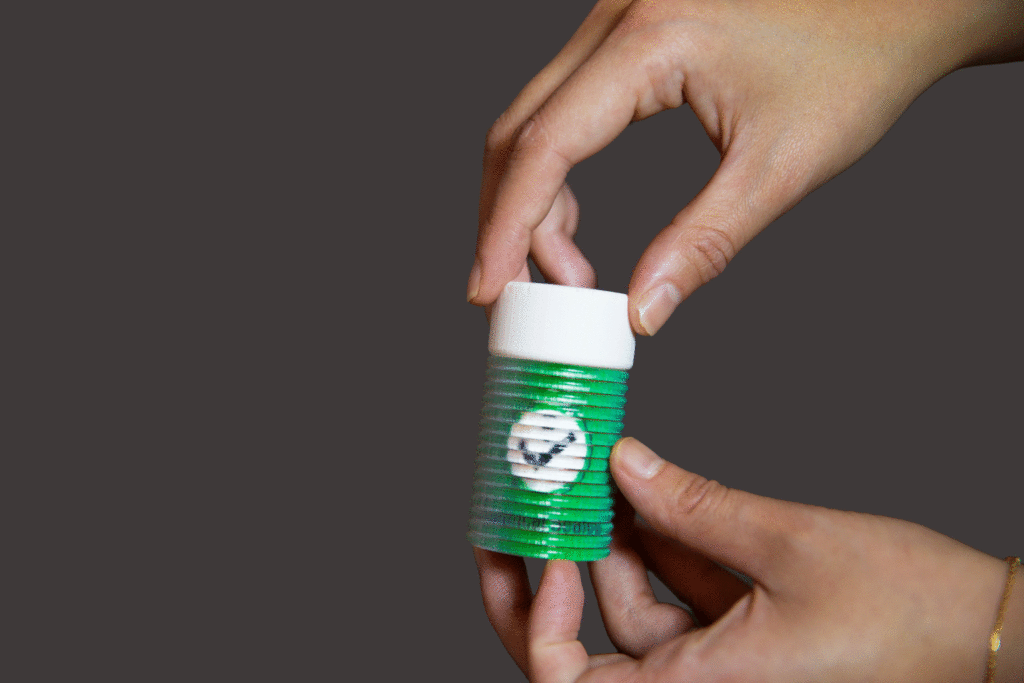
A groundbreaking system has been developed by researchers at the Massachusetts Institute of Technology (MIT) that promises to redefine how interactive objects are designed and fabricated. This innovative platform, named ShiftLens, enables the creation of dynamic, multi-state objects without the need for fragile electronic circuits, offering unparalleled resilience and intuitive user interaction. From adaptable warning signs capable of withstanding severe weather conditions to intelligent packaging that alerts users to loose fasteners during transit, the potential applications span across numerous industries. This end-to-end system is also poised to significantly streamline the rapid prototyping process for adaptable objects across artistic, architectural, and engineering domains, marking a significant leap forward in human-computer interaction.
The core of the ShiftLens innovation lies in its ability to embed interactive displays mechanically, bypassing the vulnerabilities inherent in traditional electronic systems. "With our system, an object can tell you whether you are using it properly, without the need for sensors or any complicated electronics. The interactive display is mechanical, so you can create a self-contained, multistate, interactive device that a user can control very intuitively," explains Yunyi Zhu, a graduate student in the MIT Department of Electrical Engineering and Computer Science (EECS) and the lead author of the paper detailing this transformative platform. This emphasis on mechanical interaction not only enhances durability but also simplifies the user experience, making interactive objects more accessible and reliable in diverse environments.
Addressing the Limitations of Conventional Interactive Technologies
The modern world is replete with interactive products, a vast majority of which rely heavily on screens, sensors, and intricate electronic circuitry to facilitate dynamic changes in appearance or functionality. While effective in controlled environments, these electronic components present significant vulnerabilities when exposed to harsh conditions. Water, extreme temperatures, corrosive chemicals, or even substantial physical stress like crushing, twisting, or forceful impact can render these delicate electronics inoperable. This inherent fragility limits their deployment in critical applications where robustness is paramount, such as outdoor signage, industrial equipment, or rugged consumer goods.
Conversely, existing non-electronic methods for altering an object’s appearance typically involve static labels, stickers, or specialized surface optics. Technologies like lenticular printing, for instance, can create illusions of depth or motion, but these effects are generally fixed and depend on the user’s viewing angle, offering limited, if any, true interactivity or dynamic change based on user input or environmental cues. Such conventional approaches lack the capacity for real-time adaptation or multi-state feedback, presenting a significant gap in the spectrum of interactive object design. The challenge, therefore, has been to develop a system that combines the dynamic capabilities of electronic displays with the resilience and simplicity of mechanical systems.
The Genesis of ShiftLens: A Vision for Robust Interactivity
The concept for ShiftLens emerged from a recognition of this critical technological void. Researchers aimed to simplify the process of creating dynamic, interactive objects that could operate independently of complex electronics. Their solution involved developing an automated system that translates a user’s design concept into a 3D printer-ready model of an object featuring a mechanically switchable surface appearance. This innovation directly tackles the long-standing trade-off between interactivity and durability, paving the way for a new generation of smart objects.
The research team, comprising Yunyi Zhu, Dingning Cao (an MIT undergraduate), Jeremy Mrzyglocki (a graduate student at the Technical University of Munich), Stefanie Mueller (an associate professor in EECS and the Department of Mechanical Engineering at MIT and a member of the Computer Science and Artificial Intelligence Laboratory (CSAIL)), and Narjes Pourjafarian (a postdoc at Northeastern University), will present their findings at the esteemed ACM Symposium on User Interface Software and Technology (UIST). This prestigious venue is renowned for showcasing cutting-edge advancements in human-computer interaction, underscoring the significance of the ShiftLens platform within the scientific community.
Deconstructing ShiftLens: The Mechanics of Optical Transformation
At its core, ShiftLens operates on an ingenious principle of combining two precisely engineered optical layers on an object’s surface. This design integrates a layer of specialized lenses positioned over an underlying, intricately patterned backplane. The magic unfolds as the object displays different visual states contingent upon the relative motion between these two layers.
The upper layer consists of an array of minuscule lenticular lenses. These curved lenses are specifically designed to steer light differently based on the viewing angle of the observer. This property is crucial for the dynamic visual effects. Below this, the pattern layer features strips of images, each corresponding to a distinct appearance or ‘state’ the object can adopt. When the user initiates a shift in the lens layer – whether through rotation, sliding, or other mechanical actuation – different segments of the patterned backplane are brought into alignment with the lenses. The lenticular lenses then magnify these newly exposed parts of the backplane image, causing an immediate and noticeable alteration in the surface’s visual appearance. This mechanical interplay allows for a seamless and intuitive transition between multiple pre-designed states.
Implementing this precise mechanical-optical alignment was not without its hurdles. Yunyi Zhu highlights the primary engineering challenge: "The biggest challenge in this project was to make sure all moving parts align. We need to make sure that the optical effect, mechanical linkages, and computational graphics align with one another." This intricate synchronization of optical properties, physical movement, and digital design is what distinguishes ShiftLens as a sophisticated yet robust system. Achieving this level of precision ensures that the desired visual changes occur reliably and consistently with each mechanical actuation.
A Straightforward System for Complex Designs
To democratize the creation of these dynamic objects, the researchers developed a user-friendly computational tool that orchestrates the complex design and fabrication processes behind the scenes. This innovative system automatically generates a ShiftLens structure based on a few straightforward user inputs. These inputs typically include the desired visual states, provided as images, along with the intended shape and curvature of the object. This streamlined approach allows designers and engineers, even those without specialized knowledge in optics or mechanical engineering, to conceptualize and realize sophisticated interactive objects.
Another significant challenge, as Zhu notes, was "to communicate to users who are not familiar with optics or mechanical structures and let them specify and achieve what they have in mind." This involved carefully crafting the interface and design guidelines to clearly articulate the capabilities and, importantly, the limitations of the ShiftLens tool. For instance, the system requires a shifting motion between its two layers to enable interaction. Consequently, not all object geometries or interaction paradigms are inherently compatible. Users are guided to either integrate ShiftLens into objects that naturally incorporate such motion – like the rotational mechanism of a lipstick tube – or to incorporate a dedicated actuation mechanism, such as a switch, knob, or roller, into their design. This thoughtful consideration of user experience ensures that designers can effectively leverage the system’s capabilities while understanding its inherent constraints. Ultimately, the system empowers users to gain direct control over an object’s appearance during its use, fostering a more intuitive and functional interaction.
Transformative Applications: From Lab to Real-World Impact
To demonstrate the versatility and practical utility of ShiftLens, the researchers fabricated a diverse range of interactive prototypes. These proof-of-concept objects vividly illustrate how the technology can be applied across various scenarios, offering solutions to everyday problems and opening new avenues for product design.
One compelling experiment involved a chemical bottle designed with a ShiftLens surface. This bottle intelligently communicates its status: when the cap is securely tightened, the surface turns green and displays a prominent check mark, providing immediate visual confirmation of proper sealing. Conversely, if the cap is loose, the bottle visually alerts the user by turning red and displaying an exclamation mark, preventing potential spills or contamination. This application alone holds immense implications for laboratory safety, industrial handling of hazardous materials, and even consumer product packaging where seal integrity is critical.
Another engaging demonstration showcased a tic-tac-toe game. The squares of this game could dynamically display a red ‘X’, a blue ‘O’, or remain blank, depending on the direction a user turned a small integrated knob. This not only exemplifies ShiftLens’s capacity for multi-state displays but also highlights its potential in educational toys, recreational devices, and user interfaces where simple, tactile input translates into clear visual feedback without the need for screens or batteries.
Beyond these initial prototypes, the commercial and industrial applications of ShiftLens are vast and far-reaching. Zhu suggests its potential for large-scale implementations, such as designing piping systems that can visually indicate a damaged connection causing a leak. Imagine a network of pipes in an industrial facility or even within a residential building: if a connection fails, the pipe segment could mechanically shift its surface appearance, perhaps from a neutral color to a bright warning red, or display an arrow pointing to the exact location of the fault. "The leaking sink in my apartment would be a lot easier to fix if it could tell me where the leak was coming from," Zhu quips, underscoring the everyday relevance of this technology. This capability could significantly reduce maintenance times, minimize damage, and enhance safety in critical infrastructure.
Broader Implications and Market Potential
The ShiftLens technology is poised to disrupt several market segments by offering a robust, low-maintenance alternative to electronic displays. Its inherent durability makes it ideal for environments where electronics typically fail or require extensive protective measures.
In the realm of smart packaging, ShiftLens could move beyond simple loose fastener detection. Imagine pharmaceutical packaging that visually confirms if the correct dosage has been dispensed, or food containers that indicate tampering without complex electronic tags. The global smart packaging market is projected to grow significantly in the coming years, driven by demand for enhanced product safety, traceability, and consumer engagement. ShiftLens offers a cost-effective and resilient solution to meet this demand, particularly for products exposed to varied environmental conditions during shipping and storage.
For industrial safety and signage, the implications are profound. Current electronic warning signs often require weatherproofing and are susceptible to damage from impact or extreme conditions. ShiftLens-enabled signs could dynamically change messages (e.g., "Caution: Wet Floor" to "Area Clear") purely through mechanical means, actuated by simple environmental triggers or manual input, offering unparalleled resilience and longevity in harsh outdoor or factory environments. This could lead to reduced maintenance costs and increased reliability in critical safety applications.
In consumer products, ShiftLens could introduce novel interactive elements to everyday items. Beyond the lipstick tube example, consider kitchen appliances that visually confirm settings, children’s toys with evolving narratives based on physical interaction, or even furniture that changes its decorative pattern with a simple slide. The tactile and intuitive nature of mechanical interaction could enhance user engagement in an increasingly digital world.
Architectural and Artistic Applications also stand to benefit. Imagine building facades that dynamically change patterns or colors based on sunlight angles or manual adjustments, or interactive art installations that respond to physical touch without sensitive electronic components. The robustness of ShiftLens opens up possibilities for public installations that can withstand the elements and heavy public interaction.
Economically, the absence of electronic circuits could translate into lower manufacturing costs for certain types of interactive products, particularly those requiring basic visual feedback rather than complex data processing. Furthermore, the ease of 3D printing ShiftLens components suggests a significant reduction in prototyping cycles, allowing designers and engineers to rapidly iterate and test concepts, thereby accelerating product development. This efficiency in prototyping is a key driver for innovation across industries. The reduction in reliance on electronic components also contributes to environmental sustainability by potentially decreasing e-waste and extending the lifespan of interactive objects.
The Research Team and Its Academic Recognition
The development of ShiftLens is the culmination of interdisciplinary expertise at MIT and collaborating institutions. The lead author, Yunyi Zhu, a graduate student in EECS, spearheads this innovative research. Her co-authors include Dingning Cao, an undergraduate student at MIT, contributing fresh perspectives and technical assistance. Jeremy Mrzyglocki, a graduate student at the Technical University of Munich, brings international collaboration to the project. The senior leadership and guidance come from Stefanie Mueller, an associate professor jointly appointed in EECS and the Department of Mechanical Engineering at MIT, and a member of CSAIL, MIT’s Computer Science and Artificial Intelligence Laboratory. Her extensive background in human-computer interaction and digital fabrication has been instrumental in shaping the project. Narjes Pourjafarian, a postdoc at Northeastern University, also contributes to the team’s diverse skill set.
The presentation of this research at the ACM Symposium on User Interface Software and Technology (UIST) is a significant endorsement of its impact and novelty. UIST is one of the premier forums for new research in the design, implementation, and evaluation of user interfaces. Acceptance at such a competitive symposium signifies that ShiftLens is recognized by the global HCI community as a substantial contribution that pushes the boundaries of interactive technology. It underscores the rigorous scientific merit and practical potential of the system.
Future Trajectories and Ongoing Development
The researchers are not resting on their laurels, with clear plans for the continued evolution of the ShiftLens platform. One primary area of future work involves exploring an even broader spectrum of applications. This includes delving into sectors like medical devices, educational tools, and advanced robotics, where robust, electronically-free interactivity could offer critical advantages. For instance, medical instruments that provide visual feedback on their sterile status or correct usage through mechanical cues, or educational models that demonstrate complex principles through intuitive physical interaction.
Furthermore, a key development goal is to enhance the user-friendliness and automation of the design process. The team plans to develop an advanced algorithm capable of generating ShiftLens structures with fewer user inputs. This would further simplify the design process, making the technology accessible to an even wider audience of creators, from hobbyists to industrial designers. By reducing the complexity of initial design specifications, the barrier to entry for utilizing ShiftLens will be significantly lowered, accelerating its adoption.
In addition, the researchers intend to broaden the design tool’s capabilities to incorporate a wider variety of actuation mechanisms. While current implementations can integrate with switches, knobs, and inherent object motions, future iterations could explore more sophisticated or subtle forms of mechanical input, such as responsive materials or integrated pneumatic/hydraulic systems for more complex dynamic changes. This expansion will offer designers greater flexibility and creative freedom in embedding ShiftLens into diverse product forms and functionalities, ensuring its continued relevance and innovation in the rapidly evolving landscape of interactive object design. The development of ShiftLens represents a significant step towards a future where interactive technology is not only smart but also inherently resilient, intuitive, and seamlessly integrated into our physical world.