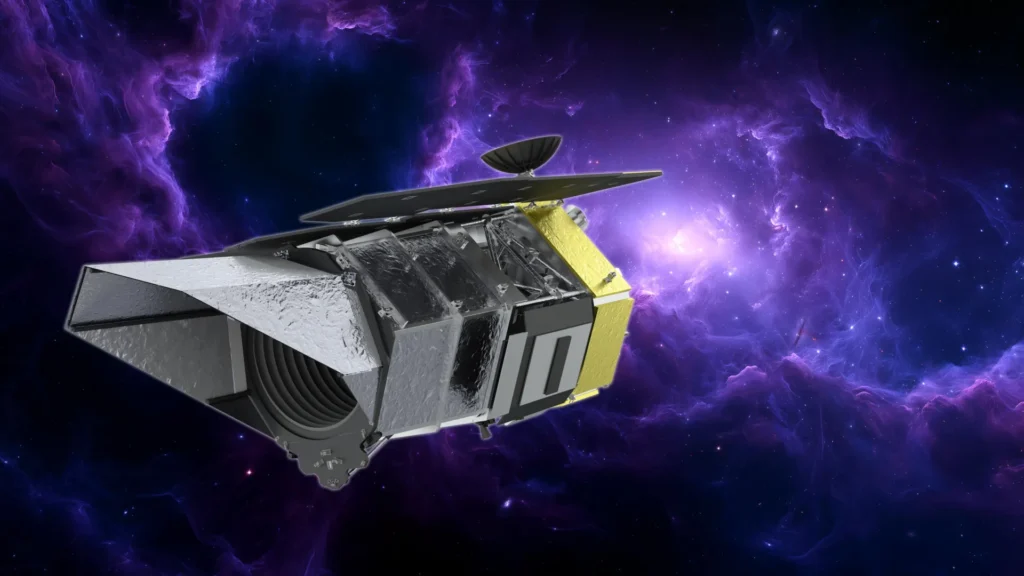
NASA’s Nancy Grace Roman Space Telescope is poised for its momentous launch, with just two days remaining until it embarks on its journey as the agency’s next flagship astrophysics mission. Following the groundbreaking success of the James Webb Space Telescope, Roman promises to usher in a new era of cosmic exploration. Faculty and students from the University of Arizona will be on hand at Cape Canaveral to witness this historic departure, anticipating science operations that are slated to commence in January 2027.
The Roman Space Telescope represents a significant paradigm shift in astronomical observation. While the James Webb Space Telescope (JWST) excels at scrutinizing relatively small celestial regions with unparalleled depth, Roman is engineered for a fundamentally different, yet complementary, purpose: to survey vast swathes of the universe with remarkable speed and efficiency. Both observatories share the critical capability of detecting infrared light, a crucial spectrum for understanding the universe’s most distant and obscured phenomena. The ability to compare and integrate data from both Roman and Webb will unlock unprecedented insights, potentially revealing far more about the universe’s structure, evolution, and composition than either telescope could achieve in isolation. This synergistic approach underscores NASA’s strategic vision for advancing astrophysics through coordinated, multi-faceted observational platforms.
A Hubble-Sized Mirror, an Unprecedented Field of View
At the heart of the Roman Space Telescope is a primary mirror measuring 7.9 feet in diameter, a dimension identical to that of the venerable Hubble Space Telescope. However, Roman’s scientific prowess is amplified by its two primary scientific instruments, each designed to push the boundaries of astronomical discovery. The Coronagraph Instrument is meticulously engineered to block and filter the intense glare of stars, a critical technique that will enable astronomers to directly study exoplanets and the protoplanetary disks that surround them. This advanced capability moves beyond indirect detection methods to direct observation of these distant worlds.
Complementing the Coronagraph is the Wide Field Instrument, a technological marvel designed to match the exquisite sensitivity of Hubble’s cameras while simultaneously capturing imagery across an area 100 times larger. This dramatic increase in field of view is a game-changer for large-scale surveys. For context, over its illustrious 30-year career, Hubble has meticulously observed approximately 0.1% of the night sky. Roman, in contrast, possesses the potential to survey the entire sky at a comparable resolution. This expansive perspective will empower Roman to identify and catalog rare celestial objects, from the ephemeral life cycles of dying stars to the formation of new planetary systems, the colossal structures of galaxy clusters, and a myriad of other cosmic targets. Researchers at the University of Arizona are set to play pivotal roles in several of these key scientific endeavors.
Probing the Mysteries of Dark Matter and Dark Energy
A cornerstone of Roman’s scientific mission is the investigation of dark matter and dark energy, two enigmatic components that collectively constitute nearly 95% of the universe’s total mass-energy content. Dark matter, though undetectable through light emission or absorption, exerts a significant gravitational influence on visible matter, shaping the large-scale structure of the cosmos. Dark energy, on the other hand, is the driving force behind the universe’s accelerating expansion, a phenomenon that has baffled cosmologists since its discovery. Understanding the nature and distribution of these invisible entities is paramount to unraveling the universe’s past, present, and future.
NASA has strategically selected the University of Arizona’s Arizona Cosmology Lab to spearhead two critical efforts focused on enhancing our comprehension of these cosmic enigmas. These involve participation in a wide-field science team and a project infrastructure team.
Leading the wide-field science team, titled "Kinematic Lensing with the Roman Space Telescope," is Elisabeth Krause, a distinguished professor of astronomy and physics at the University of Arizona. Her team has been awarded $2 million to develop and refine a sophisticated cosmological measurement technique known as kinematic lensing. By synergistically combining Roman’s high-resolution imaging capabilities with precise spectroscopic measurements, researchers aim to probe dark matter and dark energy with an unprecedented level of accuracy, potentially resolving long-standing debates in cosmology.
In parallel, another University of Arizona contingent will assume a leading role within the multi-institutional "Maximizing Cosmological Science with the Roman High Latitude Imaging Survey" project infrastructure team. Tim Eifler, also a professor of astronomy and physics, will guide the working group tasked with the crucial responsibility of interpreting Roman’s extensive cosmological observations. This collaborative effort underscores the global nature of modern astronomical research and the importance of coordinated scientific endeavors.
Transforming Galaxy Surveys into a Cosmic Map
Roman’s unparalleled survey capabilities will enable it to identify galaxies across an immense range of cosmic distances. By precisely determining their locations and meticulously measuring their characteristics, astronomers will construct vast, three-dimensional catalogs of galactic populations. These meticulously curated datasets will then serve as the foundation for applying advanced physical models, allowing scientists to deduce profound insights into the universe’s structure, its hierarchical formation, and its ongoing evolution.
The sheer scale of these observational data sets necessitates substantial computational power. To facilitate this, the NASA Roman Project has awarded Eifler’s lab $800,000 for essential computing resources. These resources will be integrated into a new university-wide high-performance computing system scheduled for installation this fall, significantly bolstering the university’s computational capacity for astronomical research. Furthermore, Eifler’s lab will receive an additional $2.4 million over a five-year period to support its ongoing scientific investigations.
"This infrastructure will be instrumental in bridging the gap from raw catalogs to profound cosmological interpretation," stated Eifler. "We will be empowered to make definitive determinations regarding the precise amounts of dark energy and dark matter present in the universe, a feat previously limited by computational constraints."
Eifler also holds the esteemed position of co-chair of the cosmology group, a sprawling international consortium comprising over 1,000 scientists from around the globe. This extensive network highlights the collaborative spirit driving Roman’s scientific objectives.
"It is incredibly rewarding to galvanize such a dedicated community and to strategically organize our collective efforts around this compelling science case," Eifler enthused. "This truly represents a dream assignment for any cosmologist."
Directly Imaging Distant Worlds: A New Frontier in Exoplanet Science
The Roman Space Telescope’s Coronagraph Instrument represents a monumental leap forward in the search for exoplanets. This sophisticated instrument will employ an array of advanced technologies, including specialized masks, prisms, detectors, filters, and self-flexing mirrors, all working in concert to effectively suppress the overwhelming light emitted by host stars. By dramatically reducing this stellar glare, astronomers will be able to directly image exoplanets and their surrounding protoplanetary disks, celestial bodies that would otherwise remain hidden within the blinding radiance of their parent stars.
Direct imaging marks a pivotal advancement in exoplanet science. Historically, the vast majority of known exoplanets have been discovered through indirect methods. These techniques often rely on detecting subtle changes, such as the slight dip in a star’s brightness when a planet transits across its face, or by observing the gravitational wobble a planet induces in its star. Roman’s coronagraph will fundamentally alter this landscape, enabling astronomers to actively search for planets by effectively shielding their parent stars. The instrument is projected to achieve unprecedented sensitivity, capable of detecting planets that are an astonishing 100 million times fainter than their host stars. This represents a performance enhancement of 100 to 1,000 times over existing space-based coronagraphs, promising to revolutionize our understanding of planetary systems beyond our own.
"This capability will serve as a crucial pathfinder for a future endeavor known as the Habitable Worlds Observatory," explained Schuyler Wolff, an associate research professor of astronomy who is leading the observation planning working group for the Coronagraph Instrument. The Habitable Worlds Observatory, a highly recommended future telescope, is specifically designed to search for definitive signs of life in other solar systems, a quest that Roman’s coronagraph will significantly advance.
Preparing for Roman’s Exoplanet Observations
The development and preparation for Roman’s exoplanet observations involve a dedicated team of researchers from the University of Arizona’s Lunar and Planetary Laboratory (LPL) and Steward Observatory. Mark Marley, director of LPL and associate professor of astronomy, alongside associate professor Ewan S. Douglas, assistant research professor Ramya Anche, and astronomy postdoctoral research associate Justin Hom, have all contributed to the development of the Coronagraph Instrument. They are poised to actively participate in future scientific investigations through their involvement in the observation planning working group.
Marley, in collaboration with LPL associate professor Ty Robinson and LPL postdoctoral research associate Zarah Brown, will leverage data from the Coronagraph Instrument to conduct in-depth studies of the atmospheres of planets orbiting stars beyond our solar system. Brown, in particular, has been engaged in sophisticated modeling of the climates and spectra of self-luminous giant planets. These distant worlds, often young and possessing substantial internal heat, emit their own thermal infrared light, making them prime targets for Roman’s capabilities.
Brown’s climate models are designed to predict atmospheric temperature, composition, and cloud structures, as well as the specific infrared spectrum that each celestial object should produce. These predictive capabilities are of paramount importance because many of these planets have yet to be observed at these critical wavelengths.
"The predicted spectrum is absolutely critical for effective planning," Brown emphasized. "Roman’s coronagraph is designed to work with extremely faint, high-contrast targets. Therefore, the team must meticulously schedule sufficient observing time to confidently detect a candidate planet without expending an inordinate amount of the mission’s limited resources."
Anche’s team is focused on characterizing the intricate structures of extrasolar systems, while Hom is spearheading efforts to identify the most suitable stars for calibrating the Coronagraph Instrument. Hom’s work also extends to leading precursor observing programs utilizing ground-based telescopes. This preparatory work is indispensable for confirming the most promising targets for future Roman science programs, ensuring the mission’s efficiency and scientific return.
Roman Science: A January 2027 Launchpad for Discovery
Upon commencing its science operations in January 2027, the data generated by the Roman Space Telescope will be made publicly accessible to the global scientific community. This open-data policy is a cornerstone of NASA’s mission to foster widespread scientific advancement and collaboration.
The University of Arizona is set to lead nine NASA-approved investigations utilizing Roman data, securing over $2 million in funding for these groundbreaking projects. These research efforts will delve into a diverse array of astronomical phenomena, including the enigmatic behavior of supermassive black holes, the gravitational bending of light by massive objects (gravitational lensing), the intricate processes of galaxy formation, the epoch of reionization that marked the universe’s transition from a neutral to an ionized state, and the composition and distribution of cosmic dust. The combined expertise and resources of the University of Arizona, coupled with the transformative capabilities of the Roman Space Telescope, promise a cascade of new discoveries that will redefine our understanding of the cosmos.