In a remarkable fusion of historical foresight and cutting-edge innovation, researchers at the Massachusetts Institute of Technology (MIT) Computer Science and Artificial Intelligence Laboratory (CSAIL) have resurrected a nearly 40-year-old concept for a revolutionary fastener, transforming it into a functional technology capable of imbuing objects with "tunable stiffness." This breakthrough, centered around a novel three-sided zipper, traces its origins back to a 1985 advertisement in Scientific American that sparked the imagination of William Freeman, then an electrical engineer at Polaroid. His initial vision of a triangular zipper, designed to seamlessly shift the rigidity of everyday items, has now been realized through advanced 3D printing and sophisticated design tools, promising significant advancements in fields ranging from consumer goods and robotics to medical applications and disaster relief.
The Genesis of a Three-Sided Concept
The story begins in 1985 when the Innovative Design Fund, in a forward-thinking initiative, placed advertisements in prominent scientific publications like Scientific American. These ads offered substantial grants, up to $10,000, to support the development of inventive prototypes across various categories, including clothing, home decor, and textiles. It was within this landscape of creative opportunity that William Freeman, a graduate of MIT with a PhD in Electrical Engineering, encountered the ad. As an electrical engineer at Polaroid, a company synonymous with photographic innovation, Freeman was already immersed in the world of design and engineering. He saw in the advertisement a chance to bring a unique concept to life: a three-sided zipper.
Freeman’s idea was elegantly simple yet profoundly different from the ubiquitous two-sided zipper. Instead of merely closing seams, his design was conceived as a dynamic mechanism, akin to a switch, capable of transitioning objects between soft and rigid states. This inherent flexibility was envisioned to revolutionize how items like chairs, tents, and purses were manufactured, packed, and assembled, making them more adaptable and user-friendly. His conceptual blueprint detailed a triangular zipper, deviating from the linear nature of conventional fasteners. Each of the three sides was to be fitted with a belt that connected narrow, wooden "teeth." A specialized slider, designed to encircle the entire device, could then be moved along the teeth, effectively interlocking them and forming a stable, triangular tube. This arrangement would allow for the controlled alteration of an object’s structural integrity.
Despite the ingenuity of his proposal, Freeman’s submission to the Innovative Design Fund was ultimately unsuccessful. However, the rejection did not deter him from pursuing his vision. He proceeded to patent his prototype, a testament to his belief in its potential, and stored it away in his garage, a tangible reminder of an idea waiting for its moment to shine. This act of preservation, often a quiet precursor to future breakthroughs, would prove prescient.
Decades Later: The Y-Zipper Emerges from the Garage
Nearly four decades after its conception, William Freeman’s pioneering concept found fertile ground within the advanced research environment of MIT’s Computer Science and Artificial Intelligence Laboratory (CSAIL). Researchers at CSAIL, driven by the pursuit of materials with "tunable stiffness," recognized the untapped potential in Freeman’s three-sided zipper. Prior attempts to achieve reversible changes in material rigidity often proved cumbersome, requiring manual assembly or lacking the ease of adjustment that Freeman’s design promised.
The CSAIL team embarked on a mission to revive and refine Freeman’s invention, leveraging contemporary technological advancements. Their endeavor resulted in the development of an automated design tool and an adaptable fastener christened the "Y-zipper," a nod to its distinctive three-pronged structure. This sophisticated software program empowers users to customize the design of three-sided zippers, tailoring their dimensions, flexibility, and functionality. Crucially, the software then translates these user-defined specifications into printable models, which are subsequently fabricated using advanced 3D printing techniques with versatile plastics.
The implications of this technological leap are far-reaching. The Y-zipper is not merely a novelty; it is a functional component designed to be integrated into a wide array of applications. Its ability to facilitate convenient assembly and disassembly, coupled with its capacity to dynamically alter structural properties, makes it an ideal candidate for incorporation into camping equipment, medical devices, robotic systems, and even intricate art installations. This adaptability addresses a long-standing challenge in product design: creating objects that can be both robust and easily manipulated for storage, transport, or reconfiguration.
Redefining Flexibility and Form
Jiaji Li, an MIT postdoctoral researcher and a lead author on the open-access paper detailing the Y-zipper project, articulated the fundamental advantage of this new fastener. "A regular zipper is great for closing up flat objects, like a jacket, but Freeman ideated something more dynamic," Li explained. "Using current fabrication technology, his mechanism can transform more complex items. We’ve developed a process that builds objects you can rapidly shift from flexible to rigid, and you can be confident they’ll work in the real world." This statement underscores the transition from a conceptual blueprint to a reliable, real-world engineering solution.
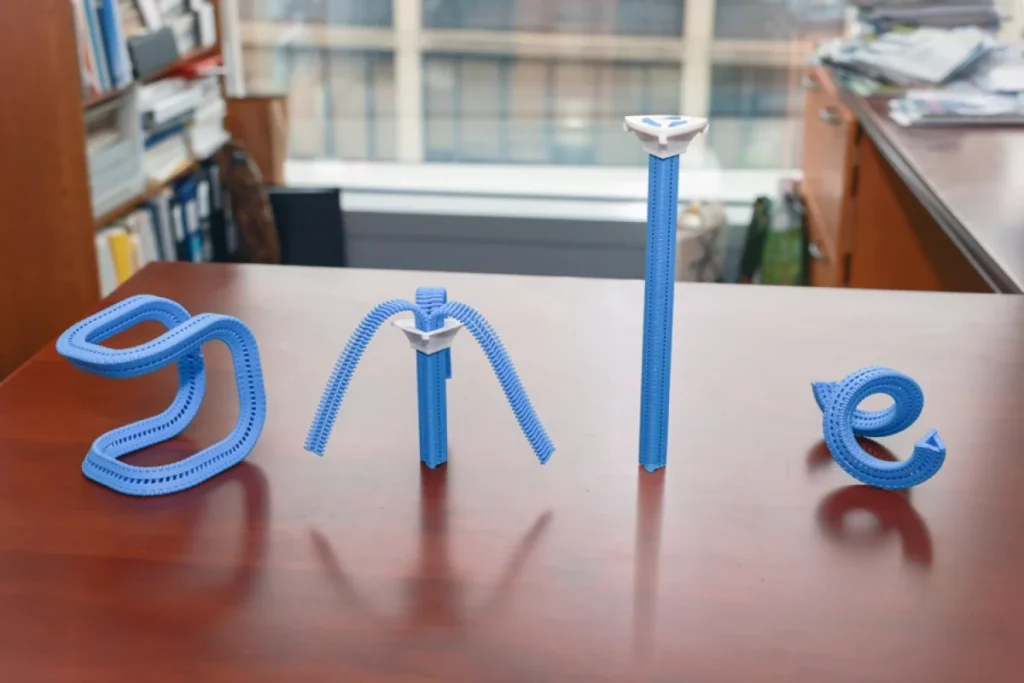
The core of the Y-zipper’s innovation lies in its customizable morphology. Through CSAIL’s intuitive software, users can precisely define the attributes of the fastener. This includes specifying the length of each of the three strips, as well as dictating the direction and angle at which they will bend when engaged. Furthermore, users can select from four distinct "motion primitives" that govern the zipper’s appearance when fully zipped: straight, bent (forming an arch), coiled (resembling a spring), or twisted (akin to a screw thread). This granular control over the fastener’s configuration allows for a high degree of design freedom, enabling the creation of objects that can "shape-shift" in practical and aesthetic ways.
When unzipped, the Y-zipper can present a dramatically different form, likened by researchers to a squid with three extending tentacles. Upon zipping, it condenses into a more compact structure, such as a rigid rod. This inherent transformability holds significant promise for optimizing portability and setup times. The researchers cite the example of pitching a tent: a process that can typically take up to six minutes when performed manually could be reduced to a mere minute and 20 seconds with the Y-zipper. By attaching each arm of the zipper to a side of the tent structure and supporting it from above, the Y-zipper can effectively "pop" the canopy into place, streamlining assembly.
Applications Across Diverse Sectors
The seamless transition between states offered by the Y-zipper extends its utility beyond recreational equipment into more critical domains, particularly in the realm of wearables and medical applications. The research team demonstrated this potential by wrapping a Y-zipper around a wrist cast. This application allows a patient to loosen the cast for comfort during the day and then zip it up securely at night to prevent further injury. The ability to transform a seemingly rigid medical device into a more comfortable, adjustable support system tailored to a patient’s evolving needs highlights the Y-zipper’s capacity to enhance patient care and compliance.
Furthermore, the Y-zipper system can empower individuals and industries to create dynamic technologies that respond to simple commands. By attaching a motor to the Y-zipper, the zipping process can be automated, leading to the development of adaptive robotic systems. One compelling example is an adaptive robotic quadruped, whose legs could dynamically alter their size. The robot could extend its limbs by tightening the Y-zippers, enabling it to traverse taller obstacles or uneven terrain, and then retract them by unzipping, allowing it to navigate lower to the ground. Such rapid adjustments could prove invaluable for robotic exploration in challenging environments like canyons or forests. Beyond robotics, actuated Y-zippers can also contribute to dynamic art installations. The CSAIL team has already showcased this potential by creating a long, winding floral sculpture that "bloomed" as a static motor actuated the Y-zipper, demonstrating the intersection of art and engineering.
Mastering the Material: Durability and Future Potential
While the creative and functional potential of the Y-zipper was evident, a critical question remained: its durability. Could these innovative fasteners withstand the rigors of daily use and repeated actuation? To address this, the CSAIL researchers subjected the Y-zippers to a series of rigorous stress tests.
The initial phase involved evaluating the mechanical properties of two commonly used 3D printing plastics: polylactic acid (PLA) and thermoplastic polyurethane (TPU). Using a specialized machine designed to bend the Y-zippers, the team assessed their strength and flexibility. The results indicated that PLA could support heavier loads, while TPU exhibited greater pliability, suggesting that material selection plays a crucial role in determining the fastener’s performance characteristics.
In a subsequent experiment, researchers employed an actuator to continuously cycle the Y-zipper open and closed, meticulously tracking its lifespan until failure. Remarkably, the Y-zippers endured approximately 18,000 cycles of zipping and unzipping before succumbing to stress. This impressive longevity is attributed, in part, to the Y-zipper’s inherent elastic structure, which, according to 3D simulations, effectively distributes the stress imposed by heavy loads, thereby enhancing its resilience.
Looking ahead, Jiaji Li envisions further improvements in the Y-zipper’s durability and applicability. He suggests the potential integration of stronger materials, such as metals, to create even more robust three-sided zippers. The researchers also acknowledge the limitations of their current 3D printing platform in producing larger-scale zippers, a development that would be necessary for expansive projects.
The potential applications for this technology extend far beyond current demonstrations. Li muses about its utility in space exploration, where Y-zipper tentacles could be incorporated into spacecraft to precisely grab and collect nearby rock samples. Moreover, the zippers could be embedded in structures designed for rapid assembly, offering a vital resource for relief workers in disaster-stricken areas, enabling the swift deployment of emergency shelters and medical tents.
Expert Perspectives and Future Directions
The innovative approach of the CSAIL team has garnered attention and praise from the wider scientific community. Guanyun Wang, an assistant professor at Zhejiang University who was not involved in the research, commented on the significance of the Y-zipper. "Reimagining an everyday zipper to tackle 3D morphological transitions is a brilliant approach to dynamic assembly," Wang stated. "More importantly, it effectively bridges the gap between soft and rigid states, offering a highly scalable and innovative fabrication approach that will greatly benefit the future design of embodied intelligence." This endorsement highlights the Y-zipper’s potential to be a foundational element in the development of more sophisticated and adaptable technologies.
The research paper detailing the Y-zipper project was co-authored by Jiaji Li and William Freeman, alongside Tianjin University PhD student Xiang Chang and a distinguished group of MIT CSAIL colleagues. These include PhD student Maxine Perroni-Scharf, undergraduate Dingning Cao, recent visiting researchers Mingming Li (Zhejiang University), Jeremy Mrzyglocki (Technical University of Munich), and Takumi Yamamoto (Keio University). The work was further guided by MIT Associate Professor Stefanie Mueller, a CSAIL principal investigator and senior author on the paper. The research received partial support from a postdoctoral research fellowship from Zhejiang University and the MIT-GIST Program, underscoring the collaborative and international nature of this innovation.
The groundbreaking work was formally presented at the ACM’s annual Conference on Human Factors in Computing Systems (CHI) in April, a premier venue for showcasing advancements in human-computer interaction. This presentation signifies the culmination of years of research and development, bringing a visionary concept from the 1980s into the tangible reality of 21st-century engineering and design. The Y-zipper stands as a compelling example of how persistent innovation, fueled by both historical inspiration and contemporary technological prowess, can unlock new possibilities for the built world around us.