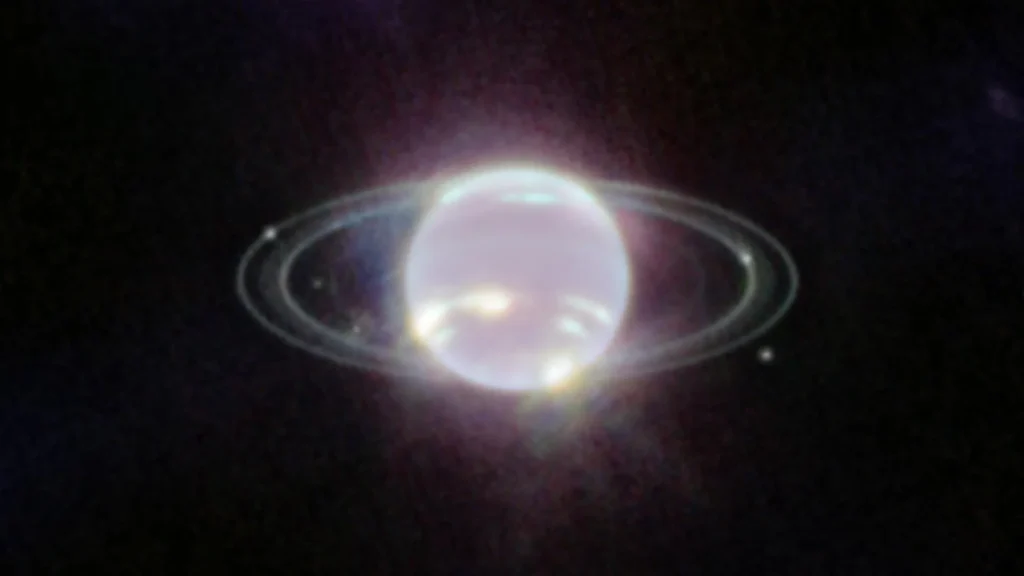
In a groundbreaking discovery that is reshaping our understanding of the outer solar system, astronomers have utilized the unparalleled capabilities of NASA’s James Webb Space Telescope (JWST) to peer into the enigmatic chemical composition of Neptune’s inner moons and rings. The findings, published in the prestigious journal Science Advances, provide compelling evidence supporting a dramatic and violent history for the ice giant’s satellite system, suggesting a catastrophic event that may have pulverized its original moons, leaving behind the smaller, inner satellites observed today.
The investigation, led by a team from the California Institute of Technology (Caltech), focused on three of Neptune’s inner moons: Larissa, Galatea, and Proteus. These small, irregularly shaped bodies orbit the planet at relatively close distances, just beyond Neptune’s main ring system. Their discovery in 1989 by the Voyager 2 spacecraft marked a significant moment in planetary science, but their diminutive size and remote location have rendered them notoriously difficult to study from Earth using traditional telescopic methods.
A New Era of Observation: The James Webb Space Telescope’s Unprecedented Gaze
The advent of the JWST, with its advanced infrared capabilities and exceptional sensitivity, has opened a new window into the solar system’s most distant and elusive objects. The Caltech-led team leveraged the telescope’s near-infrared spectrograph to meticulously analyze the light reflected from Neptune’s inner moons and rings. Spectroscopy, the science of breaking down light into its constituent wavelengths, acts as a cosmic fingerprint, revealing the chemical elements and molecular compounds present on the surfaces of celestial bodies.
"Until recently, scientists had no spectroscopy measurements of these moons," explained Ryleigh Davis, a former Caltech graduate student and lead author of the study, now a postdoctoral researcher at UC San Diego. "Instruments like JWST’s near-infrared spectrograph separate incoming light into different wavelengths. Those patterns can reveal the chemical composition of distant objects and allow researchers to identify molecules and minerals on their surfaces."
The research program, co-led by Davis and fellow Caltech postdoctoral scholar Matthew Belyakov, was specifically designed to determine the composition of these small satellites and to ascertain what these findings might reveal about their formation. The results, however, far exceeded expectations, presenting a chemical signature unlike anything previously identified among bodies in the outer solar system.
Unexpected Signatures: The Enigma of Clay Minerals in the Outer Solar System
The most striking revelation from the JWST observations was the detection of magnesium-rich phyllosilicates, commonly known as clay minerals, on Larissa, Galatea, and within Neptune’s rings. This discovery was particularly astonishing because phyllosilicates had never before been detected beyond Jupiter’s orbit.
"Phyllosilicates had never been detected anywhere in the outer solar system beyond Jupiter, so that was not on our list of things to look for," Davis stated. "We were shocked to find the observed clays, which had to come from objects that were much, much bigger than Neptune’s small inner ring moons."
The presence of phyllosilicates is significant because these minerals require liquid water to form. However, the JWST data showed no evidence of water ice on any of the three moons examined or within the rings themselves. This paradoxical combination – the presence of water-formed minerals alongside a striking absence of water ice – has left scientists perplexed.
"That’s really surprising because everything out in this part of the solar system is really icy," Davis elaborated. "So, we’re fairly confident that they had to come from deep inside something that was big enough to generate enough heat that it melted its water ice. We think the most likely place would be an original system of icy moons, although it’s a bit of a mystery where the ice may have gone."
A Cataclysmic Past: The Triton Hypothesis
These perplexing findings strongly support a leading hypothesis regarding Neptune’s unusual moon system. Unlike other giant planets, Neptune does not possess a "typical" arrangement of large, orderly moons. Instead, its satellite system is characterized by a few large moons and numerous smaller ones, including the five tiny satellites discovered by Voyager 2. This unconventional configuration hints at a history far more tumultuous than that of its planetary neighbors.
The prevailing theory posits that Neptune’s original moon system was utterly annihilated by a cataclysmic event involving Triton, the planet’s largest moon. Triton is believed to have formed elsewhere in the solar system and was subsequently captured by Neptune’s immense gravitational pull. This capture event, likely a violent process, is thought to have disrupted and destroyed the planet’s nascent family of moons.
"If Neptune once had a system of moons that looked something like what we see at Uranus today, we expect it would’ve been completely destroyed by the process of Triton getting captured," explained Ryleigh Davis. "This is exciting new evidence that something catastrophic happened at Neptune that completely destroyed its original satellites, and we’re getting to see the fingerprints left behind by that process."
Researchers theorize that the debris from this cosmic collision and subsequent destruction eventually coalesced under Neptune’s gravity, forming the smaller inner moons observed today. The presence of deep-interior material, like the phyllosilicates, on these moons suggests that they are, in essence, fragments of larger, original bodies that were ripped apart and then reassembled.
Proteus: A Divergent Story
Adding another layer of complexity to the puzzle, the largest of the studied inner moons, Proteus, did not exhibit the same phyllosilicate signature as Larissa and Galatea. This discrepancy could indicate that Proteus formed from material originating in a different region of the debris disk or that it underwent subsequent heating events that erased any pre-existing clay minerals.
"Proteus, the largest of the small moons included in the study, did not show the same phyllosilicate signature," the researchers noted. "The researchers say this difference could mean Proteus formed again from material located in another part of the debris disk. Another possibility is that it was heated later, destroying clay minerals that had once been present."
Furthermore, the team identified another unidentified hydrated mineral present on all three moons. The spectral signature of this mineral does not match any known substances in existing solar system spectral libraries, presenting a new mystery for future research.
"We see something that doesn’t really look like anything else we’ve identified in the solar system; it doesn’t match anything we have in our spectral libraries," Davis said. "We assume it’s some form of hydrated rock from the moons as well, but there’s still a lot of mystery."
Alternative Scenarios and the Value of Exposed Interiors
While the destruction of Neptune’s original moon system is the favored explanation, the research team acknowledges an alternative possibility. The material detected on the moons could have originated from a large, differentiated Kuiper Belt Object (KBO) similar in size to Pluto. If such an object passed extremely close to Neptune, the planet’s gravitational forces could have torn it apart through tidal forces.
Regardless of the specific scenario, both explanations point to the material being derived from the deep interiors of much larger celestial bodies. The inner moons of Neptune, therefore, represent an extraordinary natural laboratory, offering scientists a unique opportunity to directly examine the composition of material that is normally buried deep within icy worlds.
"Either way, what we’re seeing on these moons had to come from deep inside something much larger," Davis emphasized. "That material is normally permanently buried — we can only infer what’s there. Here, a catastrophic event essentially turned these ancient moons inside out, and we get to see what was hidden inside."
This exposure of internal material is invaluable. In most of the solar system, accessing the deep interiors of large icy bodies is impossible. Neptune’s small moons, through a destructive cosmic dance, have effectively brought these hidden compositions to light.
Reconstructing a Lost World: Future Investigations
The implications of these findings extend far beyond Neptune. They offer a tangible glimpse into the dynamic and often violent processes that shape planetary systems. Future research will focus on unraveling the precise mechanics of Neptune’s moon destruction, the subsequent evolution of the debris, and the intricate process by which some of this material reassembled into new satellites.
Questions remain about the exact size of Neptune’s original moons and the efficiency of material retention within the system following Triton’s capture. Understanding these dynamics could provide crucial insights into the formation and evolution of planetary satellite systems across the cosmos.
"If you bring Triton in, and you smash up your large moons, we think only 1 percent or so of that material stayed around in the system," Davis explained. "But the actual behavior of that material might be really different if Triton is still there shaking things up for a long time. So, looking forward, understanding how that process actually proceeds would be interesting. From there, the question is: ‘Can we learn anything about how big the initial moons had to be to have formed and provided this material?’"
The research, supported by NASA grants and conducted in collaboration with institutions such as the Space Telescope Science Institute, represents a significant leap forward in our understanding of planetary evolution. It underscores the power of advanced observational tools like the JWST to reveal the hidden histories of our solar system, transforming our perception of the seemingly static celestial bodies that populate our cosmic neighborhood into a dynamic tapestry of past cataclysms and ongoing transformations. The insights gained from Neptune’s shattered moons offer a profound reminder that even the most distant corners of space hold stories waiting to be uncovered, stories etched in the very fabric of celestial bodies.