In a significant leap for the field of nanotechnology and analytical chemistry, a research team at the University of Toronto’s Faculty of Applied Science & Engineering has engineered a novel class of dye-sensitized nanoparticles. These microscopic sensors are capable of detecting chemical substances at concentrations previously thought to be near the limit of optical detection, while simultaneously offering the precision required to distinguish between structural isomers—molecules that share identical atomic formulas but differ in their spatial arrangements. This breakthrough, recently detailed in the Journal of the American Chemical Society, addresses long-standing limitations in the brightness and efficiency of upconversion nanoparticles (UCNPs), opening new doors for pharmaceutical safety, environmental monitoring, and medical diagnostics.
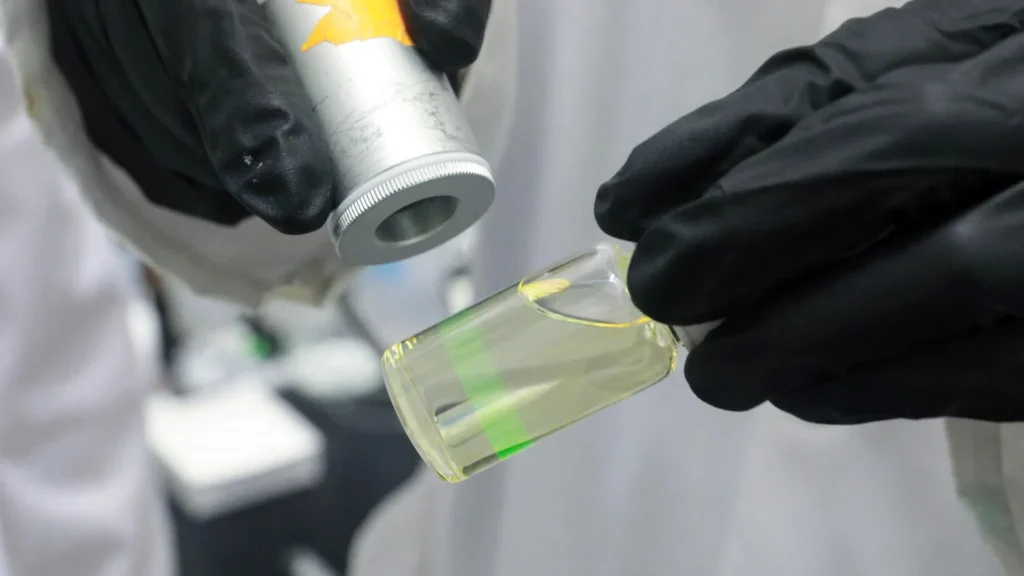
The core of this innovation lies in the particles’ ability to perform "upconversion," a physical process where low-energy photons, typically from the near-infrared spectrum, are absorbed and converted into higher-energy photons of visible light. While traditional fluorescent materials, known as fluorophores, lose energy during the emission process—converting high-energy ultraviolet or blue light into lower-energy red or green light—these new nanoparticles reverse the flow. By emitting a bright green signal when stimulated by inexpensive infrared lasers, these particles provide a high-contrast reporting mechanism that effectively eliminates background noise, a common hurdle in high-sensitivity chemical analysis.
The Science of Photon Upconversion and the "Stargazing" Effect
To understand the significance of the University of Toronto’s work, one must first look at the limitations of conventional fluorescence. For decades, organic fluorophores have been the workhorse of biological and chemical imaging. However, because they require high-energy excitation (such as UV light), they often trigger "autofluorescence" in the surrounding environment. In biological samples or complex chemical mixtures, the background itself often glows, masking the signal from the intended target.
Professor Kai Huang, the senior author of the study, likens the challenge to observing the heavens. In a typical scenario, trying to detect a faint chemical signal is like trying to see stars during a bright afternoon; the sun’s overwhelming light makes the stars invisible even though they are still shining. By utilizing upconversion, the researchers have essentially found a way to "turn off the sun." Because the excitation light (infrared) is at a completely different frequency than the emitted light (green), and because most natural substances do not naturally upconvert light, the background remains dark. This results in a "zero-autofluorescence" environment where the nanoparticles shine with extreme clarity against a pitch-black backdrop.
Overcoming the "Back-Energy Transfer" Barrier
The construction of upconversion nanoparticles typically relies on lanthanide elements, specifically ions of ytterbium (Yb) and erbium (Er). In traditional designs, these ions are embedded within a host matrix, often composed of sodium, yttrium, and fluorine (NaYF4). The ytterbium ions act as a "relay" or antenna, harvesting infrared energy and passing it to the erbium ions, which then emit the visible green light.
However, the field has historically hit a ceiling regarding brightness. Scientists found that if they increased the density of ytterbium ions to capture more light, the efficiency actually dropped. This phenomenon, known as "back-energy transfer" or concentration quenching, occurs when the ytterbium atoms become so crowded that they begin to re-absorb the energy emitted by the erbium ions. Instead of the light escaping the particle to be detected by a sensor, it bounces back into the internal relay system and is lost as heat.
To solve this, the University of Toronto team, led by PhD student Jiaze Wu, abandoned the traditional flat, hexagonal architecture of UCNPs in favor of a sophisticated, three-dimensional core-shell-shell structure. They also moved away from the standard sodium-based matrix, opting for a more complex lattice of lithium, lutetium, and fluorine (LiLuF4).
This new design features a gradient of ion concentration. The core of the diamond-shaped nanoparticle is packed densely with ytterbium, while the surrounding shells have decreasing concentrations. This "one-way energy tunnel" ensures that once energy is captured by the outer layers, it flows inward toward the erbium emitters in the core and is then pushed outward as visible light without being recaptured by the relay ions.
Computational Modeling: Designing at the Atomic Level
The success of the project was not merely a result of laboratory trial and error. The team relied heavily on advanced computational simulations to predict how energy would move through various theoretical particle designs. Undergraduate student Weixiang Ben led the computational effort, utilizing Monte Carlo simulations and Density Functional Theory (DFT) to model energy interactions at the atomic and subatomic levels.
By simulating dozens of chemical formulations and geometric structures, the researchers were able to identify the lithium-lutetium-fluorine core-shell-shell model as the most efficient configuration before a single physical particle was synthesized. This "digital twin" approach allowed the team to bypass years of physical experimentation, moving directly to the most promising candidate. The simulations confirmed that the specific gradient of lanthanide ions would prevent back-energy transfer, validating the "one-directional energy tunnel" theory.
Unprecedented Performance Data
The resulting nanoparticles demonstrated performance metrics that significantly outpace current industry standards. According to the research data:
- The new particles are approximately 150 times brighter than standard upconversion nanoparticles that lack dye sensitization.
- When compared to the most highly optimized conventional UCNPs previously reported in scientific literature, the U of T particles are 50 times brighter under identical excitation conditions.
- The particles can detect molecules at extremely low concentrations, potentially down to the parts-per-billion or even parts-per-trillion range, depending on the target.
This massive increase in brightness translates directly into sensitivity. In practical terms, a sensor using these particles requires fewer "hits" from a target molecule to generate a signal that is readable by standard laboratory equipment.
Solving the Isomer Crisis in Pharmaceutical Manufacturing
One of the most promising applications for this technology is in the pharmaceutical industry, specifically in the detection of structural isomers. Isomers are molecules that contain the same number of atoms of the same elements but are arranged in different structures. In chemistry, structure is function; two isomers can have vastly different effects on the human body.
The most famous—and tragic—example of this is thalidomide. One isomer of the drug successfully treated morning sickness, while the other caused severe birth defects. While modern pharmaceutical manufacturing is much more strictly regulated, the challenge of "isomer contamination" remains. Separating or detecting a 10% impurity of the wrong isomer in a batch of drugs is currently a slow and expensive process, often requiring high-performance liquid chromatography (HPLC) or mass spectrometry.
The University of Toronto’s nanoparticles can be "tuned" or functionalized to bind specifically to one isomer and not the other. Because the particles are so bright, they can detect even a tiny fraction of the wrong molecule in a large batch using a simple, low-cost infrared laser. This could allow for real-time quality control on the factory floor, significantly reducing the cost of drug production and increasing patient safety.
Environmental and Global Health Implications
Beyond the laboratory and the factory, these nanoparticles hold immense potential for environmental protection. Groundwater contamination is a growing global crisis, with "forever chemicals" like PFAS and trace heavy metals posing long-term health risks. Detecting these pollutants often requires collecting large volumes of water and sending them to centralized laboratories for analysis.
The high sensitivity and "stargazing" clarity of the U of T nanoparticles could enable the development of portable, field-ready sensors. Environmental researchers could potentially use hand-held devices to detect trace amounts of toxins in remote wells or rivers, receiving instant results rather than waiting weeks for lab reports.
Furthermore, the technology could be adapted for medical diagnostics in low-resource settings. Because the particles can be activated by low-cost, low-power lasers—similar to those found in consumer electronics—they could be integrated into point-of-care diagnostic chips to detect pathogens or biomarkers for diseases like malaria or cancer at their earliest stages.
The Roadmap to Commercialization
While the results are groundbreaking, Professor Huang and his team emphasize that the technology is currently in the proof-of-concept stage. The transition from a laboratory setting to widespread commercial use involves several challenges, most notably the scaling of the manufacturing process. Producing these complex, multi-layered diamond-shaped particles with atomic precision at a metric-ton scale is the next hurdle the team aims to clear.
"We are already working on the scalability aspect," says Professor Huang. "It is a long roadmap, but the fundamental physics and the computational models we’ve developed show that this is feasible. We have created a platform that can be customized. Whether you want to detect a specific pollutant in the Great Lakes or a specific impurity in a new oncology drug, the core technology remains the same."
The research has already garnered interest from various industrial sectors. The ability to customize the "functionalization" of the nanoparticle—changing the chemical "lock" on the outside of the particle to fit a specific molecular "key"—makes it a versatile tool for the future of analytical chemistry.
Conclusion: A New Era of Molecular Sensing
The development of these dye-sensitized, gradient-shell nanoparticles represents a milestone in the convergence of material science, physics, and chemistry. By solving the "back-energy transfer" problem and leveraging the power of computational design, the University of Toronto team has created a tool that is not only 150 times more powerful than its predecessors but also capable of levels of discrimination that were previously the domain of multi-million dollar analytical suites.
As the team continues to refine the manufacturing process and explore new functionalization techniques, the "bright green glow" of these nanoparticles may soon become a standard sight in the quest for cleaner water, safer medicines, and more accurate medical diagnoses. The study serves as a testament to the power of interdisciplinary research, proving that sometimes, to see the smallest details of our world, we simply need to find a better way to turn off the sun.