The fundamental laws of physics have long presented a profound contradiction that challenges our understanding of the cosmos. On one hand, the second law of thermodynamics dictates that the Universe is trending toward an inevitable state of maximum disorder, known as entropy. On the other hand, the history of the Universe is a chronicle of increasing organization, transitioning from a nearly uniform hot plasma into a vast tapestry of galaxies, stellar systems, planetary bodies, and the intricate biological structures that constitute life. A new theoretical study led by Professor Ginestra Bianconi, a mathematician at Queen Mary University of London, proposes a solution to this long-standing puzzle by framing gravity not merely as a force, but as a phenomenon emerging from entropy itself.
Published in the journal Physical Review D, the research investigates the "Gravity from Entropy" (GfE) theory. This framework suggests that the emergence of complex structures is not a violation of thermodynamic principles but is instead a natural consequence of the way spacetime geometry and information interact on a quantum scale. By analyzing the mathematical relationship between expanding space and informational density, Bianconi’s work provides a potential roadmap for reconciling the macroscopic arrow of time with the microscopic laws of quantum gravity.
The Entropy Paradox: Order from Chaos
To understand the significance of this research, one must first consider the weight of the second law of thermodynamics. Albert Einstein famously lauded this principle, suggesting it was the only physical theory of universal content that would never be overthrown. In its simplest form, the law states that in any isolated system, the total entropy—a measure of energy dispersal and informational "smearing"—tends to increase over time. This progression is often equated with a move from order to disorder.
Cosmologically, this creates a significant tension. The standard model of cosmology, the Big Bang theory, posits that the Universe began in a state of extremely low entropy. For billions of years, gravity has pulled matter together to form high-density structures like stars and planets. To the casual observer, the formation of a star from a cloud of gas looks like a decrease in entropy because it represents a move toward higher organization. While standard physics explains this by noting that the star radiates heat into the surroundings (thereby increasing the total entropy of the environment), the broader question of how the Universe maintains such sustained "pockets" of complexity remains a subject of intense debate.
Professor Bianconi’s research addresses this by examining the "informational tension" inherent in the expansion of the Universe. Her study suggests that while the total entropy of the Universe continues to rise, the density of that entropy is changing in a way that facilitates the birth of complexity.
A Chronology of Emergent Gravity and Thermodynamics
The idea that gravity and thermodynamics are inextricably linked is not a new concept, but it has evolved through several distinct phases over the last half-century.
- The 1970s: The Black Hole Revolution: Jacob Bekenstein and Stephen Hawking fundamentally altered physics by proving that black holes are not purely "black" but possess entropy and emit radiation. This established the Bekenstein-Hawking entropy formula, which suggests that a black hole’s entropy is proportional to the area of its event horizon. This was the first hint that spacetime geometry (area) and thermodynamics (entropy) were two sides of the same coin.
- The 1990s: The Holographic Principle: Building on the black hole findings, physicists like Gerard ‘t Hooft and Leonard Susskind proposed the holographic principle, suggesting that the description of a volume of space can be thought of as encoded on a lower-dimensional boundary to the region.
- 2010: Entropic Gravity: Erik Verlinde published a landmark paper proposing that gravity is not a fundamental force but an "entropic force" caused by changes in the information associated with the positions of material objects.
- 2024: The QGRE Framework: Professor Bianconi’s latest work advances these concepts by introducing the Quantum Geometric Relative Entropy (QGRE). This model provides a specific mathematical mechanism—the GfE Lagrangian—to describe how gravity emerges from the difference between the actual geometry of spacetime and a secondary metric dictated by matter and curvature.
The Mechanics of Gravity from Entropy
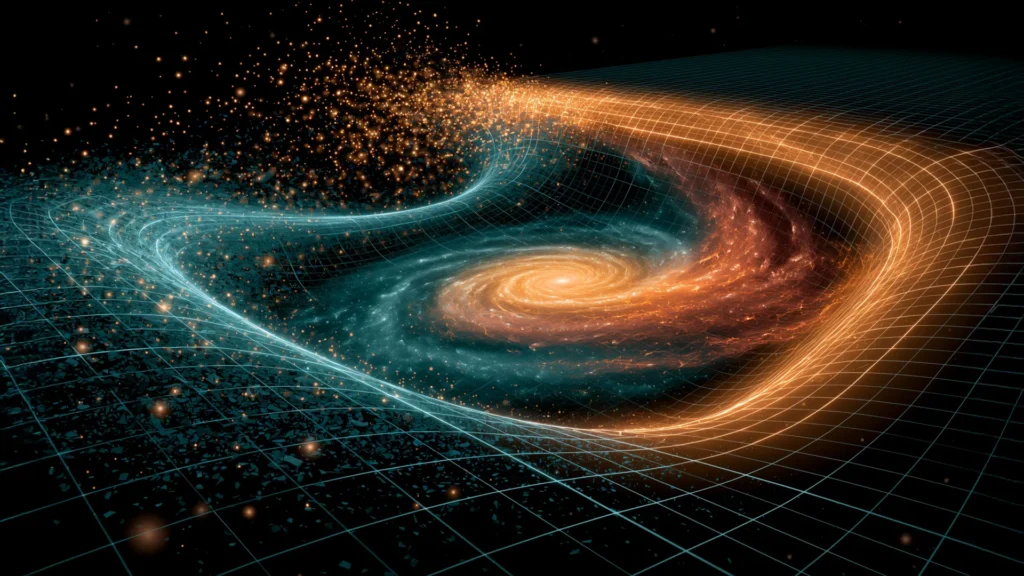
The GfE theory utilizes the tools of statistical mechanics to describe the "microscopic" properties of spacetime. In this view, spacetime is not a smooth, continuous background but is composed of underlying quantum informational states. Gravity emerges as these states attempt to reach an equilibrium.
At the heart of Bianconi’s analysis is the distinction between total entropy and local entropy density. As the Universe undergoes expansion, the total volume of the cosmos increases. Within the GfE framework, the expansion of the physical spacetime metric allows the total entropy of the system to grow, satisfying the second law of thermodynamics. However, because the volume is growing so rapidly, the "Quantum Geometric Relative Entropy" per unit of volume actually decreases.
This "thinning out" of entropy density creates a thermodynamic environment where localized regions can become highly structured. Essentially, the expansion of the Universe provides a "sink" for entropy, allowing matter to organize into galaxies and stars without violating the global requirement for increasing disorder.
Mathematical Models and Dark Energy Predictions
The study applies these thermodynamic principles to Friedmann-Robertson-Walker (FRW) spacetimes, which are the standard mathematical models used to describe an expanding, homogeneous, and isotropic Universe. In these models, Bianconi found that the equations of Gravity from Entropy naturally mirror the laws of thermodynamics.
The research demonstrates that the emerging dark energy contribution in the GfE model acts as a form of internal energy. In standard General Relativity, dark energy is often represented by the Cosmological Constant ($Lambda$), a static value that explains why the expansion of the Universe is accelerating. However, the GfE model suggests that this dark energy component is dynamic—it evolves over time.
This is a critical distinction for experimental physics. If dark energy is dynamic rather than constant, its effects on the expansion rate of the early Universe versus the late Universe would be different. This provides a "testable" prediction. Current and future cosmological surveys, such as those conducted by the Dark Energy Spectroscopic Instrument (DESI) or the Euclid space telescope, could potentially look for these dynamical signatures to see if they align with GfE predictions rather than classical General Relativity.
Supporting Data: Temperature and Pressure in Spacetime
One of the most striking aspects of Bianconi’s work is the emergence of classical thermodynamic variables from purely geometric and informational equations. In the GfE framework, quantities that correspond to temperature and pressure arise naturally.
- Effective Temperature: The model suggests that the quantum state underlying spacetime has an inherent thermal character. This temperature is linked to the fluctuations of the spacetime geometry itself.
- Pressure: The "informational tension" between different metrics of spacetime manifests as a pressure that influences how the Universe expands.
By showing that these variables obey a version of the first law of thermodynamics ($dU = TdS – PdV$), the research provides a robust mathematical foundation for the idea that the Universe is a giant thermodynamic system where gravity is the engine of heat and information exchange.
Implications for the Emergence of Life
The broader implications of this study extend beyond the realm of abstract mathematics and into the origins of life. The question of how life—a state of extremely low local entropy—can exist in a high-entropy Universe has long been a philosophical and scientific hurdle.
If gravity and the expansion of the Universe naturally lead to a decrease in local entropy density, then the emergence of complexity is not a statistical fluke or an "anti-entropic" miracle. Instead, it is a built-in feature of the gravitational dynamics of the Universe. The Universe, in effect, "makes room" for life by expanding the stage on which information is played out.
Professor Bianconi noted that this work could open new avenues for investigating the foundations of cosmological irreversibility. "This work reveals how the Gravity from Entropy theory can tackle the challenging question to reconcile the second principle of thermodynamics with the emergence of complexity in our Universe," she stated. She further emphasized that these results might help link the emergence of life with fundamental gravitational dynamics, suggesting that the "arrow of life" and the "arrow of time" are driven by the same underlying quantum informational processes.
Analysis and Future Outlook
While the Gravity from Entropy theory is still in its theoretical infancy, it represents a significant shift in how physicists view the fabric of reality. For decades, the "Holy Grail" of physics has been the unification of General Relativity (which explains the very large) and Quantum Mechanics (which explains the very small). Many theorists believe that thermodynamics and information theory are the "missing links" required for this unification.
Bianconi’s research is consistent with the "It from Bit" philosophy popularized by John Archibald Wheeler, which suggests that every physical quantity derives its ultimate significance from bits of information. By showing that gravity can be derived from the "relative entropy" of quantum states, this study strengthens the argument that information is the fundamental building block of the Universe.
However, challenges remain. Critics of emergent gravity theories often point out that these models must be able to replicate all the successes of General Relativity, including the precise orbits of planets and the behavior of gravitational waves. Bianconi’s study shows that GfE does indeed reproduce General Relativity in the limit of weak spacetime curvature and low energy. The next step for researchers will be to apply the GfE Lagrangian to more complex scenarios, such as the merging of black holes or the conditions of the very early Universe during the epoch of inflation.
As observational technology improves, the ability to measure the "fuzziness" of spacetime or the evolution of dark energy will provide the ultimate test for this theory. If confirmed, the idea that gravity emerges from entropy would not only solve the paradox of cosmic complexity but would also provide a new, unified language for understanding the birth, evolution, and ultimate fate of the Universe.