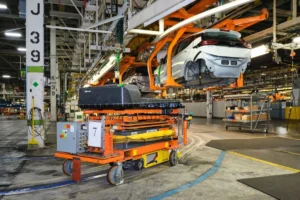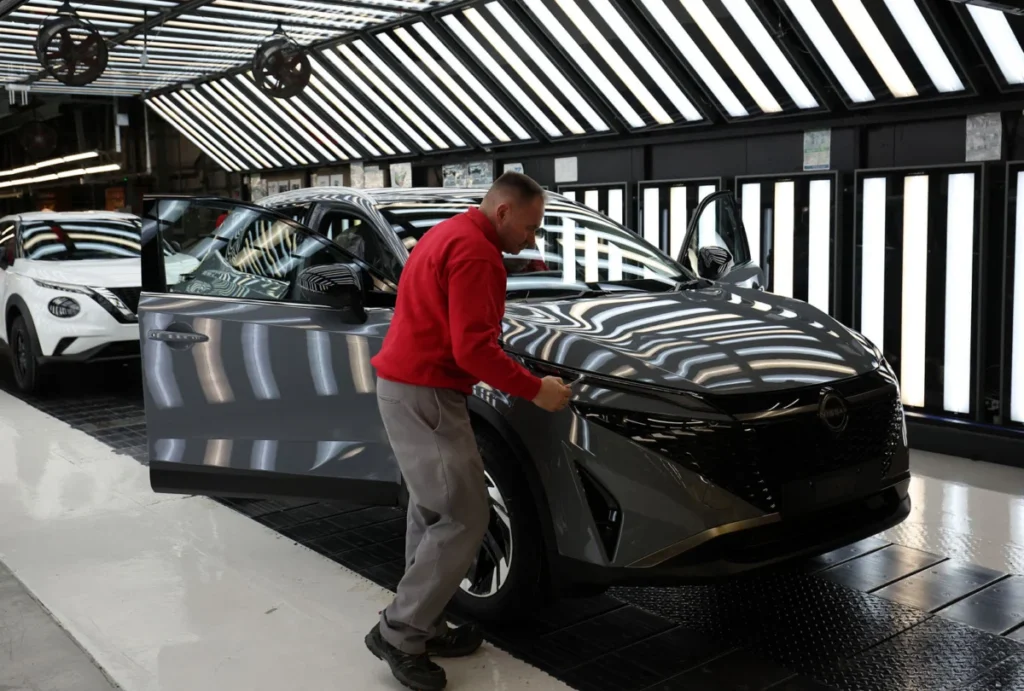
Nissan is set to close one of its two production lines at its significant Sunderland manufacturing plant in the UK, a move that forms part of a broader European cost-cutting strategy involving the elimination of approximately 900 positions across the continent. The Sunderland facility, the company’s sole production hub in Europe, currently manufactures key models including the electric Nissan Leaf, the popular Juke crossover, and the Qashqai SUV. Following the consolidation, all these vehicles will be produced on a single assembly line. While Nissan has affirmed that no jobs will be lost directly at the Sunderland plant as a consequence of this specific line closure, the company acknowledged that some roles within the UK workforce could be affected as part of the wider European reduction.
The decision to consolidate production onto a single line signifies a notable contraction in manufacturing capacity at the Sunderland plant, which has historically been a cornerstone of Nissan’s European operations. In the most recent full fiscal year, the factory produced 273,174 cars, a substantial decrease from its peak output of over half a million vehicles. This reduction underscores a challenging period for the Japanese automaker as it navigates evolving market demands and intensified global competition.
In an official statement, Nissan articulated that these measures are being implemented "to create a leaner, more resilient business that adapts quickly to market changes." The company is reportedly reviewing several strategic adjustments across its European footprint. These are understood to include the potential partial closure of its parts warehouse in Barcelona, Spain, and a shift towards an importer model for its operations in the Nordic countries. These initiatives collectively point to a strategic realignment aimed at optimizing efficiency and enhancing profitability in a complex automotive landscape.
Looking ahead, Nissan is actively seeking to attract a second automotive manufacturer to occupy and operate the now-vacant production line one at the Sunderland site. Industry observers have noted that Chinese manufacturers, such as Chery and Dongfeng, have previously been linked with potential production activities at the Sunderland facility. The successful integration of another automaker onto line one is viewed by Nissan as a crucial step towards preserving employment levels and potentially boosting overall production volume at the plant.
The operational shift is anticipated to take place in the latter half of the current year. To mitigate the impact of reduced capacity from the closure of line one, Nissan plans to transition the remaining operational line, line two, to a three-shift working pattern. This adjustment is intended to absorb the production volume and maintain output targets as effectively as possible.
The announcement has drawn a measured, albeit concerned, reaction from former industry executives. Andy Palmer, a former Nissan executive who began his career at the Sunderland plant, expressed his disappointment. "Any reduction in capacity is bad news for Nissan and bad news for Sunderland," Palmer commented to Autocar, highlighting the historical significance of the plant and the potential ripple effects of such a decision.
Nissan’s strategic adjustments are occurring against a backdrop of increasing competition in the European market, particularly from rapidly growing Chinese automotive brands. Like many established Japanese manufacturers, Nissan has faced considerable pressure from these new entrants, which often offer compelling value propositions and advanced technologies. Data indicates a tangible impact on Nissan’s market share in key regions. In the UK, for example, Nissan’s market share reportedly fell to 3.7% in the first four months of 2026, a notable decline from 5.6% recorded in 2016.
The rise of Chinese brands in Europe is a significant factor in this shifting market dynamic. Companies such as Chery, through its Jaecoo and Omoda sub-brands, have rapidly gained traction. According to data from the Society of Motor Manufacturers and Traders (SMMT), Chery achieved a market share of nearly 5% by April. Other Chinese manufacturers, including MG (which secured 4% market share) and BYD (at 3.45%), have also demonstrated strong performance, often outpacing established players like Nissan in specific segments.
This intensified competition is occurring at a time when Nissan is undertaking a global cost-reduction campaign. Under the leadership of CEO Ivan Espinosa, the company has been implementing measures to restore its financial health following a significant loss of approximately £3.8 billion in the financial year ending March 2025. This broader strategy has already seen the closure of seven manufacturing plants worldwide. The company’s global challenges are compounded by increased competition in various markets, including its home market of China, and recent increases in import tariffs on its exports to the United States.
Prior to the announcement regarding the Sunderland production line, the plant had largely been insulated from the most severe of Nissan’s global cost-cutting measures. Crucially, the UK government has provided support that helped secure the production of the new electric Juke at the Sunderland facility, with manufacturing slated to commence towards the end of the current year. This ongoing investment in new model production highlights the strategic importance of the Sunderland plant, even amidst the current operational restructuring.
Background and Context of the Sunderland Plant
The Nissan Sunderland plant, often referred to as Nissan Motor Manufacturing UK (NMUK), holds a pivotal position in the UK automotive industry. Established in 1986, it was one of the first major Japanese manufacturing facilities to be built in Europe, representing a significant foreign direct investment at the time. Its initial success was attributed to a combination of efficient production, high-quality manufacturing, and strong labor relations. Over the decades, it has become a cornerstone of the regional economy, employing thousands of people directly and supporting a vast supply chain.
The plant’s strategic importance was further cemented by its role in producing high-volume, popular models that have defined Nissan’s European portfolio. The Qashqai, in particular, is credited with creating the crossover segment and has been a consistent top seller for the brand. The introduction of the all-electric Leaf at Sunderland underscored Nissan’s early commitment to electrification, positioning the plant as a leader in EV manufacturing within the UK.
Chronology of Key Events and Decisions
- 1986: Nissan establishes its manufacturing plant in Sunderland, UK.
- Early 2000s: The Sunderland plant reaches peak production capacity, exceeding 500,000 vehicles annually.
- 2010s: Sunderland becomes a key production site for the Nissan Leaf, an early pioneer in mass-market electric vehicles. The plant also ramps up production of the highly successful Qashqai and Juke models.
- Late 2010s – Early 2020s: Nissan faces increasing global competition and financial challenges, leading to a broader cost-cutting initiative. Reports emerge of potential production realignments across its European operations.
- 2024-2025 Financial Year: Nissan reports a significant financial loss of approximately £3.8 billion, intensifying the need for strategic cost reductions.
- Early 2026 (Projected): Nissan announces the closure of one of its two production lines at the Sunderland plant as part of a European cost-saving measure, alongside a reduction of 900 positions across Europe. The company confirms no direct job losses at Sunderland due to the line closure but acknowledges potential UK role impacts.
- Late 2026 (Projected): Production of the new electric Juke is scheduled to commence at the Sunderland plant, supported by UK government assistance.
Supporting Data and Market Trends
The decision to consolidate production at Sunderland is intrinsically linked to broader shifts in the automotive market. Global vehicle sales, while recovering in some regions, face headwinds from economic uncertainty, rising inflation, and evolving consumer preferences. The transition to electric vehicles (EVs) is accelerating, requiring significant investment in new technologies and production processes, while internal combustion engine (ICE) vehicle sales are projected to decline in the long term.
Key Data Points:
- Sunderland Production Decline: From a peak of over 500,000 units, Sunderland’s output has fallen to 273,174 cars last year, representing a significant underutilization of its potential capacity.
- European Job Reductions: The planned elimination of 900 positions across Europe highlights the scale of Nissan’s restructuring efforts. The exact distribution of these cuts across various European sites is not fully detailed but impacts multiple operations.
- UK Market Share Erosion: Nissan’s UK market share has decreased from 5.6% in 2016 to 3.7% in the first four months of 2026. This decline mirrors challenges faced by other established Japanese automakers.
- Chinese Automotive Growth: Chinese brands are making significant inroads into the European market. Chery, for instance, has captured nearly 5% market share by April 2026, with its Jaecoo and Omoda brands proving particularly popular. MG and BYD are also demonstrating strong growth.
- EV Transition: The automotive industry is undergoing a fundamental shift towards electrification. While Nissan was an early mover with the Leaf, the competitive landscape for EVs is intensifying with new models and brands entering the market rapidly.
- Global Financial Performance: Nissan’s substantial loss of £3.8 billion in the financial year ending March 2025 necessitates aggressive cost management across all its global operations.
Official Responses and Stated Rationale
Nissan’s official statements emphasize a strategic imperative to adapt to a rapidly changing automotive industry. The company’s stated goal is to achieve a "leaner, more resilient business" capable of responding swiftly to market fluctuations. This proactive approach, according to Nissan, is essential for long-term sustainability and competitiveness.
The potential for a second manufacturer to occupy the vacated production line is presented as a positive development. By enabling another company to utilize the infrastructure, Nissan aims to retain employment opportunities and enhance the overall economic viability of the Sunderland site. This strategy reflects a broader trend in the automotive industry where shared manufacturing facilities or strategic partnerships are being explored to optimize asset utilization and reduce operational costs.
The support from the UK government, particularly in securing production for the new electric Juke, underscores the symbiotic relationship between Nissan and the British state. Such support is often contingent on maintaining employment and investment, demonstrating the high stakes involved in decisions impacting major manufacturing hubs like Sunderland.
Broader Impact and Implications
The closure of a production line at Nissan’s Sunderland plant carries significant implications for the UK automotive sector, the regional economy of the North East, and Nissan’s strategic positioning in Europe.
For the UK Automotive Industry: This move underscores the intense competitive pressures and economic realities facing global automakers. It highlights the vulnerability of even established plants to restructuring when faced with declining demand and rising competition, particularly from new market entrants. The success of attracting a new manufacturer to line one will be crucial for mitigating the negative perceptions and economic fallout.
For the North East Economy: The Sunderland plant has been a major employer and economic driver in the region for decades. While direct job losses are not immediately attributed to the line closure, any reduction in overall activity or a future scaling back could have ripple effects on local businesses, supply chains, and the wider community. The plant’s future attractiveness for new investment will be a key concern.
For Nissan’s European Strategy: Consolidating production onto a single line is a clear signal of Nissan’s commitment to optimizing its European manufacturing footprint. It reflects a broader trend of rationalization within the industry as companies seek to reduce fixed costs and improve efficiency. The success of this consolidation, coupled with the potential for new partnerships at Sunderland, will shape Nissan’s production capabilities and market responsiveness in Europe for years to come.
Shift in Market Dynamics: The growing presence of Chinese automakers in Europe is undeniably reshaping the competitive landscape. Nissan’s actions can be seen, in part, as a response to this intensified competition. The ability of established players like Nissan to adapt their strategies, innovate, and maintain cost competitiveness will be critical in navigating this evolving market. The future of the Sunderland plant, and indeed many other manufacturing facilities, may increasingly depend on strategic collaborations and the agility to embrace new production models and technologies. The long-term viability of such plants will hinge on their ability to attract new product mandates and adapt to the ongoing energy transition in the automotive sector.