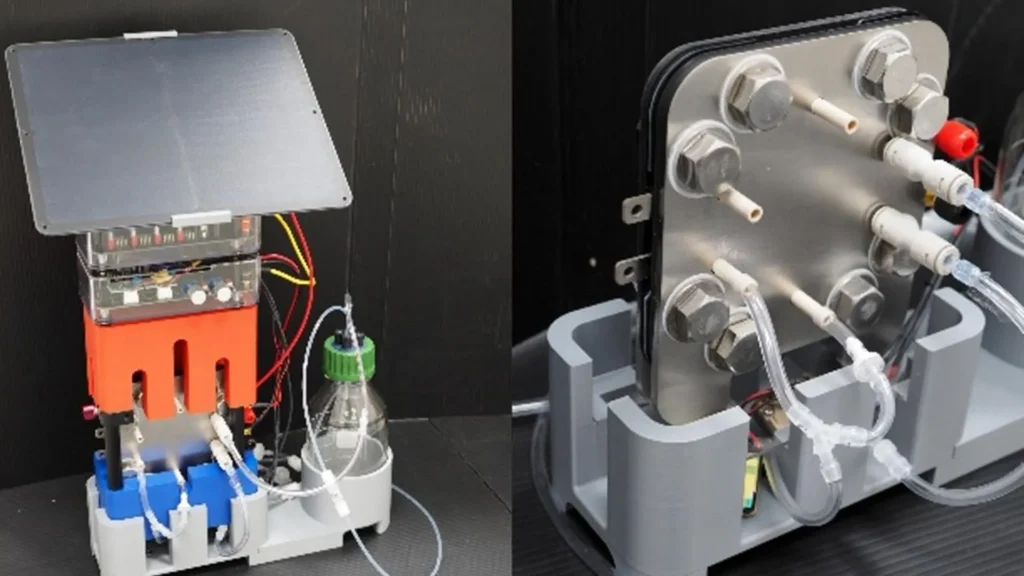
Researchers at Osaka Metropolitan University have engineered a groundbreaking artificial photosynthesis system capable of generating solar fuel with unprecedented consistency, critically eliminating the traditional reliance on battery-based control equipment. This significant technological leap stems from the integration of a self-regulating chemical component directly into the electrolyzer, a core element of the system, thereby drastically reducing both operational complexity and overall cost. This innovation marks a pivotal step toward making renewable energy more accessible, efficient, and economically viable for widespread adoption, addressing one of the most persistent challenges in solar energy conversion.
The quest for sustainable energy solutions has intensified globally amidst escalating concerns over climate change and the finite nature of fossil fuels. Artificial photosynthesis, a field dedicated to mimicking nature’s most fundamental energy conversion process, stands as a beacon of hope. Just as plants harness sunlight to transform water and carbon dioxide into energy-rich sugars, artificial systems aim to convert these ubiquitous resources into storable, high-energy chemical compounds, often referred to as solar fuels. Among the promising products of this technology is formic acid, a versatile chemical compound that not only serves as a clean fuel but also offers an efficient means of storing energy generated from intermittent solar resources. The development by Osaka Metropolitan University signifies a major advancement in overcoming the practical hurdles that have historically limited the widespread application of such technologies.
The Intricacies of Artificial Photosynthesis and the Challenge of Intermittency
At the conceptual core of artificial photosynthesis systems lies the electrolyzer. This electrochemical device acts as the bridge between electrical energy, typically supplied by solar cells, and chemical energy. Within the electrolyzer, water molecules are split, and in the presence of carbon dioxide, complex reactions yield chemical fuels like formic acid. However, the inherent variability of sunlight poses a formidable challenge to maintaining consistent and efficient operation. Solar irradiance fluctuates significantly throughout the day due to changing weather conditions, cloud cover, and the sun’s angle, leading to variable power output from solar panels.
To counteract this intermittency and ensure that solar cells operate at their peak efficiency, conventional artificial photosynthesis systems, much like many grid-tied solar installations, employ a technique known as Maximum Power Point Tracking (MPPT). MPPT algorithms continuously adjust the voltage and current output from solar cells to ensure they deliver the highest possible power, thereby maximizing energy harvesting. While highly effective in optimizing energy yield, traditional MPPT setups typically involve a suite of external electronic components, including DC-DC converters, inverters, and crucially, battery banks. These components are essential for smoothing out the erratic energy flow from solar panels, providing stable power to the electrolyzer, and enabling operation even during brief periods of low sunlight. However, the reliance on these external additions introduces significant drawbacks: increased capital expenditure, greater system complexity, a larger physical footprint, and additional maintenance requirements. These factors have, to a considerable extent, hindered the economic viability and scalability of artificial photosynthesis for practical applications.
A Paradigm Shift: The Self-Regulating Electrolyzer
Recognizing these limitations, a dedicated team at the Research Center for Artificial Photosynthesis at Osaka Metropolitan University embarked on a mission to fundamentally rethink the electrolyzer’s design. Led by Associate Professor Yasuo Matsubara and Professor Yutaka Amao, the researchers collaborated with Iida Group Holdings Co., Ltd., a partnership that underscores the commitment to bringing innovative research to practical application. Their groundbreaking approach involved integrating a specially engineered solid electrolyte directly into the electrolyzer device itself. This ingenious design allows the electrolyzer to intrinsically perform the MPPT function, rendering external battery-based control systems, along with their associated electronics and converters, entirely redundant.
Professor Amao elaborated on the elegant simplicity of their innovation: "Rather than relying on external electronics, converters, or batteries, the electrolyzer adjusts its electrical characteristics through its own thermal and impedance properties. As sunlight increases, the electrolyzer naturally heats up due to the increased current flow. The system is meticulously designed so that this warming causes its internal electrical resistance to drop, allowing electricity to flow more freely and efficiently." This inherent feedback mechanism enables the system to automatically adjust its electrical behavior in response to varying solar input, ensuring that it consistently operates near the maximum power point without any external intervention. "This self-regulating behavior helps keep fuel production more stable throughout the day and automates the system, while significantly reducing dependence on expensive external components and the environmental footprint associated with battery manufacturing and disposal," Professor Amao added, highlighting the multifaceted benefits of their design. The removal of batteries alone can slash system costs by an estimated 10-20% for typical off-grid solar applications, not to mention the reduction in maintenance and replacement costs over the system’s lifespan.
Collaborative Development and Real-World Validation
The journey from conceptualization to a functional prototype involved rigorous research and strategic partnerships. The collaboration with Iida Group Holdings Co., Ltd. was instrumental in bridging the gap between academic research and industrial application, providing expertise in engineering and manufacturing considerations. This synergy culminated in a tangible demonstration of the technology’s potential.
A significant milestone in the development timeline was the showcasing of this research at the "Joint Pavilion Iida Group × Osaka Metropolitan University" exhibition as part of the lead-up to the Osaka Kansai Expo 2025. This prestigious international event provided a global platform for presenting cutting-edge innovations. During the exhibition, the self-regulating artificial photosynthesis system successfully generated enough formic acid to power a miniature diorama within the pavilion. This compelling demonstration served as concrete evidence of the system’s viability and efficiency under conditions simulating real-world usage. "We were confident that it would be successful, as we previously showcased this research at the ‘Joint Pavilion Iida Group × Osaka Metropolitan University’ exhibition," Professor Matsubara stated, reflecting on the successful public debut. "It successfully generated enough formic acid to power a miniature diorama in the pavilion, showing its potential as an efficient artificial photosynthesis system that could potentially be used to charge applications in our homes." This practical application, albeit on a small scale, powerfully illustrated the system’s capacity to deliver consistent energy output despite environmental fluctuations.
Further validating their claims, the researchers subjected the technology to extensive testing under actual outdoor conditions. The results were highly encouraging: the system consistently produced formic acid from water and CO2, maintaining stable output even as natural sunlight levels fluctuated dramatically throughout the day. This robust performance under real-world variability underscores the effectiveness of the integrated self-regulation mechanism. The findings of this pivotal research were formally published in the esteemed scientific journal EES Solar, subjecting the methodology and results to peer review and further cementing its credibility within the scientific community.
Broader Implications and Future Outlook
The Osaka Metropolitan University’s innovation carries profound implications for the future of renewable energy and the global push towards carbon neutrality. By eliminating the need for bulky and costly battery-based MPPT systems, this technology significantly lowers the barrier to entry for artificial photosynthesis applications.
Economic Impact: The reduction in system complexity and cost is a game-changer. Batteries represent a substantial portion of the capital expenditure and ongoing maintenance costs for many renewable energy systems. Removing them makes solar fuel production more economically competitive, potentially accelerating the commercialization of artificial photosynthesis. This could open new markets for decentralized energy production, particularly in remote areas or developing nations where grid infrastructure is limited and battery logistics are challenging. The global market for renewable chemicals, which includes products like formic acid, is projected to grow significantly, reaching tens of billions of dollars in the coming years, driven by demand for sustainable alternatives. This innovation positions formic acid production more competitively within this expanding market.
Environmental Benefits: This breakthrough contributes directly to environmental sustainability in multiple ways. Firstly, it facilitates greater adoption of solar energy, reducing reliance on fossil fuels and consequently lowering greenhouse gas emissions. Formic acid, as a solar fuel, can be burned with minimal CO2 emissions or used in fuel cells, offering a cleaner energy carrier. Secondly, if the carbon dioxide feedstock for formic acid production is sourced from industrial emissions or direct air capture, the process also offers a pathway for carbon utilization, effectively turning a pollutant into a valuable resource. Furthermore, by eliminating batteries, the system reduces the demand for critical minerals, which often have significant environmental and ethical implications during extraction and disposal.
Technological Advancement and Decentralization: The inherent self-regulation represents a significant leap in smart material design and system integration. It paves the way for the development of simpler, more robust, and more autonomous renewable energy systems. The vision of powering homes or small communities with localized solar fuel production becomes more tangible. Imagine a future where residential buildings or agricultural sites can generate and store their own clean fuel on-site, reducing dependence on centralized energy grids and enhancing energy security. This move towards decentralized energy production aligns with broader global trends in energy transition, offering resilience and local empowerment.
Addressing Remaining Challenges: While transformative, the technology still faces avenues for further development and scaling. Researchers will focus on optimizing the efficiency of formic acid production, improving the long-term stability and durability of the solid electrolyte under continuous operation, and exploring scalability for industrial-level production. The materials used in the electrolyzer, while simplified by the battery elimination, will still need to be cost-effective and readily available. The full commercialization pathway will require continued research, pilot projects, and strategic investments to transition from laboratory success to widespread market adoption.
In conclusion, the Osaka Metropolitan University’s innovation in artificial photosynthesis is a testament to the power of fundamental research coupled with practical engineering. By ingeniously embedding self-regulation within the electrolyzer, the team has addressed a critical bottleneck in solar fuel production, promising a future where clean energy is not only generated but also stored and utilized with greater simplicity, efficiency, and affordability. This development underscores Japan’s leadership in sustainable technology and offers a compelling vision for a world powered by the sun, free from the complexities and environmental burdens of conventional energy storage solutions.