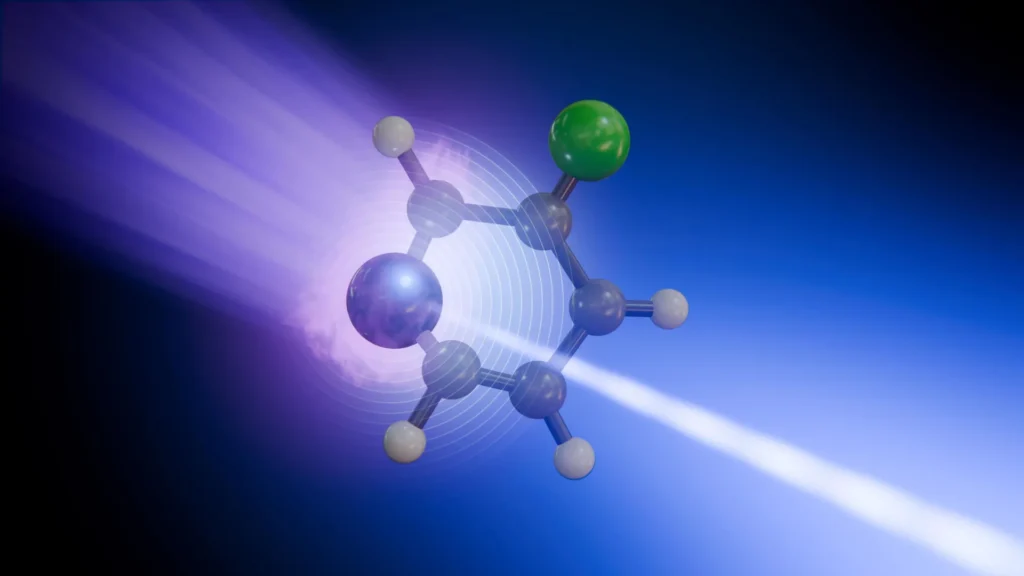
Scientists have achieved an unprecedented view into the ultrafast world of molecular photochemistry, observing precisely how energy moves through a molecule immediately after it absorbs light. This groundbreaking research, conducted at the European XFEL, reveals that individual atoms within a molecule can record vastly different aspects of the ensuing transformation, offering a granular understanding previously unattainable. This advance provides a powerful new tool for examining chemical reactions at the atomic scale and in real time, with profound implications for fields ranging from materials science to biology.
The study employed rapid X-ray flashes to meticulously track changes at specific atomic sites within a molecule as it absorbed, released, and redistributed energy from a light pulse. The findings, published in a leading scientific journal, indicate that exposure to light can significantly alter an atom’s responsiveness to the motions of its neighbors, providing distinct signatures of the complex energy cascade. This multi-site sensitivity, combined with femtosecond (quadrillionths of a second) resolution, opens a novel window into the microscopic mechanisms that govern how light initiates chemical change.
Unveiling the Ultrafast Dynamics of Photochemistry
Photochemistry, the study of chemical reactions initiated by light, underpins a vast array of natural phenomena and technological applications. From the fundamental processes of photosynthesis and human vision to the development of solar cells, photocatalysts, and light-activated medicines, understanding how molecules interact with light at the most basic level is crucial. However, the initial events of light absorption and energy redistribution occur on incredibly short timescales—picoseconds (trillionths of a second) and femtoseconds—making them notoriously difficult to observe directly. Most conventional spectroscopic techniques provide an averaged picture, blurring the distinct roles played by individual atoms.
The challenge lies in capturing these fleeting moments where electrons are excited, molecular bonds bend and stretch, and energy rapidly converts between electronic and vibrational forms. Previous methods often relied on indirect measurements or provided only a macroscopic view of the molecular ensemble. The ability to peer into these events with atomic resolution, essentially "filming" the molecular dance as it unfolds, represents a significant leap forward in scientific capability.
The Experimental Canvas: 3-Fluoropyridine
To demonstrate this new capability, the researchers focused on 3-fluoropyridine, a relatively small, ring-shaped organic molecule. This molecule was specifically chosen for its structural simplicity and the presence of both nitrogen and fluorine atoms, which were anticipated to offer distinct spectroscopic signals due to their differing chemical environments and roles in the molecule’s electronic structure.
The experiment began with a brief pulse from an ultraviolet (UV) laser, which provided the initial energy input. When 3-fluoropyridine absorbs this UV energy, its electrons are promoted to a higher energy state. This electronic excitation triggers a rapid structural rearrangement: the molecule, normally flat, quickly bends out of its planar configuration.
Crucially, this structural change leads the molecule through what scientists refer to as a "conical intersection." Conical intersections are ephemeral but pivotal crossing points on the potential energy surface where the electronic states of a molecule become degenerate, meaning their energies are identical. At these intersections, the movements of electrons and the atomic nuclei (the "cores" of the atoms) become strongly coupled. This strong coupling facilitates incredibly fast and efficient non-radiative decay, allowing the molecule to shed its excess electronic energy by converting it into vibrational motion—essentially, the atoms jiggling and oscillating within the molecular framework—rather than re-emitting light. These intersections are fundamental to the efficiency of many light-triggered reactions, preventing potentially damaging excited states from persisting and enabling rapid energy flow.
After traversing this conical intersection region, the molecule returns to its electronic ground state, albeit now with significant vibrational energy. This excess energy then propagates as vibrations throughout the entire molecular structure, a process the scientists aimed to map with unprecedented detail.
The European XFEL: A World-Leading Facility for Ultrafast Science
The key to unlocking these ultrafast dynamics was the European XFEL, located primarily in Schenefeld, Germany. As the world’s largest X-ray free-electron laser (XFEL), it generates extremely intense, ultrashort X-ray pulses. These pulses possess several unique characteristics that are indispensable for this type of research:
- Ultrafast Duration: The X-ray pulses are measured in femtoseconds, shorter than the timescale of most atomic movements. This "snapshot" capability allows researchers to freeze molecular motion and observe changes in real time.
- High Brightness: The sheer intensity of the X-ray pulses means that even dilute samples can be studied, and clear signals can be obtained from specific atomic sites.
- Tunability: The X-ray energy can be precisely tuned, allowing researchers to target specific elements and even specific electron shells within those elements.
For this study, the team utilized the Small Quantum Systems (SQS) instrument at European XFEL, which is specifically designed for investigating isolated atoms, molecules, and clusters. The technique employed was time-resolved X-ray photoelectron spectroscopy (tr-XPS).
Time-Resolved X-ray Photoelectron Spectroscopy: How it Works
Tr-XPS is a sophisticated technique that combines the temporal precision of femtosecond lasers with the elemental specificity of X-ray spectroscopy. Here’s a breakdown of the process:
- Initiation: An ultraviolet laser pulse excites the 3-fluoropyridine molecules, initiating the photochemical reaction. This "pump" pulse sets the molecular clock.
- Probing: After a precisely controlled time delay, a soft X-ray pulse from the European XFEL acts as a "probe." This X-ray pulse is energetic enough to ionize the molecules by ejecting deeply bound core electrons from specific atoms, in this case, nitrogen or fluorine.
- Detection: The kinetic energies of these ejected core electrons are then measured. The binding energy of a core electron is highly sensitive to the local chemical environment of the atom from which it originated. Any change in the electron distribution, bonding, or oxidation state of an atom will manifest as a shift in its core electron binding energy.
- Reconstruction: By repeating this pump-probe measurement with many different delays between the UV laser pulse and the X-ray pulse—ranging from femtoseconds to several picoseconds—the researchers could effectively create a molecular movie. The recorded energies of the released electrons allowed them to reconstruct how the chemical environment surrounding each targeted atom changed over the course of just a few picoseconds.
This meticulous approach enabled the team to achieve a level of temporal and spatial resolution that was previously unimaginable. The ability to distinguish between signals from different atomic sites within the same molecule was particularly revolutionary.
Distinct Atomic Signatures: A Molecular Symphony
One of the most profound revelations of this study was the discovery that different atoms within the 3-fluoropyridine molecule provided distinct and complementary narratives of the energy transformation. As Antonio Picón from the Instituto de Ciencia de Materiales de Madrid Consejo Superior de Investigaciones Científicas (ICMM-CSIC), a co-author of the study, explained, "We can now see that not every atomic site tells the same story in the signals we capture from our X-ray pulses. Some atoms report where the charge is going, while others reveal how the whole molecule vibrates."
-
The Fluorine Atom’s Tale: The fluorine atom, being somewhat peripheral to the initial electronic excitation, served as a relatively clear and straightforward indicator. Its signal primarily reflected how the molecule’s overall vibrations relaxed over time. As the excess energy from the light absorption converted into molecular vibrations, the fluorine atom’s environment changed in a way that directly correlated with the dissipation of this vibrational energy throughout the molecule. It acted like a sensitive barometer for the molecule’s structural cooling.
-
The Nitrogen Atom’s Complex Narrative: In contrast, the nitrogen atom, which played a more direct and active role in the initial electronic excitation process, presented a far more intricate signal. Its tr-XPS signature reflected a confluence of events: both the rapid redistribution of electrons within the molecule immediately after excitation and the subsequent changes in the molecule’s structure as it bent and vibrated. The nitrogen atom’s signal was a rich tapestry woven from electronic and structural dynamics, offering insights into the interplay between these two fundamental aspects of molecular transformation.
The Indispensable Role of Theory and Simulation
Interpreting the complex experimental data from tr-XPS required more than just raw measurements. Advanced computer simulations and sophisticated theoretical models were absolutely critical. These computational tools allowed the researchers to:
- Predict Electronic Structures: Model the excited states and ground states of 3-fluoropyridine.
- Simulate Molecular Dynamics: Track the movement of atoms and electrons over time, including the passage through conical intersections.
- Calculate Spectroscopic Signatures: Predict what the tr-XPS signals should look like for various electronic and structural configurations.
By comparing the experimental observations with these theoretical predictions, the scientists could confidently connect the subtle shifts in core electron binding energies to the underlying electronic redistribution and structural changes occurring in the molecule. This synergy between cutting-edge experimental techniques and advanced computational chemistry is a hallmark of modern molecular science, allowing for a comprehensive understanding of intricate quantum phenomena.
Broader Implications and Future Horizons
The findings of this study extend far beyond the specific case of 3-fluoropyridine, demonstrating a powerful new approach that could revolutionize our understanding of light-driven processes across various scientific disciplines. As Daniel Rivas, a former instrument scientist and now guest scientist at SQS and co-author of the study, emphasized, "This is what European XFEL was built to enable: watching chemical change where it begins, at specific atomic sites and on its natural timescale. By combining multi-site sensitivity with femtosecond resolution, we are opening a new window on the microscopic mechanisms that govern photochemistry."
The implications are profound and wide-ranging:
-
Understanding DNA Photoprotection and Damage: DNA molecules are constantly exposed to UV light, which can cause damage leading to mutations and disease. However, DNA also possesses remarkable intrinsic photoprotective mechanisms that efficiently dissipate excess energy before it can cause harm. Understanding these ultrafast energy transfer pathways at the atomic level could shed light on how DNA withstands light exposure and potentially inform strategies for preventing light-induced cellular damage or developing new phototherapies.
-
Designing Next-Generation Light-Harvesting Materials: The efficiency of solar cells, photocatalysts, and organic light-emitting diodes (OLEDs) hinges on how effectively materials absorb light and convert that energy into useful forms. By understanding the precise atomic-level mechanisms of energy transfer, scientists can design new materials with tailored properties for more efficient energy capture, conversion, and storage. This could accelerate the development of cheaper, more efficient renewable energy technologies. For example, understanding how energy travels through complex organic molecules could lead to more efficient exciton transport in organic photovoltaics.
-
Optimizing Photosynthesis and Bio-Inspired Technologies: Photosynthesis, the process by which plants convert sunlight into chemical energy, is one of the most efficient light-harvesting systems known. Gaining atom-specific insights into energy flow in analogous biological systems could inspire the creation of artificial photosynthetic systems or biomimetic technologies.
-
Advancing Fundamental Quantum Chemistry: This research pushes the boundaries of fundamental quantum chemistry, providing experimental benchmarks for theoretical models of excited-state dynamics, conical intersections, and non-adiabatic processes. It allows for a deeper exploration of the quantum mechanical interplay between electrons and nuclei during chemical reactions.
-
Exploring Complex Molecular Systems: While the initial experiment focused on a relatively simple molecule, the established methodology can now be applied to increasingly complex systems. This includes functional organic molecules with practical applications, more intricate biomolecular building blocks (like amino acids or nucleobases), and advanced materials designed to capture or transfer energy from light. The ability to differentiate the roles of various atoms within such complex structures will be invaluable.
This landmark study at the European XFEL represents a significant stride in our ability to probe the fundamental processes that govern the interaction of light and matter. By providing an unprecedented, atom-specific view of ultrafast energy dynamics, it not only answers long-standing questions in photochemistry but also lays the groundwork for transformative advancements across numerous scientific and technological frontiers. The era of truly "watching chemistry happen" at its most fundamental level has arrived, promising a cascade of discoveries in the years to come.