In the intricate world of high-precision manufacturing and advanced automation, the pursuit of optimal system performance often begins and ends with a granular understanding of every component layer. While the foundational elements of mechanics and motors are undeniably crucial, achieving true precision in motion control applications ultimately hinges on the sophisticated intelligence and meticulous execution provided by drives and controls. This critical insight forms the core of the third installment in a comprehensive series dedicated to demystifying the multi-layered performance considerations in motion control systems. Authored by Corey Foster, Director of Automation Sales & Application Engineering at Valin Corporation, this segment meticulously dissects how these electronic "brains" orchestrate the precise movements demanded by today’s most challenging industrial applications.
Historically, system performance in high-precision motion control has often been simplistically evaluated based solely on the specifications of mechanical components. Actuators, for instance, are frequently categorized by standard metrics such as repeatability, accuracy, and load capability. While these parameters offer a baseline understanding, and indeed suffice for many conventional applications, they represent only a fraction of the entire performance equation. A deeper, more nuanced comprehension of the entire motion control system, encompassing mechanics, motors, drives, and controls, is indispensable for engineers striving for genuine precision, particularly as industries push the boundaries beyond micron-level accuracy.
The preceding articles in this series laid the groundwork by exploring the foundational layers. The inaugural piece delved into the mechanics, highlighting often-overlooked yet critical factors like bearing deflection, body stiffness, and structural smoothness – elements that fundamentally dictate the physical limits of motion. The second article shifted focus to motors, examining their diverse designs, construction methodologies, quality benchmarks, and how these attributes contribute to the system’s dynamic capabilities. Now, this third part brings into sharp focus the pivotal role of drives and controls, dissecting their design philosophies, features, and inherent importance in elevating overall system performance. It aims to equip engineers, designers, and system integrators with the insights necessary to recognize that successful high-precision motion system deployment is a symphony of coordinated elements, where details not appearing on a datasheet can ultimately make or break performance expectations. As demands escalate for nanometer-level accuracy and repeatability, traditional specifications become increasingly inadequate, making informed engineering decisions paramount.
The Evolving Landscape of Motion Control Precision
The global motion control market, valued at approximately $15 billion in 2023, is projected to grow significantly, with analysts forecasting it to exceed $25 billion by 2030, exhibiting a compound annual growth rate (CAGR) of over 6%. This robust growth is largely propelled by the relentless demand for automation, enhanced productivity, and, critically, ever-increasing precision across a multitude of industries. Sectors such as semiconductor manufacturing, medical device production, advanced optics, aerospace, and defense are at the forefront of this demand, requiring motion systems that can execute tasks with sub-micron, and even nanometer, accuracy and repeatability. These applications necessitate not just robust mechanics and powerful motors, but an intelligent control architecture capable of orchestrating complex movements with exquisite finesse.
The journey of motion control technology has evolved from rudimentary on/off motor activation to highly sophisticated digital systems capable of real-time adaptive control. Early electric motor applications were inherently simple, involving direct power application that merely caused a motor to turn. The introduction of drives—the electronic components that modulate and supply power to motors—marked a significant leap, enabling smoother, more efficient operation. Controllers then added a layer of intelligence, providing capabilities such as controlled acceleration, velocity, and precise positioning. While this level of electronics often surpasses the requirements of basic motor tasks where default settings suffice, the true transformative power of drives and controls becomes evident in applications demanding tighter control and extreme precision.
Drives and Controls: The Brains Behind the Motion
In the context of tiered performance—basic, specification-level, and pushing-beyond-specifications—drives and controls are fundamental to each tier, with their complexity and capabilities scaling exponentially with the performance demands.
For basic applications, the primary requirement is compatibility and the ability to run the motor. The electronics are simple, often with limited configurability. If tuning features are present, their default settings are typically adequate. The focus here is on cost-effectiveness and functional operation rather than optimized performance.
Moving to specification-level applications, the features of drives and controllers become significantly more important. These systems demand specific tuning capabilities, where parameters such as proportional, integral, and derivative (PID) gains must be carefully adjusted to achieve desired performance characteristics. Controllers must be programmed with precise motion profiles and action sequences to meet application requirements. Common issues at this level often stem from straightforward setup errors or missing configurations, which are usually rectifiable. More challenging are tuning problems, frequently encountered when adjustments are made by personnel lacking adequate training. This can lead to undesirable motion, ranging from sluggish and unresponsive behavior to overly aggressive and unstable movements. A mismatch, such as pairing a high-performance motor with lower-performance electronics, is generally suboptimal, though it may not pose critical issues in many mid-range applications.
However, the limitations of under-specified drives and controls become glaringly apparent in high-performance applications that truly push the boundaries of precision. In these scenarios, the motor fails to achieve its intended performance, and the entire system becomes exceedingly difficult to tune, often resulting in suboptimal operation. In extreme cases, meeting the application’s stringent requirements can become impossible.
High-performance motion control demands an advanced suite of features from drives and controllers:

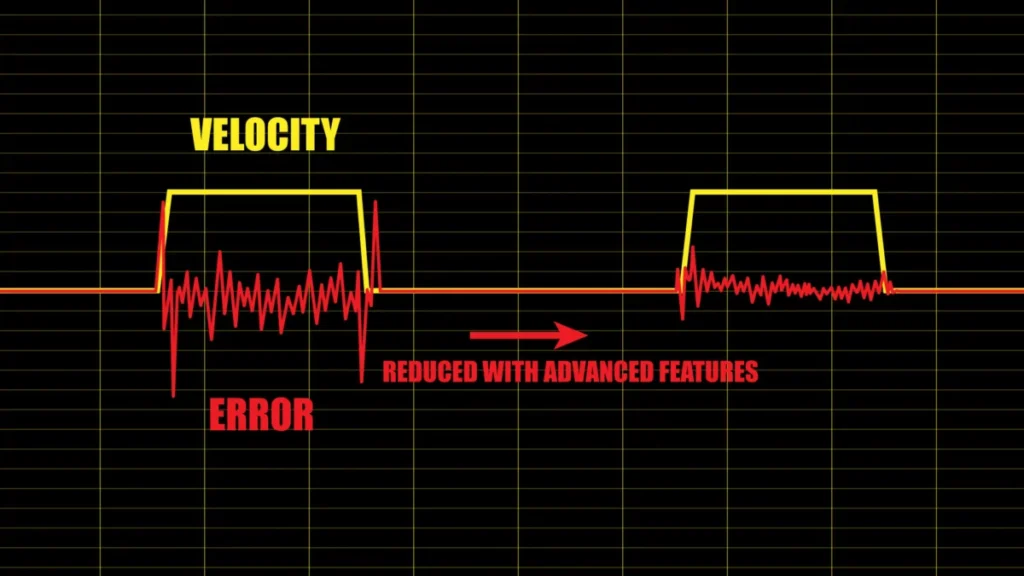
- Advanced Tuning Features: These go beyond simple PID loops. They include dynamic and adaptable gains, which can automatically adjust based on changing loads, speeds, or environmental conditions. Model-predictive control (MPC) algorithms anticipate future system states and optimize control outputs accordingly, while adaptive control systems continuously learn and adjust to system dynamics. These capabilities are crucial for maintaining stability and accuracy in highly dynamic environments.
- Multi-axis Synchronization: For complex multi-axis mechanics such as gantries, Cartesian robots, and delta robots, precise coordination among axes is paramount. Drives and controllers must support multi-axis synchronization with extremely low jitter and latency. This is often achieved through high-speed, deterministic industrial Ethernet protocols like EtherCAT, PROFINET, or SERCOS III, which enable real-time communication and coordinated motion across multiple drives. The ability to maintain synchronized motion ensures that the overall system acts as a cohesive unit, preventing errors and optimizing throughput.
- Fast Update Rates and Processors: Precision is directly linked to the speed at which the control loop can operate. High-performance applications require fast servo sampling and update rates (often in the kilohertz range) for tight current, velocity, and position control loops. This necessitates powerful processors, typically digital signal processors (DSPs) or field-programmable gate arrays (FPGAs), capable of executing complex algorithms in real-time to prevent lag in logic and maintain system responsiveness. A controller’s processing power dictates its ability to handle complex calculations and respond to feedback quickly, directly impacting dynamic accuracy.
- Environmental Robustness and Adaptability: Real-world industrial environments are rarely pristine. Electrical noise from arc welders, mechanical vibrations from heavy machinery, and even human activity can significantly degrade motion system performance. High-performance controls must incorporate tools to adapt to such challenging environments. This includes advanced filtering techniques like notch filters to suppress resonant frequencies, anti-vibration algorithms, and robust disturbance rejection capabilities. Corey Foster’s anecdote of an OEM tool failing in a noisy real-world environment highlights this point; the initial controls, designed for an isolated setting, lacked the necessary adaptive features, necessitating an upgrade to more robust systems.
Beyond the Datasheet: Critical Factors for Elite Performance
The nuances of high-end applications extend beyond these core features, touching upon several critical factors often glossed over in standard data sheets:
- "Auto-tuning" – A Starting Point, Not a Silver Bullet: While convenient for initial setup, auto-tuning functions provided by drives are rarely sufficient for optimizing high-performance systems. They offer a baseline, but true optimization requires expert manual tuning, iterative adjustments, and a deep understanding of the system’s mechanical and electrical characteristics. Over-reliance on auto-tuning can lead to sub-optimal performance, leaving significant accuracy and speed potential untapped.
- Encoder Resolution and Compatibility: The precision of motor position feedback is fundamental. Encoder resolution must not only match the application’s goal but also be fully utilized by the electronics’ capabilities. High-resolution encoders generate a vast amount of data; the drive and controller must have the processing power and interpolation capabilities to effectively interpret and act upon this feedback, translating raw encoder counts into precise position information. A high-resolution encoder paired with a low-resolution drive effectively negates the encoder’s potential.
- Fieldbus Communication Protocols: In multi-axis systems, the choice of fieldbus protocol is critical for ensuring demanding speed and coordination. Protocols like EtherCAT offer deterministic, high-speed communication ideal for synchronized motion control, enabling multiple drives to operate as a single, cohesive unit. In contrast, less deterministic protocols can introduce latency and jitter, compromising the overall precision and synchronization, particularly in applications requiring simultaneous movements or precise trajectory following.
- Proprietary Servo Algorithms and Software: Beyond the hardware, the intellectual property embedded in a drive’s firmware and control algorithms often represents its true differentiating factor. These proprietary algorithms can offer superior control stability, faster settling times, better disturbance rejection, and more efficient motion profiles (e.g., S-curve acceleration/deceleration to minimize jerk). The software tools provided for configuration, diagnostics, and programming are equally vital, offering engineers the necessary interface to extract maximum performance from the system.
- Real-time Operating Systems (RTOS): High-performance controllers often rely on RTOS to ensure deterministic execution of control tasks. An RTOS guarantees that critical tasks are completed within a specified timeframe, preventing delays that could lead to position errors or instability, especially in highly dynamic applications.
Precision motion is far more than simply controlling a motor effectively. It is the sophisticated art of harmonizing information from the target, accounting for environmental variables, and coordinating with the inherent characteristics of the mechanics and motors themselves, all to achieve the specified goal of the application. As many industry experts attest, even the best mechanical hardware cannot overcome a poorly designed or improperly tuned control loop. The intelligence embedded in drives and controls acts as the conductor, ensuring that every component plays its part in perfect synchronicity.
Implications for Design and System Integration
The implications of these insights for system design and integration are profound. A holistic approach is indispensable, moving beyond the siloed evaluation of individual components. Engineers must consider the interdependencies of all system layers, recognizing that a weakness in one area can undermine the strengths of others. The financial consequences of neglecting the critical role of drives and controls can be substantial, manifesting as lost productivity, reduced yield, extended development cycles, and, ultimately, the inability to meet crucial performance targets in competitive markets.
The need for highly skilled engineers and system integrators who possess a deep understanding of motion control theory, advanced tuning techniques, and the intricacies of various control architectures has never been greater. Their expertise is paramount in selecting, configuring, and optimizing these complex systems to unlock their full potential.
Future Trends and Innovations
The field of motion control continues to evolve rapidly. Future trends point towards even greater intelligence and autonomy:
- Artificial Intelligence (AI) and Machine Learning (ML): Integrating AI/ML algorithms into drives and controls promises predictive maintenance, where system anomalies are detected before failures occur, and self-optimizing systems that can adapt to changing conditions and loads in real-time without human intervention.
- Edge Computing: Decentralized control architectures leveraging edge computing will enable faster response times and reduce reliance on centralized control, enhancing the robustness and scalability of motion systems.
- Enhanced Connectivity and IIoT Integration: Deeper integration with the Industrial Internet of Things (IIoT) and cloud platforms will facilitate comprehensive data analysis, remote diagnostics, and condition monitoring, leading to more efficient operations and proactive maintenance.
- Energy Efficiency: Advances in power electronics and control strategies are continuously improving the energy efficiency of drives, incorporating features like regenerative braking to recapture energy and reduce operational costs.
In conclusion, while the robust foundations of mechanics and the dynamic capabilities of motors are non-negotiable, it is the sophisticated intelligence and precise execution offered by drives and controls that ultimately define the upper echelons of motion control performance. They are the true architects of precision, translating high-level commands into exquisitely coordinated movements that meet the most stringent demands of modern industry. Understanding and optimizing this layer is not merely an option but a strategic imperative for any engineer or organization striving for leadership in advanced manufacturing and automation.
This article forms part of a series exploring the multifaceted layers of performance and specifications in motion control. Readers are encouraged to delve into the other installments for a comprehensive understanding:
Part 1: Layers of performance and specifications in motion control
Part 2: Layers of performance and specifications in motion control
Part 4: Layers of performance and specifications in motion control